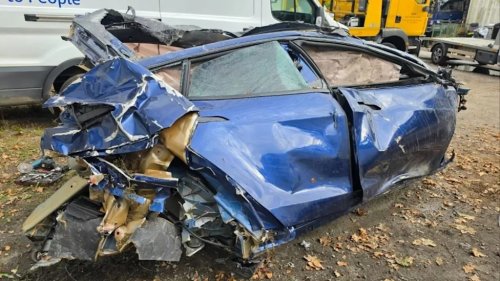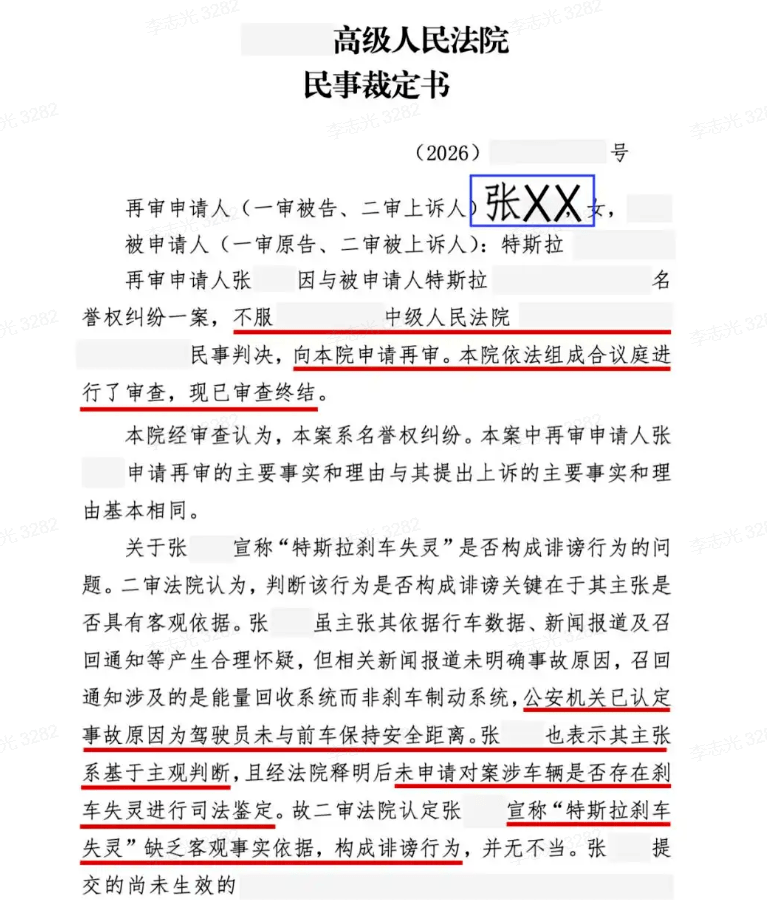
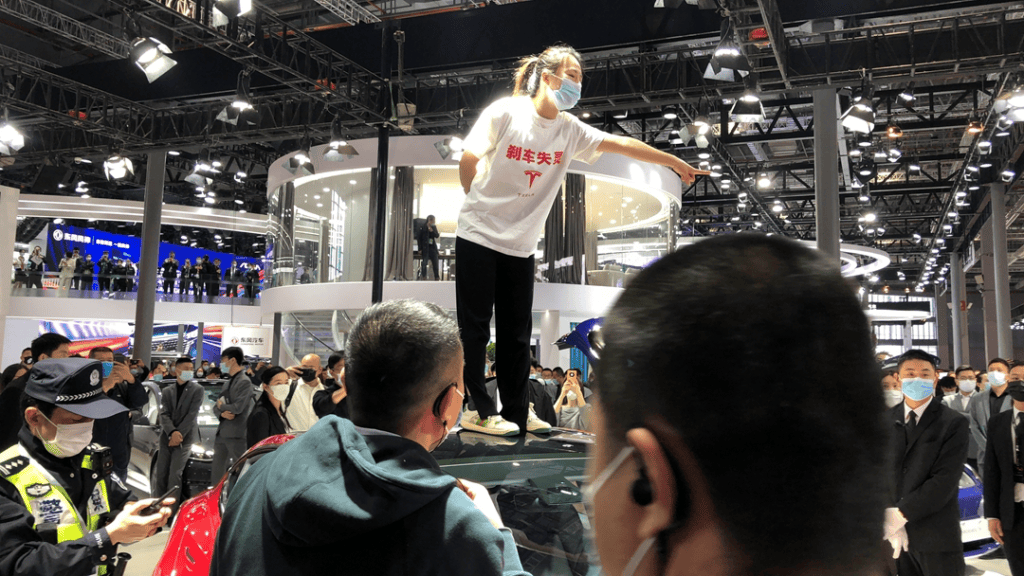
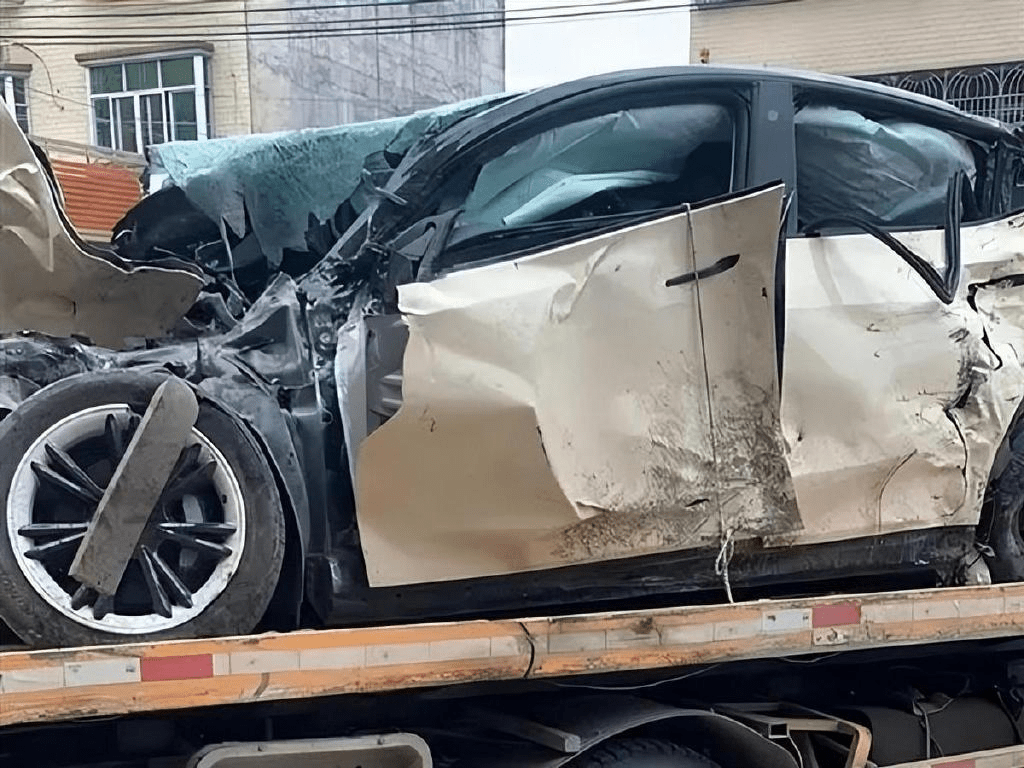


















Five years after the rooftop protest that erupted at the Shanghai Auto Show, one of China’s most closely watched EV controversies has reached its conclusion. Chinese courts have rejected retrial applications filed by the Henan vehicle owner at the center of the dispute, along with an automotive media commentator involved in the case. The rulings effectively close the long-running legal battle over claims that a Tesla vehicle had suffered “brake failure.” The court’s final judgment in the case between Ms. Zhang and Tesla. According to publicly released judgments, courts across the first-instance, appellate, and retrial review stages reached the same conclusion. Judges found that the vehicle owner publicly accused Tesla of brake failure without sufficient factual evidence or technical verification, constituting infringement of Tesla’s reputation rights. The owner was ordered to issue a public apology and pay approximately RMB 172,300 ($23.9K) in damages. An automotive media figure found to have played an organizational role in amplifying the incident was ordered to issue a public apology and pay RMB 250K ($34.7K) in compensation. The court stressed that consumers have the legal right to criticize products, defend their interests, and exercise public oversight. However, such claims must be grounded in verifiable facts rather than unproven personal conclusions presented as established facts. The ruling brings formal closure to a dispute that began during the 2021 Shanghai Auto Show, later drawing global attention. At the event, a Tesla owner climbed onto the roof of a display vehicle wearing a T-shirt bearing the words “Brake Failure.” Videos spread rapidly across social media, becoming one of China’s most discussed topics within hours. Zhang stood atop a Tesla display vehicle at the Shanghai Auto Show shouting “brake failure.” The controversy soon expanded far beyond China’s automotive sector. At the time, China’s new-energy vehicle industry was entering a period of explosive growth. National NEV sales exceeded 3.5 million units in 2021, rising more than 150% year-on-year. Tesla delivered more than 320K vehicles in China that year. Meanwhile, technologies such as one-pedal driving, regenerative braking, and advanced driver assistance systems were entering mainstream consumer use. Many first-time EV buyers remained unfamiliar with driving characteristics that differed significantly from traditional internal combustion vehicles. Against that backdrop, allegations of “brake failure” quickly fueled public concerns about Tesla’s braking systems and one-pedal driving design. Tesla later released portions of vehicle data. Market regulators opened investigations. Debate continued for years over accident causation, data interpretation, and liability assessments. Several Tesla-related crashes across China were subsequently linked by public opinion to alleged brake failures, repeatedly becoming major online discussion topics. As more cases entered judicial review and technical examination, a clearer picture emerged. A forensic analysis of a 2020 crash in Nanchong, Sichuan found no evidence of brake system malfunction. A 2021 accident in Taizhou, Zhejiang was examined through Event Data Recorder records and surveillance footage; investigators concluded the crash was unrelated to braking-system defects. A 2022 crash in Chaozhou, Guangdong similarly resulted in a forensic report excluding faults in both braking and steering systems. A Tesla after a crash in Chaozhou, Guangdong, in 2022. These findings align with a broader pattern: over recent years, several high-profile incidents initially blamed on brake failures were subject to formal technical probes, none of which found hardware defects in the braking systems. Beyond the legal dispute itself, the episode may have left a deeper mark on China’s automotive industry. What began as a single auto-show protest evolved into a catalyst for industry maturation. For consumers, the case highlighted the importance of evaluating new technologies through evidence, independent technical assessments, and legal procedures rather than relying solely on public narratives. It also clarified the legal boundaries between criticism and factual allegations. For automakers, the controversy reinforced the importance of transparency, data disclosure, and rapid communication when addressing safety concerns. It pushed companies to place greater emphasis on product safety management and customer engagement. For regulators, the incident exposed gaps that existed during the early stages of China’s EV transition, accelerating the development of more comprehensive oversight mechanisms. In many ways, the dispute ultimately became larger than Tesla itself. It evolved into a defining collision between emerging automotive technologies and consumer understanding during the early years of the electric-vehicle era.