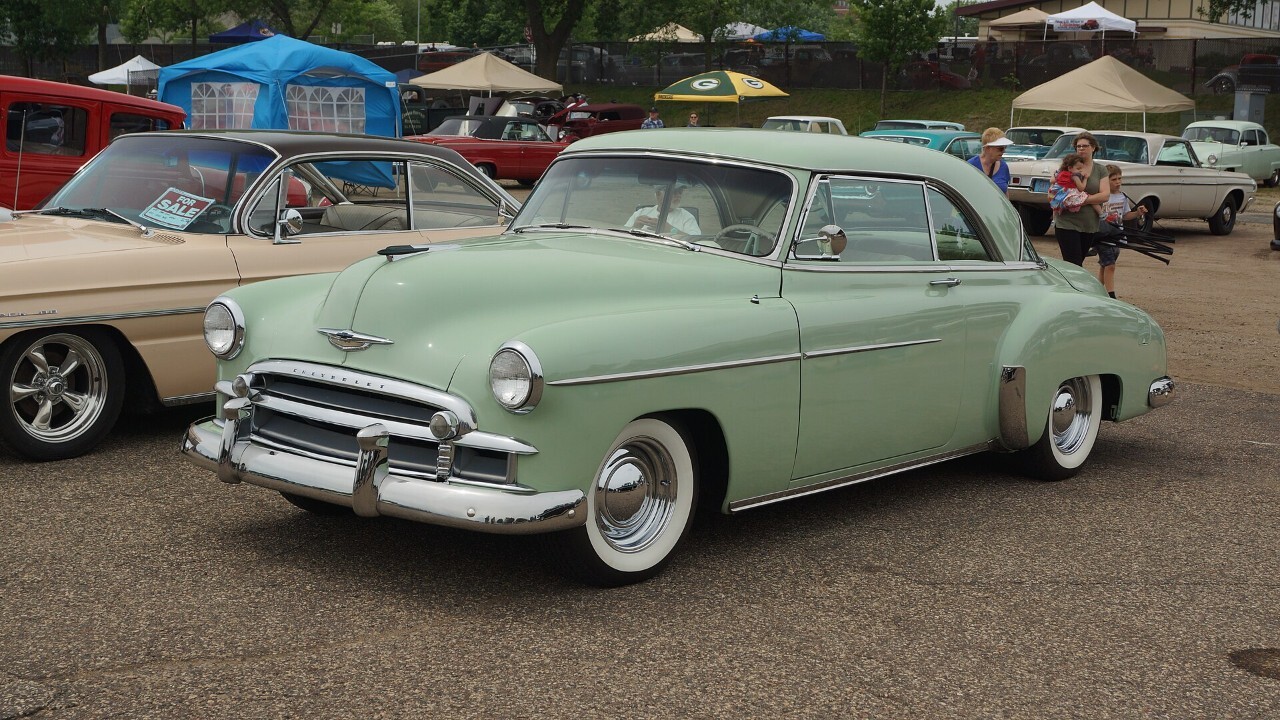
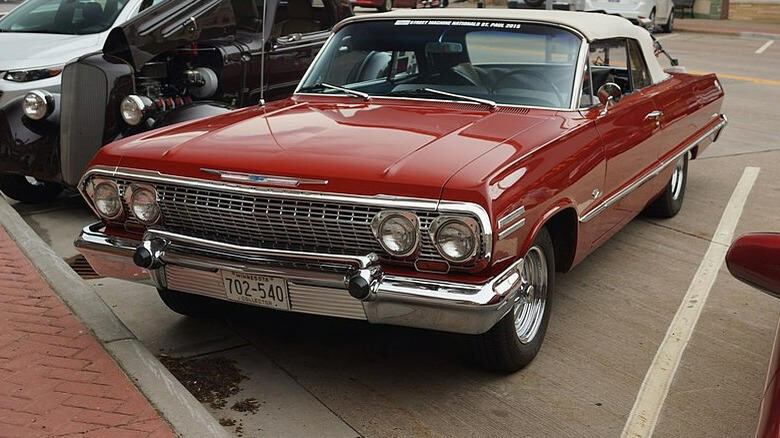
Chevrolet sold 76,662 copies of its first Bel Air hardtop in 1950, a strong start for a name borrowed from a wealthy Los Angeles suburb. Over the next three decades, that badge moved from a stylish pillarless coupe to sedans, wagons and finally a no-frills fleet car. Few nameplates covered that much ground. Of course, most people picture just one Bel Air: a two-tone 1957 with chrome fins. That car certainly deserves its fame. Yet the full story includes lowered cruisers, big-block sleepers, family sedans and even a funeral coach, and each one shows a different side of American car life. These are our picks, 12 Bel Airs we think are worth remembering, from the first hardtop to one of the last U.S. cars to wear the name. Every choice is our opinion. By contrast, the engines, prices and production figures behind them come from period data and the references linked in the list. 1. 1950 Chevrolet Bel Air Styleline De Luxe hardtop The first Bel Air wasn’t a trim level at all. It was a single body style, officially the Styleline De Luxe Bel Air Coupe, and it brought the pillarless hardtop look to Chevrolet buyers. GM had introduced that roofline on the Buick Riviera in mid-1949. For 1950, Chevrolet shared its roof stamping with the Pontiac Catalina and the Oldsmobile Holiday hardtops. According to Mac’s Motor City Garage, the car cost $1,741, which made it the most expensive Chevy coupe that year and nearly as pricey as a convertible. Even so, it outsold the convertible by about two to one. Buyers got genuine leather seats in red, blue, green or black, trimmed with wool cord fabric. Also, small courtesy lights in the rear roof pillars added a touch of luxury. Under the hood sat a 216.5-cubic-inch “Thriftmaster” inline-six rated at 92 horsepower. That was hardly exciting, but performance wasn’t the point. Instead, the point was style at a Chevrolet price. Our take: this is where the whole story begins. Without the 1950 Bel Air hardtop, there’s no Tri-Five legend and no Impala. If you find one with its leather interior intact, you’re holding the blueprint for a decade of Chevy design. 2. 1952 Chevrolet Bel Air hardtop The 1952 Bel Air hardtop marks the end of an era for the name. From 1950 through 1952, “Bel Air” meant one thing only: the two-door hardtop. After that, Chevrolet turned the badge into a premium trim across several body styles, so the 1952 car is the last of the exclusive originals. Its construction hints at how Chevrolet kept costs down. The hardtop shared its windshield, doors, glass and trunk with the Styleline De Luxe convertible. In fact, only the roof and rear quarters were unique. In other words, Chevrolet built a new-looking car mostly from parts it already had, then charged extra for the airy pillarless profile. That trick worked because buyers loved the look. A hardtop felt like a convertible with the top up, without the leaks and wind noise of a fabric roof. Meanwhile, the six-cylinder engine and simple mechanicals made it easy to live with every day. We think the 1952 car often gets overlooked because it sits between the groundbreaking 1950 and the restyled 1953. That’s a shame, though. It’s the purest version of the original idea, refined over three seasons. If you’re shopping, look for solid rear quarters, since those unique panels are the hardest part to replace. A clean one makes a fine entry into early 1950s Chevy ownership. 3. 1954 Chevrolet Bel Air four-door sedan Once the Bel Air name spread across the range, the four-door sedan became its most practical form. By 1954, buyers could order surprising comforts for a Chevrolet. The options list included power brakes, a power seat and power windows, while 1953 had already added power steering. Chevrolet also improved what was under the hood. For 1954, the six-cylinder engine gained full-flow oil filtration. With the Powerglide automatic, it made 125 horsepower. That was a meaningful step for a family car, since a 1953 Bel Air had needed 19.6 seconds to reach 60 mph in a Popular Mechanics test. The 1954 car also got a revised grille and new taillights. In addition, Chevrolet added the Beauville wagon to the Bel Air line that year. As a result, the sedan sat in a broad, well-equipped family of cars that suited nearly every household. Our take: the four-door sedan is the Bel Air most families owned, and that’s why we’d remember it. It shows what Chevrolet thought a nice family car should offer in the mid-1950s. Granted, it isn’t the flashiest choice. Even so, a power-option 1954 sedan is a comfortable, affordable way into the hobby, and its six is simple to keep healthy. 4. 1955 Chevrolet Bel Air Nomad The 1955 Nomad has one feature its 1956 and 1957 siblings lack. According to Hagerty’s Tri-Five buyer’s guide, 1955 was the only year with fully radiused rear wheel openings. It’s a small detail, but it gives the first Nomad a smoother, sportier profile. The idea came from GM’s 1954 Motorama show, where a Nomad “dream car” appeared under head stylist Harley Earl. Chevrolet put it into production for 1955 as a two-door sport wagon. It borrowed the Corvette’s front styling and used a forward-sloping rear door pillar that set it apart from any other wagon on the road. Chevrolet trimmed the Nomad like a Bel Air sedan, with Bel Air badges on the fenders. It cost $2,571, among the priciest 1955 Chevrolets apart from the Corvette. As a result, that price limited sales. Then again, the Nomad was never meant to be a volume car. Instead, it was a showpiece. In our view, the 1955 is the Nomad to own if you care about design history. It’s the closest to the original show car in spirit. If you’re buying, check the rear wheel arches carefully. Those curved openings are part of what makes the 1955 special, and they’re also a common spot for rust repairs. 5. 1955 Chevrolet Bel Air convertible The 1955 Bel Air convertible arrived with the engine that changed Chevrolet. A new 265-cubic-inch V8 became available, rated at 162 horsepower in base form. The Power Pack, with a four-barrel carburetor and dual exhaust, raised that to 180 horsepower. A Super Power Pack added roughly 15 more. That V8 transformed the car. Popular Mechanics timed a V8 Powerglide Bel Air from zero to 60 mph in 12.9 seconds. That’s slow today, but it was a big leap from the six-cylinder cars just two years earlier. Suddenly, the sensible Chevrolet had a bit of hot rod in it. Collectors have noticed, too. Hagerty reports that a modified 1955 Bel Air convertible sold for $363,000 at Barrett-Jackson’s Scottsdale auction in 2019. Not every car brings that kind of money, of course. Even so, the sale shows how strongly the market favors these open Tri-Five cars, especially well-built ones. Our take: if you want a single car to explain the 1950s, this is it. It has the new V8, the clean first-year Tri-Five styling and an open top for summer nights. We’d look for one with the Power Pack, since that combination best captures what made 1955 such a turning point for Chevrolet. 6. 1957 Chevrolet Bel Air four-door hardtop Chevrolet added the pillarless four-door Sport Sedan to the Bel Air line in 1956. By 1957, the four-door hardtop gave families the same airy, open-window look as the coupe. Roll down every window, and nothing interrupts the view from the windshield to the rear glass. The 1957 engine menu made it more than a pretty family car. Chevrolet offered its 283 V8 in four carbureted forms, from 185 horsepower to 270 horsepower. At the top sat Rochester Ramjet mechanical fuel injection, which pushed the “Corvette” V8 to 283 horsepower. In fact, Popular Mechanics found that 34.4 percent of 1957 Chevrolet owners wanted fuel injection, a sign of how much buzz the new technology created. However, few four-door buyers chose those top engines. Most went for comfort and style rather than speed. Yet the option existed, and that alone made the 1957 lineup feel special. We think the four-door hardtop is the smart buy among 1957 Bel Airs. It has the same famous fins, grille and trim as the two-door cars. Because it seats a family, though, it often costs less than the coupe or convertible. If you want the 1957 look for road trips, this is the one we’d take. 7. 1958 Chevrolet Bel Air Impala Sport Coupe The first Impala was technically a Bel Air. For 1958, Chevrolet made it the top-of-the-line Bel Air, offered only as a two-door Sport Coupe and a convertible. Curiously, the Bel Air name didn’t appear on the car, in the brochures or in the ads. Chevrolet built the Impala for GM’s 50th anniversary year. It rode on a new X-shaped frame, which Chevrolet said improved rigidity and allowed a lower cabin. Impalas also wore three taillights on each side, while lesser models had two. Under the hood, buyers could order Chevrolet’s first big-block, a 348 V8 rated at 250 horsepower with one four-barrel or 280 horsepower with three two-barrels. Buyers responded quickly, too. Chevrolet built 125,480 Impala coupes and 55,989 convertibles for 1958, about 15 percent of its production. For 1959, the Impala became its own series. Meanwhile, the Bel Air moved down a step in the lineup. Our take: this car is the bridge between two famous names. It’s the last moment when the Bel Air was Chevrolet’s top dog, even in disguise. If you find a 1958 Sport Coupe with the 348, you’ve found a single-year car with a big story behind it. 8. 1962 Chevrolet Bel Air 409 By 1962, the Bel Air sat below the Impala, but Chevrolet let buyers order serious power. The 409-cubic-inch V8 came rated at 380 horsepower. With dual four-barrel carburetors, it reached 409 horsepower, one horsepower per cubic inch. In our view, that made the plainer Bel Air a clever choice for anyone who wanted speed without flash. The big engine didn’t care which badge sat on the fender. Meanwhile, Chevrolet also simplified its automatic choices that year. It dropped Turboglide, leaving Powerglide as the only automatic. After that, the 409 kept growing in strength. For 1963, Chevrolet offered it at 340, 400 and 425 horsepower. Still, the 1962 version holds a special place, because it delivered that headline-grabbing one-horse-per-cube figure in a family-size car. In our view, the 1962 Bel Air 409 is one of the great sleepers of its era. From the outside, it looks like a sensible full-size Chevy. Under the hood, it’s ready for the strip. If you’re shopping, verify the engine with documents before paying a 409 premium, since swaps are common. A real one is worth the extra homework. 9. 1963 Chevrolet Bel Air lowrider The 1963 Bel Air was a simple car on paper. Chevrolet cut the line to two-door and four-door sedans that year. A 230-cubic-inch six rated at 140 horsepower came standard. Yet plain full-size Chevrolets like this became favorite canvases for one of America’s richest car cultures. Lowriders grew out of the 1940s and 1950s, likely in Southern California. Mexican American veterans customized cars to cruise “low and slow,” the opposite of the hot rod’s speed obsession. Then, on January 1, 1958, California made it illegal to lower a car’s body below the bottom of its wheel rims. In 1959, mechanic Ron Aguirre answered with hydraulic pumps and valves that let drivers raise and lower the car with a switch. Even so, the culture kept growing. In 1977, San Jose State students started Lowrider magazine. Later, in 2023, California lifted its body-height limits and overrode local cruising bans. Our take: a lowrider Bel Air isn’t a stock car, and that’s the point. It’s personal, artistic and full of family history. We think it deserves a spot on any list of Bel Airs worth remembering. If you buy one, have the hydraulics inspected by a specialist, because a well-built setup is part of the car’s value. 10. 1966 Chevrolet Bel Air coupe The mid-1960s Bel Air is the full-size Chevy many people forget. Chevrolet restyled the big cars for 1965, stretching them to 213.3 inches overall. The 1966 Bel Air coupe kept that long, clean shape with a fixed pillar rather than a pillarless hardtop roof. That sounds plain, but the engine list was anything but. For 1966, the standard six grew to 250 cubic inches and 155 horsepower. Meanwhile, Chevrolet also offered a 427 V8 at 390 or 425 horsepower. In other words, a modest-looking two-door could carry the same big-block power that made headlines in flashier models. Most buyers, of course, chose sensible engines. Above all, they wanted room, comfort and reliability for the money. As a result, the Bel Air coupe served as an everyday car for countless families and small businesses, and many were used until they wore out. We think the 1966 coupe deserves more love than it gets. In our view, the clean, pillared styling has aged well. If you want a full-size 1960s Chevy without Impala prices, this is a smart place to look. Finding one with the 427 would be a rare bonus. 11. 1970 Chevrolet Bel Air four-door pillared sedan By 1970, the Bel Air had become a one-body car. Chevrolet sold it only as a four-door pillared sedan, while the wagon wore the Townsman name. The two-door sedan had disappeared after 1969, leaving this sensible four-door as the Bel Air in the U.S. Even so, the engine list had plenty of muscle. The standard V8 was a 350-cubic-inch unit rated at 250 horsepower. Buyers could order a 300-horsepower 350, a 265-horsepower 400 or a 345-horsepower 454. That last choice put big-block power into the most conservative car in the showroom. Interestingly, Canada kept a sportier Bel Air alive. From 1970 to 1975, Canadian buyers alone could get a Bel Air Sport Coupe. The U.S. market, by contrast, saw the name settle into a quiet family role. Our take: the 1970 sedan is the forgotten Bel Air, and that’s why it belongs here. It shows how the name aged from glamour to dependable transportation. For a buyer, a 454-equipped example would be a fun surprise, but a well-kept 350 car makes a comfortable cruiser. It’s also one of the most affordable ways to own a Bel Air today. 12. 1975 Chevrolet Bel Air hearse The 1975 model year closed the Bel Air’s American chapter, because Chevrolet built its last U.S.-market Bel Airs that year. By then, the name that once meant a stylish hardtop had become a budget model aimed largely at fleet buyers. That plain, sturdy role also explains this unusual car. A full-size Bel Air sedan offered a long body and a durable chassis at a modest price. The example pictured carries a funeral coach conversion, with an extended rear section built for its somber job. It’s a long way from the leather-lined 1950 coupe that started the line. The Bel Air story didn’t stop at the border, however. In Canada, the name continued through the 1981 model year. So this hearse comes from the very end of the U.S. chapter, when the badge was mostly a working car. We think the hearse makes a fitting final item. It shows how far the Bel Air traveled, from a glamorous pillarless coupe to a car built for duty and dignity. Hearses also attract a small, devoted hobby. If you’re tempted, budget for parts unique to the conversion, since the coachwork can be the hardest part to restore. The Bel Air name itself ran in Canada until 1981, more than three decades after the first hardtop.