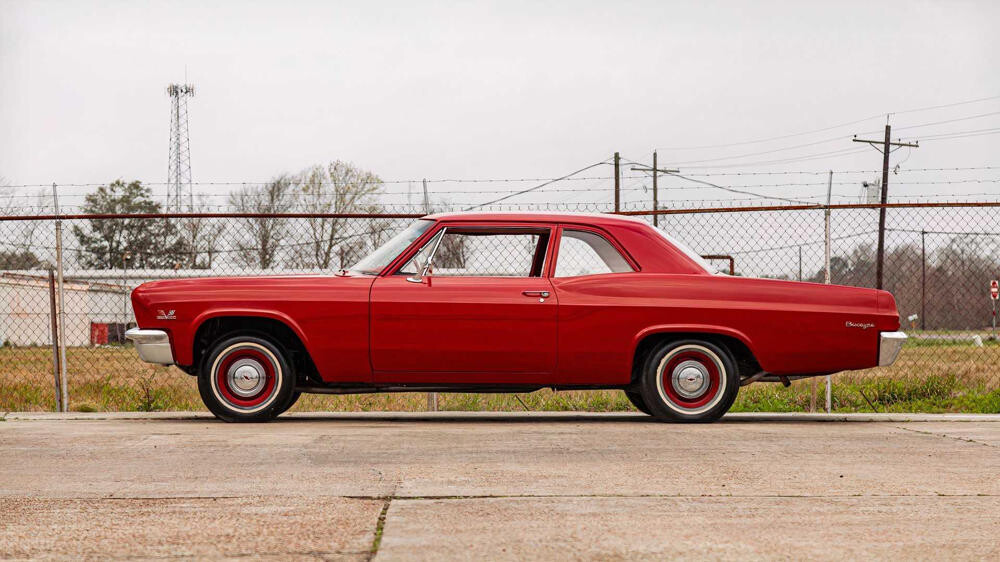
Chevrolet offered a heater-delete option for its 1966 full-size cars, letting buyers save roughly $70 and remove about 22 pounds. That was a curious choice for a family sedan. The same order sheet could pair the plainest body with a solid-lifter 427 rated at 425 horsepower. Even against the Impala SS, this combination carried an advantage of about 140 pounds. Drag racers had good reason to look past the badges and start with the cheaper car. That was unusual indeed. Chevrolet's Cheapest Full-Size Could Be Ordered Without A Heater Chevrolet's full-size range gave buyers several ways to spend more, but its entry-level two-door sedan kept the equipment list simple. There was less bright trim, a plainer cabin, and fewer luxury touches than in an Impala SS. For a buyer interested in quarter-mile times, that was no hardship. The heater-delete option, RPO C48, removed the heater and defroster and reportedly saved 22 pounds. It also brought a credit of roughly $70, a useful detail for someone building a car around performance rather than comfort. It was an unusual factory choice, but it suited the purpose. It was a small savings, but racers counted every pound. The Cheapest Order Sheet Could Make The Most Purposeful Drag Car The order sheet could turn that basic sedan into a serious performance car. Chevrolet allowed buyers to specify the L72 427, a solid-lifter big-block sharing its basic engine architecture with the Corvette's L72, along with manual transmissions and a Positraction rear axle. A heater-free cabin might sound miserable for daily use, but a racer could regard it as weight that did not need to be carried. Without the Impala's extra trim and SS identity, the car looked like ordinary transportation. Its options list, however, could make it one of the most purposeful full-size Chevrolets available. The 1966 Biscayne Could Hide Chevrolet's 425-HP L72 427 That plain sedan was the 1966 Chevrolet Biscayne, the least expensive full-size model in the lineup. Buyers could order it with the L72 427, a 7.0-liter V8 using a solid-lifter camshaft, high-flow cylinder heads, and a single four-barrel carburetor. Chevrolet rated it at 425 horsepower at 5,600 rpm and 460 lb-ft at 4,000 rpm. The engine was also offered in the 1966 Corvette, giving the Biscayne a direct connection to Chevrolet's sports car. It was not simply a Corvette engine assembly dropped into a sedan; the important link was the L72 specification and its high-performance design. 1966 Chevrolet Biscayne 427 L72 Specs Displacement Horsepower Torque Compression Ratio Fuel System / Carburetion 427 ci / 7.0 L 425 hp 460 lb-ft 11.0:1 Holley 780-cfm 4-barrel The 427's Advertised Horsepower May Have Been Lower Than Its Original Rating Several sources say Chevrolet initially listed the L72 at 450 hp, then reduced its advertised rating to 425. The explanation commonly repeated is concern over insurance costs and the politics surrounding increasingly powerful road cars. That account is plausible, but it should remain attributed rather than treated as a confirmed corporate directive. The 425-hp figure remained the published rating for the 1966 engine. Chevrolet installed 1,856 L72 engines across its full-size passenger-car range for 1966, including more than just Biscaynes. GM did not publish a reliable body-style breakdown, so that total cannot tell us how many received the engine. The Biscayne Was 140 Pounds Lighter Than The Impala SS Hemmings gives the L72 Biscayne a curb weight of 3,895 pounds, compared with 4,035 pounds for the 1966 Impala SS. That is a 140-pound difference before a buyer ticks the heater-delete box. The two cars also used different body styles. The Biscayne was a two-door pillared sedan, with a fixed center pillar between the side windows; the Impala SS was a hardtop, with no fixed B-pillar. That distinction matters to the car's structure, particularly when the body is subjected to the twisting forces of hard launches. The Biscayne's simpler equipment helped its weight advantage, too. The Pillared Sedan Had An Advantage The Impala SS Couldn't Match A fixed B-pillar gives a body a structural connection that an open-sided hardtop lacks, and racers valued that additional support. It does not mean every pillared sedan was automatically stronger in every measurement, but it helps explain the Biscayne's appeal as a drag-racing platform. Less trim and fewer comfort features also meant less mass to move. Put those traits together with the L72's torque and the Biscayne had a clear purpose. The Impala SS carried more prestige and visual drama, but the cheaper sedan offered a useful combination of lower weight and a body better suited to the demands of repeated launches. A Four-Speed And Positraction Made The L72 Biscayne A Serious Drag Car The L72's standard transmission was Chevrolet's heavy-duty M13 three-speed manual, but buyers could order a Muncie four-speed instead. The choices included the M20 wide-ratio, M21 close-ratio, and M22 heavy-duty close-ratio gearbox. Positraction was another available option, helping both rear tires put power down rather than leaving one to spin away the engine's effort. A period-correct example with a four-speed and Positraction is the combination enthusiasts often seek, but neither should be assumed on every L72 Biscayne. The factory order sheet and surviving documentation matter more than a seller's description. The Rarest Combinations Are The Ones Worth Checking Carefully Hemmings believes fewer than 200 four-speed Biscaynes were built, but GM did not publish a complete body-style and transmission breakdown. A dealer's claim of 183 cars should therefore not be repeated as a confirmed factory count. One reported quarter-mile run of 11.76 seconds with 4.88 gears gives a sense of the car's potential. Classic.com registered an average sale of $48,567, with a top sale hitting $93,500 in 2026. The Biscayne's appeal is not a disputed survivor total. It is the factory combination of a high-winding 427, a lighter pillared body, and equipment chosen with racing in mind. That made it a purposeful factory starting point for racers. Source: Classic, Mecum

 Liked by Abigail Campbell, Nicole Brown
 Liked by Abigail Campbell, Nicole Brown