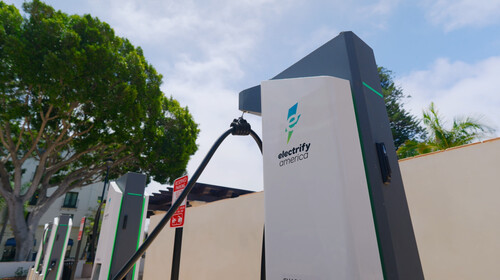
Charge your car at Menards? Its Illinois stores are adding EV ports.Menards is a Midwest staple: The Wisconsin-based chain, known for its “Save BIG Money” slogan, is the nation’s third-largest home-improvement retail brand, behind Home Depot and Lowe’s. But in Illinois, it’s slowly becoming more than just a place for folks to pick up ceiling hooks and gardening gloves, as developers eye the big-box store as a promising spot to build public EV chargers.Two companies — JOJO Superfast EV Charging and charger manufacturer XCharge North America — announced last month that they aim to install chargers across nine of the brand’s Illinois stores. They’ve already outfitted two suburban Chicago Menards with four dual-port chargers, meaning eight cars can charge simultaneously at each store, and another suburban Chicago site is under construction. These add to the chargers that other firms have already installed at Menards in other cities, including the Chicago suburb of Dolton.While these projects may be limited in scale, they represent a key strategy to convince more people to get EVs: make it convenient to charge as they go about daily routines.AdvertisementAdvertisement“People in the Chicagoland area really enjoy going to Menards,” said Alex Urist, co-founder and senior vice president of marketing at XCharge North America, noting that as a Northeasterner, he was intrigued by the Midwestern affection for the company.Installations like these “have a direct effect on the adoption of EVs, because they increase the perceived — and actual — availability of chargers” in places people visit regularly, he continued.The U.S. currently has tens of thousands of public chargers and counting, located along highways as well as at parking garages, shopping centers, hotels, and public buildings. But that growth will need to continue to get more consumers comfortable with electrifying their ride. This is especially true in states with ambitious electrification goals like Illinois, which aims to get 1 million EVs on the road by 2030. Meeting such targets became more challenging last year as the Trump administration axed federal EV incentives and tried to freeze billions in funding for charging networks, although Iran war–driven gasoline price spikes and increasingly cheap used EVs may bolster the market.Big-box stores anchored in suburban shopping centers are natural places for EV chargers. People frequently drop by to run multiple errands and grab lunch or coffee, so they can charge as they check items off their to-do list.AdvertisementAdvertisement“At the end of the day, this business is about real estate,” Urist said. “The charger works when it’s in the right place.”Urist feels that big-box stores are among the “different pockets emerging” as EV charging sites. “Walmart is really leading the charge on this,” he said, and Ikea has ports at nearly all its U.S. locations.But installing chargers at big-box stores and outdoor malls involves overcoming some hurdles. For one thing, the company that owns the store may not own the parking area. And identifying the right location for chargers within sprawling lots is not easy: Ideally, the chargers would be near a store’s entrance for convenience’s sake, but that might be far from the hookup to the local grid, creating extra costs and construction.“Adding 25 feet can add an additional $10,000 in conduit work and trenching,” Urist said.AdvertisementAdvertisementPutting chargers behind a store, if that’s where the nearest power source is, runs the risk that drivers don’t realize the ports are there, and may make it less convenient for shoppers to walk to nearby establishments. Meanwhile, charger installation and maintenance may threaten to block off parts of a parking lot or store access for periods of time.“EV charging and infrastructure development is a lot more challenging than customers see,” Urist said. “People say it would be great to have chargers at McDonald’s. I’ve looked at a few McDonald’s. It gets logistically difficult. Is the location going to impact how that drive-through functions? Are you going to have clogs in the parking spaces?”The number of partners who must collaborate to make such projects a reality adds to the complexity.For the Menards project, XCharge North America supplies the chargers, monitors them, and offers an extended warranty that includes labor and parts. JOJO Superfast, which owns and operates the chargers, collects revenue from drivers who use them.AdvertisementAdvertisementComEd, the utility serving northern Illinois, is considering funding the site preparation for the two Menards stores with operational chargers through its “make-ready” rebate program. The state of Illinois is also providing incentives through its clean energy programs, according to Kim Biggs, spokesperson for the Illinois Environmental Protection Agency. State legislators helped make it all possible by passing laws with ambitious clean energy mandates and funding. Over the last three years, he state has funded chargers at over 575 locations, almost a third of which are up and running, according to a state map.“As the federal supports dissipate, states and utilities are increasingly required to assume a greater role in driving continued EV market growth and ensuring the timely deployment of essential charging infrastructure,” Biggs said.She called the Menards project “a strong example of how public funding and private-sector collaboration can accelerate deployment of EV infrastructure in practical, high-use settings.”Urist said that one of XCharge’s products could be particularly useful at big-box stores and similar locations. The company’s GridLink is essentially an EV charger outfitted with a small battery that can fill up on grid power or from an on-site solar panel.AdvertisementAdvertisement“It can pull power from the grid slowly throughout the day and store it so that when an EV pulls up, the charger pulls from both the grid and its internal battery simultaneously,” Urist explained, noting that over 25 GridLink units have been deployed across the U.S. and Canada.The battery can reduce strain on the grid, allowing GridLink to be installed in places with less built-out electrical networks. “It’s a great way to get high-speed [charging] infrastructure into communities that have traditionally been overlooked in the energy transition,” Urist said.For example, a GridLink unit is helping Detroit electrify its municipal fleet, providing charging at a Department of Public Works site with a limited grid connection, he said.Urist noted that GridLink chargers could also provide vehicle-to-grid services, wherein a utility pays a charger owner for providing storage on the grid.AdvertisementAdvertisementComEd does not currently offer a vehicle-to-grid program but is studying the possibility, and it launched a pilot last year involving school buses.“Even when a project does not directly provide grid services today,” ComEd spokesperson Anthony Garcia said, “installations like this help inform how ComEd designs infrastructure upgrades, demand management strategies, and future programs that ensure EV charging can grow without compromising reliability for all customers.”