Specifically, the Chinese manufacturer sold 305,743 battery-electric passenger cars – an increase of 37.4 per cent compared to the same month last year. Even compared to the previous month of September, BYD saw growth: total sales increased by 5.74 per cent, while pure electric car sales rose by 11.9 per cent. This marks the third consecutive month that BEVs have set a new monthly record. The trend underscores that growth within the BYD Group is increasingly shifting towards fully electric drivetrains.
Plug-in hybrids (PHEVs), on the other hand, performed less strongly. BYD sold 177,382 units in October – a decline of 17.2 per cent compared to the same month last year. The company had already recorded a slight drop in this drivetrain category in September.
For clarity: the sales figures include all four brands of the group. While these are also listed individually in an infographic, they are not broken down by drivetrain type. The figures show that the core BYD brand sold 423,843 units, the performance-oriented, off-road SUV-focused Fangchengbao brand sold 43,872 vehicles, the premium brand Denza – which has now also launched in Europe – sold 15,152 cars, and the hypercar brand Yangwang sold 258 units.
BYD increases exports by 103 per cent
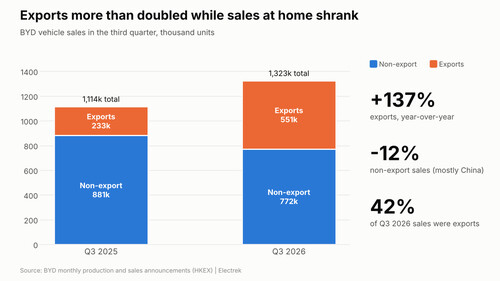
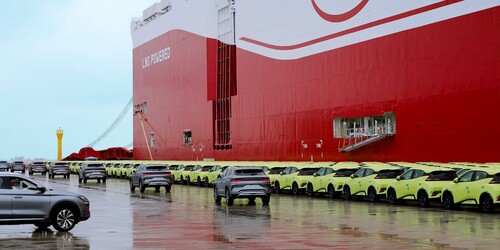
A key growth driver remains the international business. In October, BYD exported a total of 170,194 vehicles. As is well known, BYD only produces so-called New Energy Vehicles (NEVs), i.e. pure electric cars and plug-in hybrids. This represents an increase of 102.8 per cent compared to the same month last year. However, compared to September, exports fell by 5.8 per cent. Around 35 per cent of total October sales were thus accounted for by exports.
In contrast, BYD sold 319,974 vehicles on the domestic Chinese market. This was 10.6 per cent fewer than in October 2025. However, compared to September 2026, the manufacturer increased its domestic sales by 13.1 per cent. This continues to show a clear shift in growth drivers: while BYD faces intense competition and weaker demand in China, its international business is gaining increasing importance. This is also illustrated by the following table, which shows the development of the past 24 months in terms of BYD’s domestic sales in China and its export sales.
| Month | Domestic | Export |
|---|---|---|
| Nov. 2024 | 475.827 | 30.977 |
| Dec. 2024 | 457.655 | 57.154 |
| Jan. 2025 | 234.202 | 66.336 |
| Feb. 2025 | 255.821 | 67.025 |
| Mar. 2025 | 304.697 | 72.723 |
| Apr. 2025 | 301.003 | 79.086 |
| May 2025 | 293.429 | 89.047 |
| Jun. 2025 | 292.536 | 90.049 |
| Jul. 2025 | 263.559 | 80.737 |
| Aug. 2025 | 292.813 | 80.813 |
| Sep. 2025 | 325.014 | 71.256 |
| Oct. 2025 | 357.802 | 83.904 |
| Nov. 2025 | 348.251 | 131.935 |
| Dec. 2025 | 287.226 | 133.172 |
| Jan. 2026 | 109.569 | 100.482 |
| Feb. 2026 | 89.590 | 100.600 |
| Mar. 2026 | 180.139 | 120.083 |
| Apr. 2026 | 186.025 | 135.098 |
| May 2026 | 222.809 | 160.644 |
| Jun. 2026 | 228.123 | 175.349 |
| Jul. 2026 | 238.673 | 180.538 |
| Aug. 2026 | 250.827 | 189.466 |
| Sep. 2026 | 282.861 | 180.700 |
| Oct. 2026 | 319.974 | 170.194 |
Annual balance still below previous year’s level
Despite recent sales increases, BYD’s total sales for 2026 remain slightly below the previous year’s level. From January to October, the group sold a total of 3,621,744 New Energy Vehicles, representing a decline of 2.16 per cent compared to the first ten months of the previous year. After nine months, the deficit had still been 3.9 per cent.
The picture looks better for battery-electric passenger cars: since the beginning of the year, BYD has sold 1,935,700 units, an increase of 5.86 per cent. Plug-in hybrids, on the other hand, are down by 11.02 per cent with 1,625,969 vehicles compared to the previous year.
The export business has also been particularly dynamic since the beginning of the year – as seen in the individual month of October. From January to October, BYD exported a total of 1,513,154 alternatively powered vehicles, representing growth of 93.75 per cent compared to the same period last year. This increasing internationalisation is likely to play a decisive role in compensating for BYD’s declining sales on the domestic Chinese market.
bydglobal.com (PDF in Chinese), byd.com (brand infographic), cnevpost.com