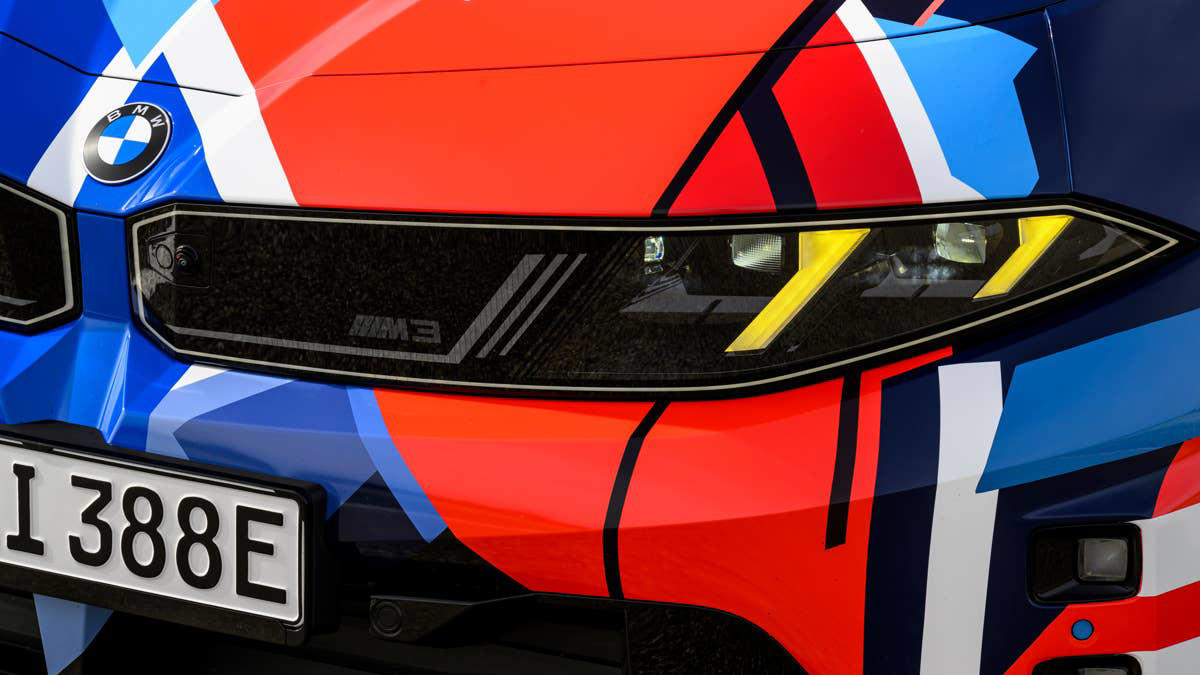
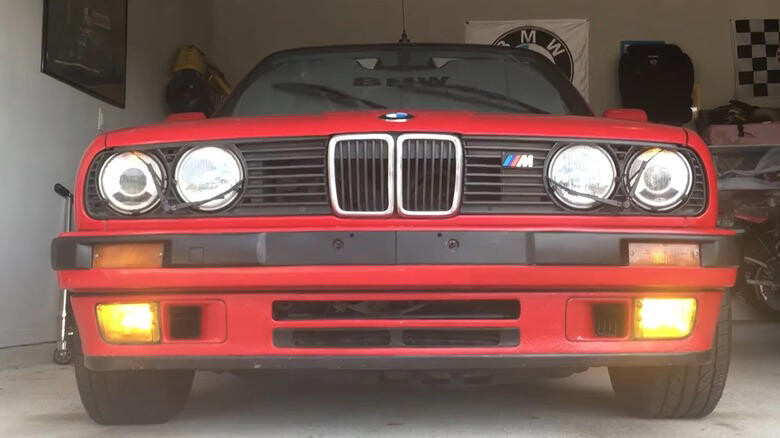
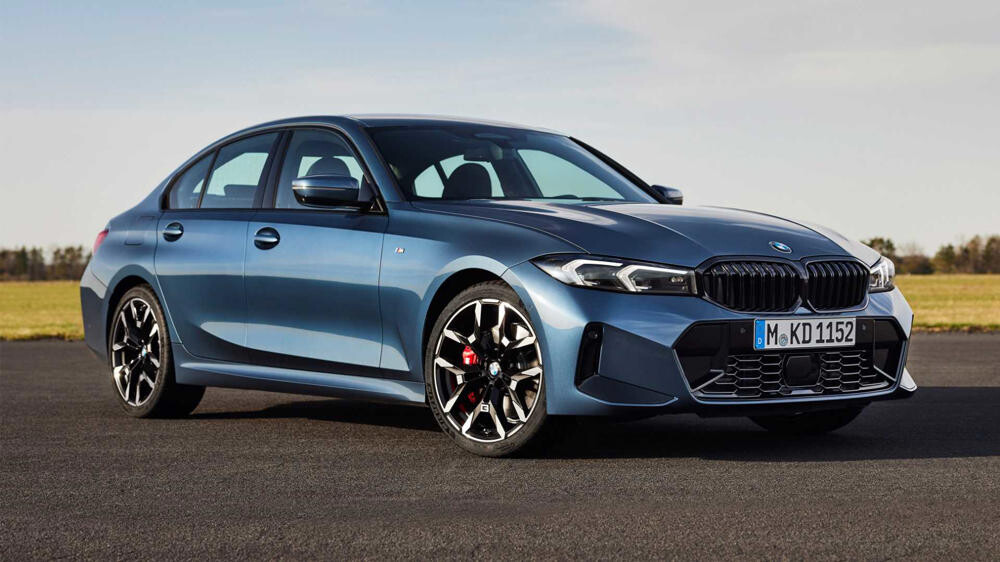
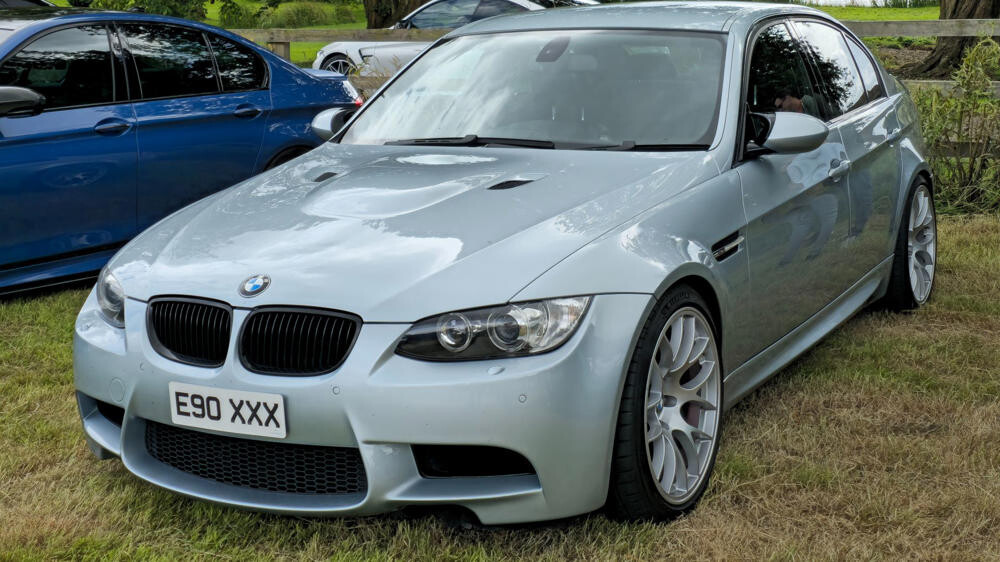
How does a company like BMW prove that it has complete confidence in a new product? By slapping what is arguably its most important badge all over it. The next-generation BMW M3 will spawn two variants: a traditional gas-powered model and an electric one. I had a chance to drive the latter, and there is something important to understand about this car. BMW won’t call it the i3 M or M3 Electric; this is an M3. That’s a pretty bold statement, especially for the first M3 to completely abandon internal combustion. But after getting behind the wheel, I’m starting to understand why BMW is so confident. The headline figures are outrageous: four electric motors, over 800 horsepower, simulated “Stages” to mimics gear changes, and artificial engine sounds piped through the speakers that pay homage to what might be the greatest-sounding M3 of all time: the E9X. That should quiet the haters. The M3 hasn’t just entered its electric era, it’s gone into supercar territory. Electrifying Looks I’ve seen the criticisms surrounding the new BMW 3 Series and its electric i3 sibling; frankly, I don’t understand it. The i3 looks especially futuristic while still retaining its 3 Series lineage. This all-electric M3 is based on the i3, and will thus spawn its own internal chassis code, ZA0. The upcoming gas-powered M3 will be labeled G84 for enthusiasts who will seek to differentiate the two cars. For the M version, the i3 gets a more aggressive stance courtesy of wider wheels sandwiched under flared wheel arches. Yellow daytime running lights come standard, as do square marker lights that harken back to the E30 M3. All it’s missing from to complete the E30 homage is a giant rear wing. There’s plenty of modern elements too, like a new natural fiber weave made of flax that replaces carbon fiber. The natural fiber is just as strong, but creates 40% less CO2 emissions during its production. BMW even deleted the i3’s front trunk to implement a hood vent that directs air over the car. Double The Motors, Most Of The Range Most high performance EVs have two electric motors, one per axle. The M3 doubles that number with two motors per axle. BMW’s preliminary figures are bonkers: 838 horsepower and 858 lb-ft of torque, making this the most powerful M car ever built. No other performance specifications were given, but I imagine the M3 should pull away from any previous BMW in a zero to 60 mph sprint. Expect a low two-second time. When automakers transform their luxury EVs into high-performance one, it always delivers negative impact to the range. While the M3 is no exception, the i3’s 468-mile capacity was a high starting point. BMW estimates the new M3 will still go 300 miles on a charge on its 100 kWh (estimated) battery. The M3 gets an M-specific battery with a unique cooling system and housing that connects it to the front and rear axles. Charging performance is improved over the i3, which was already among the quickest EVs on the market. BMW says the M3 will hit peak speeds of 420 kW, meaning it can gain 217 miles in just 10 minutes of charging. If you drive at a racetrack with DC chargers, you should be able to get back out in the time between stints. Making It Feel Like A Gas M3 So many EVs, even the quickest ones, aren’t very nice to drive on a race track. They feel heavy, it’s harder to judge speed without any sound or gear changes, and they eventually make you sick with their rapid acceleration. The M3 attempts to solve these issues with its new M eDrive and M eSound systems. M eDrive defaults to automatic mode, simulating six shift points that BMW calls “stages.” Drivers can take manual control with the paddle shifters or turn the stage off to run with one long “gear.” Independent of the stages, the M eSound pumps a noise into the cabin with, making you think there is an engine under the hood. There are mid, max, and off modes for the sounds in case you want to drive without it. BMW says it didn’t want to simply use MP3 files of its best-sounding gas engines, so it instead recorded a new sound for the M3. I would describe it as an E9X M3, if that car existed in a Cyber Punk world. The tone is distinctly aggressive and visceral, like the S65 V8, but the cracks and pops during downshifts sound like a digitized glitch, as to not create an uncanny valley effect for the driver. While I would personally love to have more optional sounds that mimic other past M3 generations, this first M eSound is pretty epic. What’s It Like To Drive? As you might expect, the M3 is painfully fast. Mash the throttle, and it pins your head back like a roller coaster taking off. The added drama of the M e Sound makes you forget the M3 is fully electric. I’ve been enamored with the idea of simulated gears ever since Hyundai debuted them in the Ioniq 5 N. While BMW’s stages are similar, they are not identical. Hyundai’s system feels more like a traditional transmission; it pauses torque from the electric motors to simulate the loss in power during a shift. BMW does not restrict torque, so the M3 will be just as quick when shifting as when you drive without the stages. The Hyundai system feels more natural to me, but track enthusiasts may prefer that the BMW approach is faster. You can still leave it in one stage and it the “rev limiter,” at which point the car will pull power and stop accelerating. On BMW’s development track in France, I preferred keeping the stages on, but leaving it in automatic. The car knew exactly which stage I wanted to be in, and my manual shifting only slowed it down. Since the M3 has four electric motors with a gearbox for each wheel, it has more variability for torque vectoring compared to any car I’ve ever driven. If you take too much speed into a turn, it can slow down the inside wheels, overdrive the outside ones, can correct any understeer that might occur. The car’s Heart of Joy ECU system can make decisions in under a millisecond, making this one of the easiest cars to slide. If you are about to understeer, it can be corrected with a heavy throttle kick, and the car just figures it out with its AI brain. There is almost no need to counter steer, since the car can adjust itself with torque vectoring. It’s slightly bizarre at first, but it becomes natural within a lap or two. Charging With The Brakes? The way this car accelerates and turns is miraculous, but the braking might be the most impressive component. Like the i3, the M3 can come to a full stop using regeneration, even at track speeds. BMW says the regen system can recoup up to 540 kW, which is a boggling number. To help visualize that, if you were driving on an canyon road, the M3 would recover around 50% of the energy expelled for acceleration using its brakes. On a track, it can recoup approximately one in three laps, keeping you out for longer. BMW even gave us a fun fact about the brake regeneration; if you came to a hard stop from top speed, the M3 could capture up to 3% of its battery. That’s three kWh generated from one stopping maneuver. Combined with the available carbon ceramic brakes, the M3’s stopping power feels like it can knock your eyeballs out of their sockets. Is It A Real M3? BMW could have hedged it bets by calling this new car the i3 M, a new name that would carry far less baggage. Instead, the German automaker wanted its customers to fully embrace the electric future with the M3 name. Will the gamble pay off? Some people will never embrace an electric M3, but I believe that is simply because of their bias. In just a few short years, BMW evolved from building performance EVs that could keep up with M cars in a straight line, but never hold a candle to them on a track. Then Hyundai launched the Ioniq 5 N, and showed the Germans how to have more fun in an EV. Hyundai’s simulated gears and sounds were the innovation that took EVs to the next level, and now BMW has iterated on the idea with even more performance. I think BMW has a bit further to go if it wants to reach Hyundai’s level of whimsy. BMW M boss Frank Van Meel says BMW won’t just mimic the sound of a V8 or V10 engine, calling it “copycat behavior.” That’s fine in theory, and I think the company landed on a sound that pays homage to a V8 M3 without copying it outright. BMW should continue building on this idea, adding more options inspired by other great M cars, like the M1, E46 M3, or E60 M5. With its quad motor setup, genius torque vectoring, and mind-boggling regen braking, the M3 handles better than any EV I’ve ever driven on a track. This car proves that the M3 formula can survive in the electrified era.

 Liked by Grace Wilson, Sophie Girard
 Liked by Grace Wilson, Sophie Girard