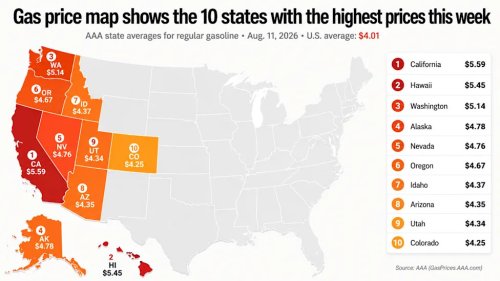



















Photo Credit: iStockGas prices are climbing quickly, making one part of the electric vehicle debate easier than ever to measure: fuel costs. Using recent AAA and U.S. Department of Energy data, Climate Crisis 247 found that EV drivers in several states can save hundreds of dollars a year compared with drivers of traditional gas-powered vehicles — and in some states, the savings now top $1,000 annually.EV fuel-cost savings are the difference between what a typical driver spends each year on gasoline for an internal combustion engine vehicle and what that same driver would spend on electricity to charge an EV.AdvertisementAdvertisementFor this ranking, Climate Crisis 247 used state-level gas and charging prices reported by AAA as of Thursday, along with federal estimates for annual driving distance, fuel economy, and EV efficiency. The analysis assumed 10,573 miles driven per year, 24.4 miles per gallon for a gas vehicle, and 0.3 kilowatt-hours per mile for an EV.The main reason is straightforward: Lower operating costs can help offset the higher purchase price that still keeps many Americans from buying an EV.That concern remains significant. Cox Automotive, as cited in Climate Crisis 247, reported the average price of a new EV in the U.S. in April was $55,211, roughly $6,200 above the average price of a new gas-powered vehicle. EV adoption in the United States also continues to lag behind many other countries. EVs and plug-in hybrids made up just about 10% of U.S. new-car sales in 2025, compared with over 30% in the United Kingdom, over 50% in China, and nearly 100% in Norway.AdvertisementAdvertisementOverall, economics, however, are beginning to shift. National average gas prices have moved above $4.50 a gallon, up roughly 43% from a year earlier. That means a typical U.S. driver now spends around $2,000 a year on gasoline, often far more than an EV driver spends on charging.As Climate Crisis 247 noted, "in some parts of the country, EV owners are paying nearly 50% less per year to drive the same amount as ICE vehicle owners."When gasoline prices rise, every mile driven in a gas-powered vehicle becomes more expensive. That widens the cost gap between filling up and plugging in.Driving an EV can lead to lower transportation costs and less exposure to sudden price spikes at the pump. Broader EV adoption can also cut harmful tailpipe pollution, especially as more electricity comes from cleaner energy sources.AdvertisementAdvertisementAccording to Climate Crisis 247's analysis, these 10 states offer the biggest yearly fuel-cost savings for EV drivers, with savings of just over $800-$1,200: 10. Hawaiʻi9. Vermont 8. Kansas 7. Maryland 6. Michigan 5. Nevada 4. Utah 3. Oregon 2. California 1. Washington Some of these states also have a high EV adoption rate. Fuel savings are only part of the equation. Upfront vehicle cost, access to home charging, and the availability of public chargers nearby can all affect whether an EV makes financial sense for a household. Used EVs are also becoming a growing option, with their sales increasing, too. AdvertisementAdvertisementStill, the ranking helps explain why rising gas prices may be changing the conversation. Even in a country where many car buyers remain hesitant, the states with the largest savings are giving drivers a clearer economic reason to make the switch.Get TCD's free newsletters for easy tips, smart advice, and a chance to earn $5,000 toward home upgrades. To see more stories like this one, change your Google preferences here.