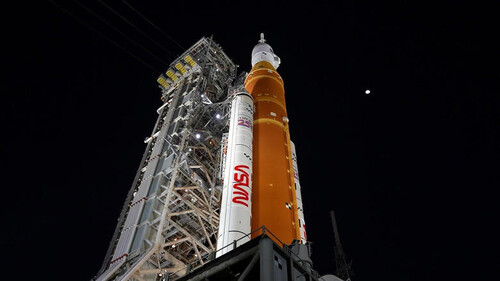
Artemis II, the space capsule that transported four people to the moon and back, is set to return to Earth today. In her latest Fast Forward post on Substack, Theresa Hanafin, a long time columnist for the Boston Globe, wrote about that voyage with special emphasis on Artemis, the Greek goddess who was the twin of Apollo. How fitting that NASA has chosen both Apollo and Artemis to be the namesakes of two lunar programs, decades apart. Hanafin tells us that Artemis — the daughter of Zeus and Leto — “was a bit of a crunchy granola type minus the pacifism. She liked hanging out in the woods, and although she admired both wild and domestic animals, she also was quite the hunter: Her weapon of choice was a bow and arrow. She had a soft spot for deer. Despite her striking beauty, she never married. In fact, she became a symbol of feminine independence and empowerment. Some considered her a goddess.” Artemis’ hunting companion was Orion, and so it is fitting that the spacecraft carrying the astronauts to the moon and back is named Orion — two legendary figures in Greek mythology flying through the heavens together on an epic journey of discovery. When he died, Artemis placed his body in the sky where he resides today — Orion the Hunter — one of the most prominent constellations in the nighttime sky. Hanafin writes, “This has been one of the most enjoyable and uplifting space missions I can remember. Their enthusiasm has been a delight. They have been full of wonder, marveling at the moon as they drew closer; enthralled by its terrain, stunned that they were so close.” It Was The Best Of Times Reid Wiseman, the mission commander, said, “You know, I’m not one for hyperbole, but it’s the only thing I could come up with. Just seeing Tycho. there’s mountains to the north. You can see Copernicus, Reiner Gamma. It’s just everything from the training, but in three dimensions and absolutely unbelievable. This is incredible.” At Mission Control in Houston, Jacki Mahaffey, the Artemis II chief training officer, chuckled, “Copy, moon joy.” To which Hanafin said, “Moon joy. It’s a glee that has spread globally, inspiring adults and children alike. The astronauts’ sense of wonder has been conveyed in a myriad of ways, both big and small.” As Artemis II prepared to travel to the dark side of the moon, and lose communication with Earth for about 40 minutes, Pilot Victor Glover reflected on their journey: “As we get close to the nearest point to the moon and farthest point from Earth, as we continue to unlock the mysteries of the cosmos, I would like to remind you of one of the most important mysteries there on Earth, and that’s love. Christ said, in response to what was the greatest commandment, that it was to love God with all that you are. And he, also being a great teacher, said the second is equal to it, and that is to love your neighbor as yourself. And, so, as we prepare to go out of radio communication, we’re still open to feel your love from Earth, and to all of you down there on Earth and around Earth, we love you from the moon. We will see you on the other side.” Mission Specialist Jeremy Hansen, a Canadian Space Agency astronaut, called Mission Control with a special request. The crew wanted to name a bright crater on the Moon that is often visible from Earth in honor of Wiseman’s wife, who died of cancer in 2020 at the age of 46. “A number of years ago we started this journey in our close-knit astronaut family, and we lost a loved one. And there’s a feature in a really neat place on the moon. It is on the near side / far side boundary …. And so we lost a loved one, her name was Carroll. The spouse of Reid. The mother of Katie and Ellie. It’s a bright spot on the moon, and we would like to call that Carroll.” As he spoke, Wiseman grew emotional. Koch wiped away tears. And then they all embraced. “We needed this. All of this. The thrill, the joy, the love, the humanity. The bravery of those four astronauts to travel a quarter of a million miles from home,” Hanafin wrote. “The expertise in electrical engineering, space science instrument development, flight test engineering, deep-space navigation, robotic systems, and other scientific research. The tenderness with which they have treated each other. “Love has been missing from our daily discourse. Perhaps because hope has faded, replaced by a quiet despair that we’re losing our humanity. But these astronauts were determined to show love in more than one way. After they swung around the moon’s back side and re-established communication with Earth, they had something important to do before they left Moon’s orbit. They have shown us that even during what feels like the worst of times, we can still experience the best of times.” It Was The Worst Of Times The worst of times Hanafin refers to occurred earlier this week when the so-called president of the United States threatened to exterminate the Iranian people. In response, Pope Leo said, “I would like to invite everyone to think in their hearts of so many innocent children, so many totally innocent elderly people who would also be victims of this escalation. I would like to invite everyone to pray, but also to seek ways to communicate — perhaps with congressmen, with authorities — saying that we don’t want war; we want peace.” The Pope’s remarks were in direct conflict with the lunatic ravings of the US Secretary of War Crimes Pete Hegseth, who has repeatedly invoked God in connection with the US military campaign, likening the rescue of a downed American pilot to the resurrection of Jesus and asking the American people to pray “every day, on bended knee” for a military victory in Iran “in the name of Jesus Christ.” On Wednesday, Hegseth said “tens of thousands of sorties, refuelings and strikes [have been] carried out under the protection of divine providence.” In his Palm Sunday homily, Pope Leo demolished the false piety of Hegseth. He said God “does not listen to the prayers of those who wage war, but rejects them.” Then he quoting from Isaiah 1:15: “Even though you make many prayers, I will not listen: your hands are full of blood.” Yesterday, Melania Trump gave a 6-minute speech at what is left of the White House in which she decried suggestions that she had any relationship with Jeffrey Epstein, thereby reopening that can of worms at a time when many believe one of the motivations for bombing Iran was to make the press stop writing about Epstein. In her Substack post this morning, Heather Cox Richardson wrote, “At 7:49 tonight, the president’s social media account posted a graphic video of a man killing a woman with a hammer. The screed that accompanied the video attacked Haitian immigrants, former president Joe Biden, and “the Radical Democrats in Congress.” The post echoed the usual vicious racism to which Trump turns to feed his base. But it is hard to miss that hours after his wife gave an unexpected press conference about Jeffrey Epstein, Trump posted a video of a woman’s murder. ” (Emphasis added.) The message from the astronauts aboard Orion is one we need to hear. It is beyond regrettable that so many people — and virtually everyone who identifies as a MAGA supporter — prefers a narrative in which women are beaten to death with hammers. It seems clear that the US — and the world — needs to make a choice between love and hate if the Earth is to have any chance of sustaining life as we know it.