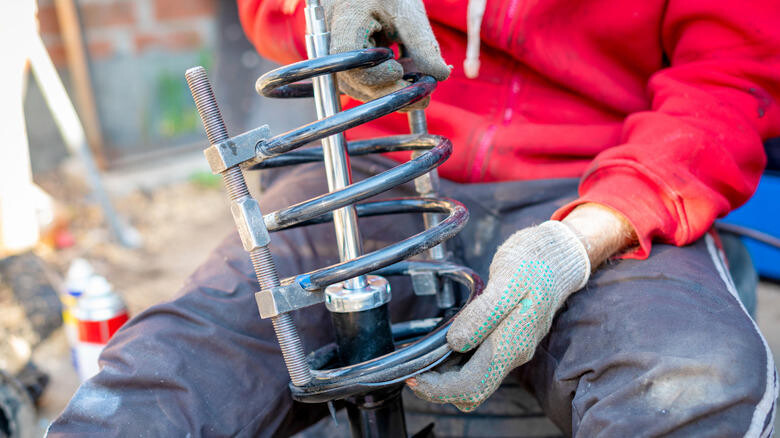
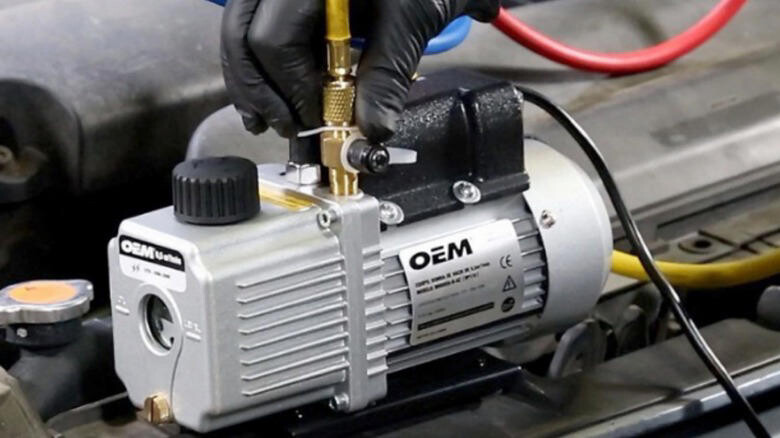
Mechanic shows cylinder compressor test under the hood.We may receive a commission on purchases made from links.The best way to make fun of your DIY mechanic friend for making you feel lazy is to ask them how much they've spent on tools. Tools, particularly specialty items, have gotten out of control in the pricing department, and those who work on their own cars know that every other wrenching session usually includes an impromptu trip to the local auto parts store for some random item you either lost or didn't know you'd need for the job. It's especially frustrating when you know in your heart that the tool you bought will be used once and never again.So, don't go wasting the time you spent learning wrenching skills or the money you're supposed to use on groceries this month, because there's a simple solution. Many folks may not be privy to this idea, but you can rent tools from local auto parts stores — sometimes, for an affordable hourly/daily fee, or even for free (as long as you return the tool intact).Renting tools may sound odd to experienced wrenchers — after all, owning is better than renting in most aspects of life. But saving money is almost just as good, and renting from a parts store can be extremely cost effective, even for seasoned home mechanics who may need a specialty tool that won't be used often. So, what kinds of goodies can you borrow? Well, we've compiled a list of eight rentable/loanable tools that will cover the needs of all kinds of DIY mechanics, as well as info about where to rent from. Engine hoistA mechanic uses an engine hoist to install an engine.Engine hoists are heavy, take up garage space, and, unless you're Freiburger and Finnegan or run your own shop, you probably aren't swapping motors every other week, making them fantastic candidates for renting. Not to mention, a brand new engine hoist can run up a nasty bill. We're talking about anywhere from $300 for a smaller capacity hoist all the way up to $5,000+ for heavy-duty units.Because an engine hoist leans more toward the "heavy machinery" category than "tool," it's not something that you'll easily find for rent at the average AutoZone, NAPA, or O'Reilly Auto Parts. So, unless you want to build an engine crane out of wood (don't do this), we recommend an industrial or commercial hardware store. We did a quick Google search in our area and found a company called Sunbelt Rentals with multiple accessible locations that quoted us $30 for 4 hours, $43 per day, and $155 if we needed to keep the hoist all week. Of course, if you are going to rent an engine hoist, you'll want to plan ahead as much as you can. You may encounter setbacks and untimely issues that delay progress, so it's important that you're ready to pull or install an engine before renting the hoist, lest it sit in your garage for days of paid rent without being put to use.Most important, however, is the safety aspect. With smaller, simpler tools, this won't be as dire, but when lifting hundreds or even thousands of pounds of metal into the air, you can never be too careful. Do your own research, but, in general, read the directions, don't work on the engine while it's in the air (get an engine stand for that), and don't rush the process. Coil spring compressorMechanic uses a spring compressor to safely handle coil springs.In a typical automotive suspension system, the coil springs support much of the vehicle's weight. This means that your springs can resist an incredible amount of force. Most automotive springs are rated in pounds per inch, aka, how much force it takes to compress the spring 1 inch. So, even if your car is in the air and the spring is compressed 1 or just half of an inch, it can still be storing several hundred pounds of force.Where are we going with this? Well, if you're like us and want to lower your daily driver, the shocks and springs usually have to come out — a task that means compressing each spring to a smaller size so it can be removed. The issue is, if that kinetic energy is released abruptly and all at once, it can seriously injure anyone standing in its way. Luckily, there's a tool for that. Spring compressors are set up similarly to other puller-type tools, with a jaw or clamp to grab the springs and a threaded shaft that can be driven by a drill, ratchet, or wrench to compress the spring.Unlike an engine hoist, these are widely found in auto parts stores for rent, usually available the same day. We went to O'Reilly's website and found a 4-star-rated EverTough universal coil spring compressor you can borrow for $56 as a deposit and return for a full refund. Remember, though, not all coil compressors are rated the same, and if you have a heavy-duty truck or commercial vehicle with high-weight springs, you may need a beefier compressor to handle the job. And, as always, read the tool's instructions. It could save you from a trip to the ER. Brake bleed kitClose up image of a brake fluid reservoir from a brake bleed kit.Bleeding brakes has almost always been considered a two-person job, with one opening and closing the bleeder valve and the other pumping the brakes to get the air out of the system. But those who frequent the DIY realm know that working on cars presents many unique situations, one of which may entail bleeding the brakes by yourself, which you can do with a brake bleed kit.These can come in a couple of different forms, but the simplest include a small bottle reservoir with a tube for the brake assembly's bleeder valve. When the tube is secured to the bleeder valve, you simply top off the master cylinder with fluid, crack open the bleeder valve with a wrench, and pump the brakes a few times. The fluid, as well as any air bubbles, is sucked through the tube and into the top of the reservoir, which retains the fluid and expels any air in the system. As long as you make sure the master cylinder has enough fluid (and the bleeder kit's reservoir isn't full of expelled fluid), you simply keep pumping until there's no more air in the system.Additionally, if you don't like having to go back and forth, pumping the brakes and checking the tube for air bubbles, there are rental kits with hand pumps or shop air compressor adapters that simulate the brake pedal, allowing you to complete the whole process at the wheel. This OEMTools hand Vacuum Pump (which we found for $55 to borrow at AutoZone) operates just like that and even comes with multiple adapters and fittings to either help with a more accurate brake bleed or be used for other applications. Vacuum pumpA close-up image of an OEM branded automotive vacuum pump being used in a car's engine bayMost experienced mechanics will likely own an air compressor of some sort, but we'd wager the same can't necessarily be said for a vacuum pump, and that's okay. For most automotive jobs, an external vacuum source outside of the engine itself isn't always needed, but there may come a time when one is necessary. One of the most common uses for a vacuum pump is for cycling the refrigerant inside a car's AC system. There are dedicated AC recycling machines, but those usually aren't for rent at auto parts stores, and they can cost thousands of dollars. So, a regular pump works just fine for the average AC job.Other applications may also fall into the "testing" department, whether that be making sure certain valves are opening and closing under engine vacuum, or that fluids are going where they need to go. But regardless of the application, renting is a great solution. On that note, we were able to find a couple of well-rated units available at both O'Reilly and AutoZone.We were drawn to AutoZone's variety of vacuum pumps that differ in levels of power, size, and attachment options. However, its "Loan-A-Tool" pumps seemed to be limited to just one unit, which is the OEMTools Electric A/C Vacuum Pump. It costs $200 as a deposit and received a 4.3-star overall rating from more than 1,200 reviews. O'Reilly's offering is the EverTough Vacuum Pump, which is very similar in spec to the OEMTools version, with a 4.4-star rating (280 reviews) and a $214.99 loan deposit. Also important to consider are rental periods, as some stores like O'Reilly Auto Parts require you to return a tool within 48 hours, while AutoZone's program allows for 90-day rentals. Cylinder honing toolA white-background image of a AutoZone Duralast cylinder honing tool.While you should absolutely support your local engine machine shop, some projects don't require a full overhaul to be "good enough." Take cylinder resurfacing, for example. In the average cheap home engine rebuild, you may decide to tidy up the block, getting rid of any material buildup or corrosion, especially if you're fixing up a car that's been sitting for a while. And if you can't afford to haul the block to a shop and pay them to clean it up (or to buy proper machining tools), the option is always there to rent or borrow a cylinder honing tool.Though they may look odd from the outside, honing tools like these are very simple rotating assemblies that push against the inner cylinder walls and remove any unwanted deposits or minor surface inconsistencies. They can be connected to the end of your at-home power drill and with the proper lubrication, you simply spin the honing tool inside each cylinder briefly to get the job done. Much like a chef's knife honing rod, these tools are not meant to remove large amounts of material, but simply resurface the block to promote better piston ring seal, among other benefits.Because honing tools are largely a niche engine-builder's tool, there isn't a massive selection on the rental market, but both O'Reilly and AutoZone had at least one stone-based honing tool available for loan. In our research, the honing tools that were available were primarily universal units, which are adjustable for different cylinder diameters. So, if you require perfect precision, you may want to look for more specialized tools or a machine shop to get your preferred results. Regardless, the items we found both cost around $25 as a deposit. Axle shaft and hub removal kitClose up image of a mechanic using a hub puller to remove an axle.When it comes to wrenching on cars, there is one inescapable truth that will plague just about every project you undertake: Something will refuse to come apart. This time, it may be a rusty leaf shackle bolt, and next time, it could be a lug nut that's been torqued by Optimus Prime himself, but very commonly, the culprit is an axle shaft or wheel hub that doesn't want to leave its home. It's a good thing, then, that one of our favorite automotive specialty tools, the hub and axle remover, exists. Removal kits can differ widely in design, so it's important to consult the store first to know which will be compatible with your vehicle. Some use small sleeves to isolate the axle shaft or hub and utilize the power steering's force to slide it out of its housing, while others may be a long shaft that bolts to the end of the hub with a flange on the opposite end to hammer out, but the style we'd recommend is a traditional grapple or claw puller that's driven by a standard drill.They do tend to be more expensive to loan out, but it's worth not having to swing a hammer close to your car's precious sheet metal or risk blowing a power steering line. We landed on the EverTough Hub Remover/Installer kit and the EverTough Axle Puller, both from O'Reilly's selection. The hub remover has solid 4.4-star average reviews and costs $415.99 as a loan deposit. That's not cheap, but it should get the job done. The axle puller is far simpler and smaller, so it will only require a hold of about $28 (it has a rating of 4.5 stars overall). Compression testerMechanic checks the compression of cylinders on an engine.Those who build engines will already have this tool for regular use, but for the average DIY mechanic who simply maintains their own cars, a compression tester is something you hope you'll never need. When a cylinder loses compression, it typically means you're about to spend a lot of time or money fixing it. For our readers' sake, we hope you won't need an emergency compression test, but if the time comes when your engine loses one of its cylindrical soldiers, trust us, you'll want to know before your problems are exacerbated.If you do find yourself with a lack of compression, the good news is that finding the right tool to test it won't be nearly as stressful. After a quick search on the average parts store loaner websites, we found well-rated compression testers at both O'Reilly and AutoZone. Both were priced at about $50 and had average ratings close to four stars from both owners and loaner customers.Compression testers are also one of the simplest "specialty tools" to use. As always, you should read any instructions before use, but as a quick guide, here's the skinny: First, disconnect the ignition and fuel delivery systems on your car so the engine doesn't start while cranking. Next, remove all of the spark plugs and make sure your compression tester kit has the correct size fitting to go in the spark plug hole. Finally, once the kit is in place, crank the engine until the needle on the dial stops going up — that reading is the cylinder's compression. All that's left is repeating the process for each cylinder to find out which ones are lacking. WelderA close-up shot of a worker TIG welding two metal pipes together.In a similar case as the engine hoist, unless you're someone who performs crazy car builds or restorations all year round (or uses a welder for work), a proper welder is just too much of an investment for your DIY mechanic needs. Depending on the type (MIG, stick, TIG, etc.) and quality, welders can cost as little as a few hundred dollars or as much as $10,000+ (some go way up from there). But at the same time, a welder is a tool that can change your wrenching life, so we looked into rental options at hardware stores or dedicated hardware rental companies.Our first dive took us to Home Depot, which has a vast rental program for just about any power tool you could imagine. We were able to find one available welder in our local store — a 125-Amp Lincoln Electric welder, good for smaller home projects and automotive repair. Unlike the more basic tools we've covered already, welder rental doesn't typically allow for a full refund of your down payment upon returning, but rather a traditional fixed rental period price. The rates were as follows in our area: $38 for 4 hours, $54 per day, $216 per week, and $648 for 4 weeks.We also checked out Sunbelt Rentals, which, being a rental company, had a much wider selection. Depending on the kind of power you need, Sunbelt's per-day rates averaged around $90 to $150, while the 4-week rates hovered between $500 and $700, depending on location. As a parting note, we hope this goes without saying, but don't rent a welder if you don't know how to use it. Your eyes, skin, and car will thank you. Want more like this? Join the Jalopnik newsletter to get the latest auto news sent straight to your inbox, and add us as a preferred search source on Google.