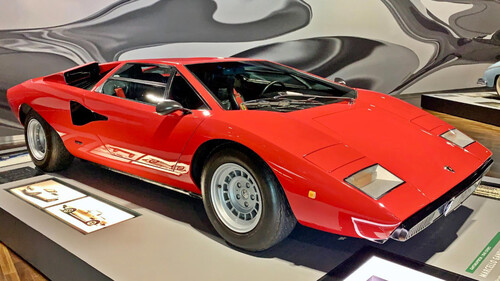
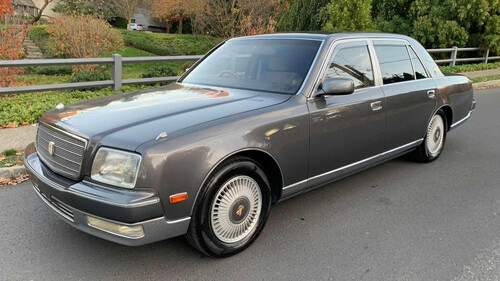
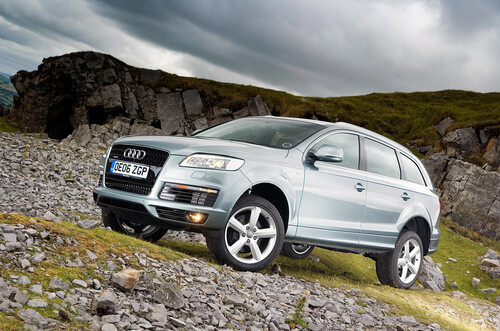
NorthSky Films/ShutterstockA V12 engine commands a certain level of respect, no matter what car it's in. There's a definite weight to the "V12" badge on the side of a luxury saloon or high-powered supercar; these engines are typically reserved for the highest trim levels of the highest models. In other words, halo cars: Everything from the timeless classic V12s like Ferraris of the 1950s and 1960s and the ultra-luxurious Toyota Century, to the Lamborghini Aventador and the Jaguar E-Type. These are names etched into the indexes of many automotive enthusiasts, and undoubtedly hung up on posters as inspirations to budding minds.These engines are powerful, smooth, and prestigious — arguably more so than any other commonly-built block outside of something like a Bugatti W16. But, as Uncle Ben famously said, "With great power comes great responsibility," and that's certainly true with these engines, especially the larger, more premier ones. While V12s are unquestionably fantastic engines, they're also notoriously finicky. There's a reason why they're not produced in greater numbers — several, in fact, which we'll go over here.In this article, we'll be discussing specific issues regarding V12 engines as a whole, rather than pointing out specific flaws inherent to individual engines; such a list would be hundreds of paragraphs long, considering the history behind these powerplants. Moreover, these engines have been used in everything ranging from regular production cars to bespoke racers; for simplicity's sake, we'll be sticking with the former. Let's get into it.AdvertisementAdvertisementRead more: 10 Of The Most Reliable V6 Engines Ever MadeV12s are incredibly complex designs by engine standardsHeritage Images/Getty ImagesV12s are so well-regarded in the first place because of their refinement. These engines are the gold standard of smoothness, providing effectively perfect balance; this means all the vibrating forces generated by the pistons and moving parts cancel each other out, leading to an exceptionally stable engine design. This makes them particularly well-suited to premium vehicles, which all have their own issues due to design complexity and hand-fitted parts — sometimes including the engines themselves.Intuitively, one would think that such an engine would be simple, and that's certainly true of the internals. At its core, a V12 engine is just two straight sixes meshed together on a single crankshaft, and straight sixes need no balance shafts to counteract those aforementioned forces, either — they, too, have perfect primary and secondary balance characteristics. The problem comes with the fact that you're taking all that and multiplying it by two.Do a quick search and look up what the innards of a V12-equipped Jaguar XJS look like, for instance. It's a car known for having one of the most intimidating-looking engine bays ever devised for an automobile. It's as if someone started building an engine and just gave up halfway through, haphazardly tossing all the rest of it into the engine bay and forcefully slamming it closed, compacting everything together in the process. It's easily one of the worst cars to work on, with no exaggeration. Of course, that doesn't apply to every single V12 engine out there, but let's be real: When you have 12 pistons, each one needing fuel, spark, airflow, and exhaust, things can get fairly complicated.V12s are extremely tight fits in many carsJoshBryan/ShutterstockThis goes back to the engines' complexity as well — having 12 pistons requires a lot of real estate. Many V12-equipped cars solve that problem by having exceptionally long noses or engine bays, like the BMW 850i with its pronounced front-end or the Lamborghini Miura opening up to give access to the entire engine. But what about something like a Lamborghini Countach with its mid-mounted engine, or an Audi Q7 diesel crammed with technology? Then you're looking at accessibility concerns or an engine bay packed with accessories, electrics, and other gadgets.AdvertisementAdvertisementFor one, these engines are long. One of the benefits of a straight six is you at least have enough room to work on one side or the other, albeit at the cost of some accessibility at the front or rear. Timing belt changes on straight sixes can already be a pain, sometimes requiring removal of whole systems like the radiator to adequately access. Now imagine having to route a belt to a double-overhead cam V12 in that same cramped space. Spark plugs, coils, alternators and other accessories — it's all inside that engine bay alongside all those pistons, so get used to squeezing your hands into awkward places.Of course, there are solutions to this problem. For instance, Jaguar E-Types have a clamshell hood that opens forwards, making that engine particularly easy to access. But if the car isn't specifically engineered for ease of maintenance — like an Audi Q7 TDi — it can require removal of the entire engine to access certain parts because of this inherent complexity.Maintenance is expensive and often labor-intensive on a V12Filippo Carlott/ShutterstockOwing to its size and complexity, daily driving a V12 might be smooth on the road, but it'll likely leave your wallet far emptier than an equivalent V6 on the lift. There's a reason why you might see used German V12s for fairly cheap — all the money you save on the car itself ends up getting spent in the shop. Granted, you can DIY a lot of the maintenance to effect substantial savings, but you still need the space, tools, and knowledge to actually work on the thing.One issue with V12s is that you'll basically never find one in a normal car. Sure, they might be incredibly civilized engines, but a lot of these vehicles are quite niche or prestigious. Even relatively inexpensive V12s like a low-mileage imported Toyota Century with its 1GZ-FE, one of the best V12s ever made, have vanishingly few specialists in the United States. It doesn't mean one can't learn to do the maintenance, just that it's absolutely not as straightforward as many other cars of that vintage.AdvertisementAdvertisementThe same story also applies to modern V12s as well; obviously, more cylinders means more points of failure like spark plugs, coils, electronics like sensors, connections for the intake and exhaust, more oil and coolant, and so on. Regardless if you know what you're doing or not, it just takes longer to accomplish the work because of the sheer quantity. For instance, even a simple oil change for something like a Mercedes S600 can run upwards of several hundred dollars if you don't want to change the oil yourself.V12's are gas guzzlersSimonskafar/Getty ImagesTo put it mildly, V12s drink fuel, which isn't exactly unexpected — you don't buy a V12-equipped car because it's good on gas. And again, the reason is just simple arithmetic — you have 12 cylinders, each one needing fuel to produce power. Sure, you could theoretically run a cylinder cutoff like the HEMI's MDS feature, but that would ruin a lot of what makes a V12 so desirable. People delete HEMI's MDS both as a matter of principle and because it adds even more complexity and failure points. That, plus potentially compromising the smoothness, means it's a lot of trouble for some emissions brownie-points.There is legitimately not a single V12 on the market, now nor ever, marketed as an economy engine. Moreover, because they're almost always placed within massive full-size vehicles packed with luxury features, they're already working at a disadvantage.But if these cars are so inefficient, then how are automakers still producing them in the first place? That's because of CAFE standards — Corporate Average Fuel Economy. The keyword here being "average": If you produce a lot of economical vehicles like EVs and hybrids, you can bank that economy like money and "spend" it on gas-guzzling V12s, as long as it doesn't exceed the limit across the fleet. This, combined with their operating principles, means there's no logical reason why automakers should make V12s more economical than they have to be. Which, by extension, means that if you buy a cheap used V12, expect to pay a lot every time you fill up.Our methodologySue Thatcher/Getty ImagesV12 engines share much of the basic architecture of straight sixes, given their obvious similarities. Moreover, they function identically to any other reciprocating piston engine configuration in the sense that they're usually four-stroke, fuel-injected or carbureted, running on gasoline or diesel, and so on. All of these systems have their own inherent pros and cons regarding the physics of their operation, such as heat generation, taking up valuable space, and so on. Unless it's something particularly exaggerated with a twelve-cylinder configuration, we chose not to include these because it's not a problem with the V12 design, but rather engines as a whole.AdvertisementAdvertisementMoreover, the problems we listed must be applicable to most V12-pattern designs, ranging from classic to brand-new, and scale across displacements and cylinder bank angles. For instance, all of these concerns could equally apply to a flat twelve in a Ferrari Testarossa as much as a diesel TDi.As for sources, we elected to use hands-on data from long-term owners and mechanics who discuss these problems in detail. For specific details and maintenance quotes, we use sites like Repair Pal to give ballpark estimates, alongside YouTube videos and individual testimonials for specific numbers wherever possible.Please note that this is a generalization across a broad spectrum of V12 engines; there are always exceptions to the rule, this list included.Want the latest in tech and auto trends? Subscribe to our free newsletter for the latest headlines, expert guides, and how-to tips, one email at a time. You can also add us as a preferred search source on Google.AdvertisementAdvertisementRead the original article on SlashGear.