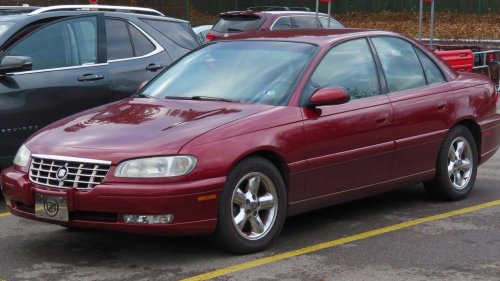



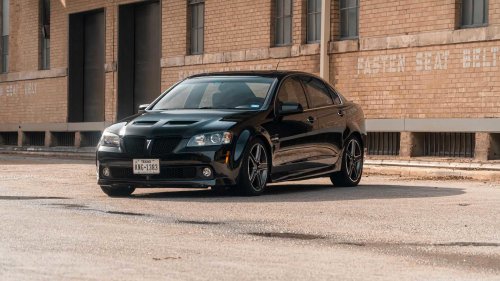


















One of the oddest niches of the world of American cars are captive imports. These are cars exported wholesale from overseas markets and barely changed to try to suit the American market. A lot of the time, this was done by simply rebranding it.Sometimes, this process results in very successful cars. Other times, it creates oddities that either faded into obscurity or gained a cult following. The 10 cars on this list definitely fall into the odd category. Cadillac Catera MercurySable99, via Wikimedia CommonsThe Cadillac Catera has always been seen as an ugly duckling in the Cadillac model lineup. It's a captive import, being only a mildly restyled version of the Opel Omega (known in the UK as the Vauxhall Omega). It was positioned as an entry-level model, competing in the US market with many of the same cars it competed against in Europe. The Catera only came with one engine option. This was the British-built 3.0-liter V6, which produced 200 hp. That power went to the rear wheels through GM's standard-issue 4-speed automatic transmission. While that made the Catera not exactly slow, it wasn't a V8 like what many American luxury car buyers would have wanted.There were probably many customers who were happy when the Catera was replaced by the CTS in 2003. The CTS was far more suited to American buyers, and it had a high-performance V8 option thanks to the CTS-V. Much like the Opel and Vauxhall Omega in Europe, the Cadillac Catera faded into obscurity. Chevrolet Caprice PPV There aren't many American cars that are odder than the Chevrolet Caprice PPV. This car was only available to law enforcement when it was new, and its origins lay far away from the US. The Caprice PPV was actually a badge-engineered version of the WM Holden Caprice. It was available with either a 3.6-liter V6 or a 6-liter V8, and both engine options were able to be run on E85 fuel.While these cars were only meant to be used by the Police, many retired examples have found their way into private hands. Some of those private owners have discovered that they're easy to tune, creating absolute power monsters in the process. There's at least one known build that produces 1,000 hp, thanks to a nitrous system being installed. Hoonigan also once featured a 700 hp Caprice PPV, which surprisingly still had some of the stock components. Dodge Stealth Dodge Stealth Front Three QuarterMany people will know about the Mitsubishi 3000GT. This Japanese sports car has gained a reputation for being one of the most underrated (and one of the best bargains!) of its era. That's especially the case with the VR4 model, which had some of the most advanced tech you could get in a road car back in the '90s. But, people outside of North America may not remember that Dodge had its own captive import version of the 3000GT.This was known as the Dodge Stealth, and it was virtually identical to the Mitsubishi 3000GT. Dodge even sold a Stealth version of the Mitsubishi 3000GT VR4, which was known as the Dodge Stealth R/T Twin Turbo.The story with the Stealth doesn't even stop there with its oddness. What's even weirder than the fact that it existed in the first place is that both the Mitsubishi and Dodge versions of this car were sold in North America! Eagle Medallion Out of all the cars you'd expect to show up in the US as a captive import, the Renault 21 is probably the last one you'd think of. But, this fairly ordinary French sedan did actually get to have a go at cracking the US market. Groupe Renault was a partial owner of AMC during the '80s, and this gave the French automaker some interesting options. This included introducing its European models to America. Renault used AMC's Eagle brand, which was full of captive imports, to try and get the Renault 21 into this new market. It was known as the Eagle Medallion, and its Renault origins were definitely obvious from some angles.The Eagle Medallion wasn't a success. It only lasted from 1988-1989, and it seemingly fell out of favour when Chrysler took over AMC. Thanks to that, it ended up being almost entirely forgotten. These days, it's only ever brought up as an example of a captive import experiment that didn't succeed. Geo Storm From the outside, the Geo Storm looks like a swanky and futuristic compact American sports car. Under the skin, though, it's a very different story. The Geo brand was very much like Eagle in that it was a vehicle for captive imports. In the case of the Geo Storm, it was a captive import of the Isuzu Piazza. The only differences between the Geo Storm and the Isuzu Piazza are the body, not having the Lotus-tuned suspension, and not having a turbocharged option. Much like the Mitsubishi 3000GT and the Dodge Stealth, you could buy both the original car (known as the Isuzu Impulse in the US) and the captive import version if you lived in America. Mercury Capri (First Generation) North America may have had the Mustang. But, over on the other side of the Atlantic, British and European customers got the Capri. The first-generation Ford Capri was an instant hit in Europe for many of the same reasons the Mustang was in America. It was affordable, cheap, and easy to maintain, and it could be tuned. The only thing European Capri buyers didn't get that Mustang buyers in North America got was a V8 option.Clearly, Detroit saw how much of a runaway success the Capri was, because it wasn't that long before Ford imported European-built Capris stateside. They were sold under the Mercury nameplate and positioned below the Ford Mustang and Mercury Cougar. The Mercury Capri came with many of the same engine options as the Ford Capri did in Europe, ranging from the 1.6-liter Kent inline-4 to the 2.8-liter Cologne V6. It actually ended up becoming the first American-market Ford to be fitted with a V6 engine!The Mercury Capri was well-received by journalists at the time. But, its mass-market appeal didn't translate over to the US in the same way. Ford stopped importing European-built Capris after 1978, and the Capri nameplate was used on a Mercury-branded version of the Fox Body Mustang instead. Merkur Scorpio Mr. Choppers, via Wikimedia CommonsAnyone who spent any time in Europe during the '80s and '90s will know all about the Ford Scorpio. It replaced the Granada as Ford's executive car in 1985, and was intended to go head-to-head with the best offerings from Audi, Mercedes-Benz, and BMW at the time. The American version was rebranded under the short-lived Merkur name and was only sold from 1988-1989. It was only offered in the hatchback body style, and it only came with the 2.9-liter Cologne V6 that topped the Scorpio range in Europe. Much like in Europe, buyers got a choice between a 5-speed manual and a 4-speed automatic.The Merkur Scorpio should have been a hit. It had independent rear suspension, giving it better handling than most American luxury cars at the time. Its V6 also had a reputation for being a great engine. But, Merkur ended up failing as a brand, and only just over 22,000 V6 Scorpios were imported from Europe to get given the Merkur treatment. Because it sold so poorly, Ford also didn't feel that adapting the Scorpio to more modern safety requirements that had to be adopted by 1990 was worth it. Merkur XR4Ti Bring a TrailerThe Merkur Scorpio has been fully consigned to the annals of history. The same can't be said for the other European Ford that got imported to America under that brand, though. The super-rare Merkur XR4Ti has developed somewhat of a cult fanbase from people who are fully aware of what they are. It was an American-market version of the lauded Ford Sierra XR4i. The Merkur XR4Ti didn't have the Ford Sierra XR4i's 2.8-liter Cologne V6 due to US emissions regulations. It got the 2.3-liter turbocharged Lima inline-4 instead. Versions with the 5-speed manual transmission produced 175 hp, while versions with the 3-speed automatic produced 145 hp.The Merkur XR4Ti lasted for the entire life of the Merkur sub-brand, being sold from 1985-1989. It didn't sell well, and it got a mixed reception thanks to its odd appearance and the weirdness of the Merkur brand name itself. But, that bad reputation has faded away over the years. People have started to realize that it was a great car, albeit a very strange one! Pontiac G8 2008 Pontiac G8 SLP FirehawkIf you mention the Pontiac G8 in certain enthusiast crowds, people will speak with reverence about how great it is. That doesn't come without reason! The G8 is often regarded as one of the best-performing cars General Motors has ever made. A captive import in the truest sense of the word, the G8 was a rebadged and mildly restyled version of the Australian Holden Commodore VE. It was even built in Holden's plant in Elizabeth, South Australia.The base model G8 came with a 3.6-liter V6 that produced 256 hp and a 5-speed automatic transmission. The mid-level G8 GT had a 6-liter V8 and a 6-speed automatic transmission, while the top-of-the-line G8 GXP had a 415 hp 6.2-liter V8 and a 6-speed manual transmission. The GXP model has the most legendary reputation, thanks to it being a full-on muscle sedan that could rival the fast Audi and Mercedes models of the day.While the Pontiac G8 was gone after 2009, its spirit carried on in the form of the Chevrolet SS (and, to a lesser extent, the Chevrolet Caprice PPV). The Chevrolet SS managed to last from 2014-2017, only ceasing to exist when General Motors wound up car production in Australia. Saturn Astra Out of all the odd captive imports on this list, this one has to be the oddest of them all. That's not because of it looking weird, or having some odd differences that were required to get it into the US market. The Saturn Astra is weird for just being a regular European hatchback that was lifted straight into America! Based on the third-generation Opel & Vauxhall Astra, it only came with a 103 hp 1.8-liter inline-4 engine. Matched with its fairly bland looks, this meant it was an incredibly mediocre car that couldn't carve a USP for itself in America.As you'll have probably guessed, the Saturn Astra was a complete sales disaster. Many of the Astras that were imported to the US just sat unsold on dealer lots. This meant it only lasted from 2008-2010, and it's now a rarer car in the US than some supercars.Sources: Cadillac, Chevrolet, Dodge, Eagle, Geo, Mercury, Merkur, Pontiac, Saturn