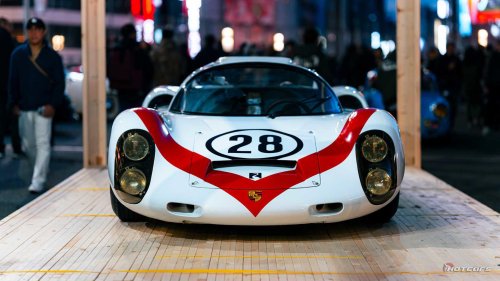
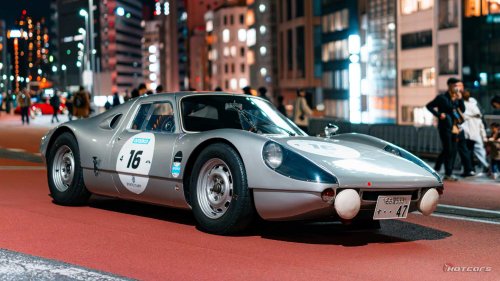
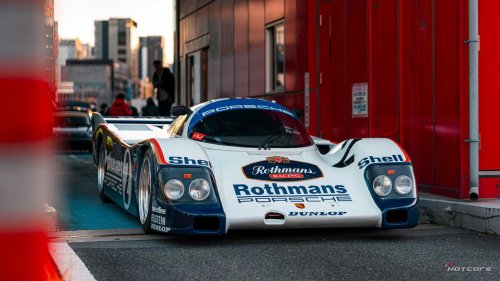
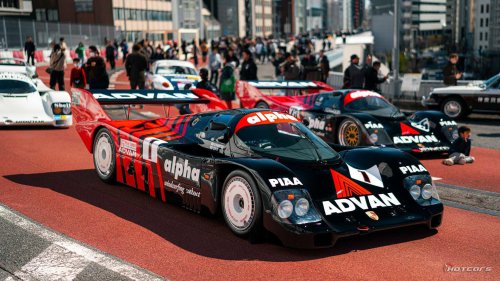
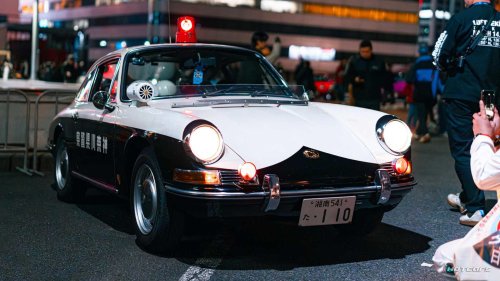
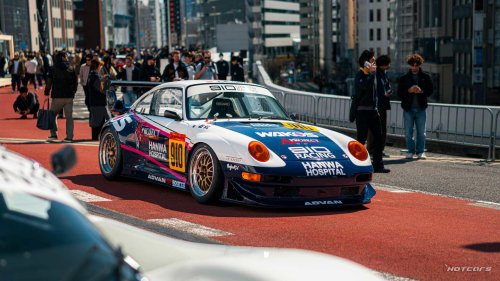
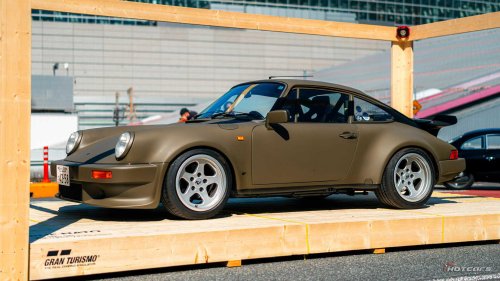
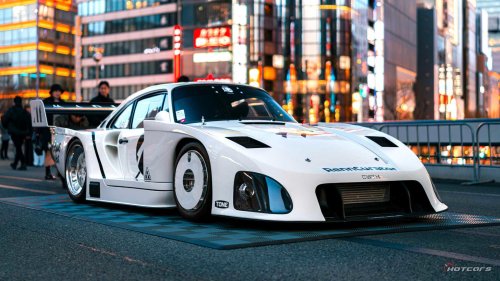
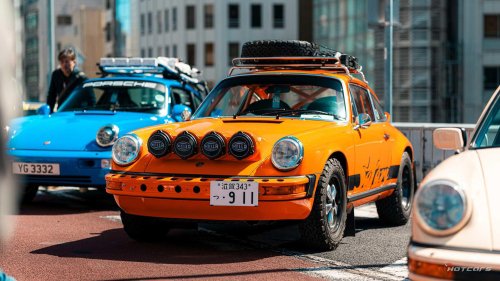
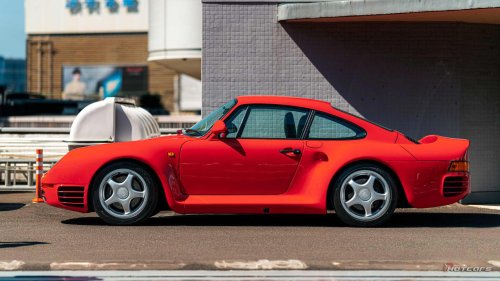
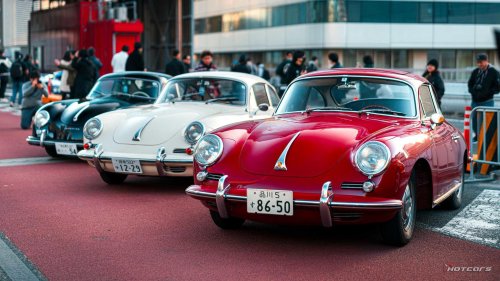
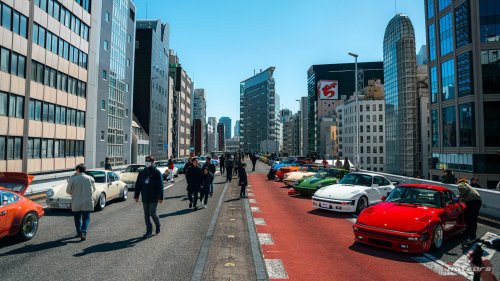
















Luftgekühlt once again lived up to its name, bringing together over 220 air-cooled Porsches for another unforgettable edition. This edition of Luftgekühlt, "Luft Tokyo," marked a special milestone, with the event’s debut in Asia. With a jaw-dropping lineup of museum-grade cars, the display showcased Japan's deep appreciation of Porsche. As the host city for this event, Tokyo did not disappoint and the setting was equally remarkable. Held on the former Tokyo Expressway KK Line, the highway that once cut through the heart of Ginza officially closed in 2024 for a decade-long transformation, and provided the perfect backdrop to welcome the air-cooled icons.Choosing favorites among the 220 air-cooled Porsches on display is no easy task, but a few highlights stood out, such as the rare sight of five Porsche 956 and 962 race cars gathered in one place. The countless Porsche 356 models in pristine condition, spanning from pre-A to SC, were equally captivating. Here is a closer look at some of the rarest and most special air-cooled Porsches from Luft Tokyo. Porsche 910 Ayesh Seneviratne / HotCars This number 28 Porsche 910 is a race car that was driven by Tetsu Ikuzawa, who finished second overall and first in class at the 1968 Japan Grand Prix at Fuji Speedway. The 910 was fitted with a 2.0-liter engine but competed against the likes of the Nissan R381 and the Lola T70, which both featured larger engines (respectively 5.5-liter and 6.3-liter).Following the footsteps of the 904 and 906, the 910 was a Group 6 sports prototype that featured a compact, low-slung body and weighing a mere 1,322 lbs to prioritize agility over power. Its 2.0-liter air-cooled flat-six engine produced over 200 horsepower and was paired with a 5-speed manual gearbox. Its mid-engine layout made it a well-balanced race car that excelled in corners. Other notable achievements for the Porsche 910 included the Nürburgring 1000 km and the Targa Florio, which helped cement Porsche’s reputation for agile and reliable race cars. Porsche 904 Carrera GTS Ayesh Seneviratne / HotCars The Porsche Carrera 904 GTS is perhaps one of Stuttgart’s most elegant race cars, blending lightweight engineering with a sleek and timeless design. Introduced in 1963, the 904 featured a fiberglass body to save weight, which was fitted over a steel ladder chassis to improve rigidity. The GTS was powered by a mid-mounted 2.0-liter flat-four, and some of the later race cars came with flat-six engines. To meet FIA GT2 homologation requirements, just over 100 units were produced. Porsche’s growing success in racing ultimately led to a rare flat-eight variant, the 904/8, which used a Formula One-derived engine. Only two 904/8 were ever built, with one of the two cars securing a class victory at the 1964 Targa Florio. The GTS has also built itself a reputation in Japan, having won second place at the 1964 Japan Grand Prix. Porsche 956 Ayesh Seneviratne / HotCars The Porsche 956 was a Group C prototype that debuted in 1982 at the 6 Hours of Silverstone, and cemented its reputation as one of Porsche’s most successful endurance race cars. The 956 secured four consecutive victories at the 24 Hours of Le Mans from 1982 until 1985, and set a record-breaking lap time of 6:11.13 at the Nürburgring.The 956 featured the first first aluminium monocoque chassis in a race car, which helped the car meet the weight minimum of 1,764 lbs for Group C cars, and was fitted with a turbocharged 2.65-liter flat-six derived from the 936 producing 620PS. The race car was also the first Porsche to get ground effect aerodynamics, which drastically helped increase downforce. The Trust Iseki Porsche 956 on display at Luft Tokyo competed in the 1984 All Japan Endurance Championship. Porsche 962C Ayesh Seneviratne / HotCars Succeeding the 956 to meet IMSA regulations, the Porsche 962 continued Porsche’s Group C success, and is regarded as one of the most dominant endurance race cars of its era. Introduced in 1984, the 962C featured a turbocharged 2.8-liter flat-six engine that delivered the necessary speed and durability for endurance racing. It also featured a longer wheelbase extended by 4.7 inches over the 956, for improved leg safety in case of frontal impacts, and a steel roll cage integrated into a new aluminium chassis. The 962 made its debut at the 1984 24 Hours of Daytona. In 1987 Porsche gave the 962 a more durable and powerful 3.0-liter engine, which helped the constructor secure an overall win at the 1987 24 Hours of Le Mans. The 962 also found its fair share of success in Japan, with driver Kunimitsu Takahashi securing multiple wins in the iconic black and red Advan Alpha 962C. Porsche 912 Police Car Ayesh Seneviratne / HotCars In the 1960s, the official Porsche importer to Japan, Mizwa Motors, exclusively built four police cars based on the Porsche 912, with one of them donated to the Kanagawa Prefectural Police. The car was used from 1968 on the Tomei Expressway and other highways, until it was retired in 1973 after 155,943 km on the counter, due to an engine failure. The police car was then displayed at the National Police Academy for 26 years before being scrapped in 1999. It was miraculously acquired by a private owner and former policeman, who restored it for 20 years. Porsche 993 3.8 RSR Ayesh Seneviratne / HotCars Developed for GT racing in the 1990s, the 993 RSR represents the final evolution of the air-cooled 911 race car. The RSR, which stood for “Rennsport Rennwagen” or "racing sport racing car" in English, notably featured a full welded Matter roll cage, an alloy bonnet and lightweight materials, adjustable Bilstein suspension and a wider bodywork. Its naturally aspirated 3.8-liter flat-six engine produced over 320 horsepower. A total of 45 units of the 993 RSR were built. Here in Japan, the RSR competed in the 1998 All Japan Grand Touring Car Championship, a series now known as Super GT. RUF BTR "NATO" Ayesh Seneviratne / HotCars Originally a 1977 Porsche 930 Turbo, the car was acquired by Ruf founder Alois Ruf as a development prototype to develop the Ruf BTR. The 930 served as a test bed for the BTR engine, as well as for the BTR gearbox and suspension. While the silhouette of the 930 Turbo is clearly recognizable, the car stands out with a pronounced front bumper, flared fenders and a large rear spoiler. As a prototype, the interior was kept extremely minimal, with bucket seats, a roll cage and no backseats. Officially named “NATO,” the name referenced its matte olive “NATO green” paint, traditionally used for military camouflage. The matte paintwork also helped conceal the car from the press during testing. Only one BTR NATO was ever built, and although the car was destined for scrapping after testing, it was ultimately saved by Ishida Engineering, who brought the car to Japan. Madlane 935ML Ayesh Seneviratne / HotCars From restomods to stance Porsches on display, one modified Porsche took center stage: meet the Madlane 935ML. The man behind this build is Kazuki Ohashi, founder of the Okayama-based tuning brand Madlane. The Madlane 935ML is an extreme and modern interpretation of the iconic Porsche 935. For this creation, Ohashi used a Porsche 964 as a base, and used 935 K4 panels that he brought back from the United States. Aside from the bespoke bodywork, the 935ML features a heavily reworked chassis, and the car is powered by a tuned twin-turbo, air-cooled 3.8-liter flat-six engine with a power output estimated to be around 700-800 horsepower. Mixing race-inspired elements with contemporary design, some of the 935ML’s most eye-catching exterior features include the flat nose, the double rear wing and BBS rims. The Madlane car was given one of the best display areas at the event, with the Ginza Sukiyabashi crossing as a backdrop. Porsche Safari (replica) Ayesh Seneviratne / HotCars The Porsche 911 SC Safari is an extremely rare Porsche model, with only two factory-built 911 SC Safari ever built. Inspired by other of Porsche’s rally successes, the Safari was built specifically for the 1978 East African Safari Rally. Equipped with a 3.0-liter air-cooled flat-six, the two Safaris tackled 3,000 miles through Kenya’s savannas, deserts and highlands in a mere 94 hours. Based on the late 1970s 911 SC, the Safari was prepared for off-road competition, with raised suspension offering a ground clearance of 11 inches, a reinforced chassis and body, a bullbar, fog lights and of course the iconic Martini racing livery.The two Safari replicas on display at the Luft Tokyo event were meticulously built, with the orange model based on a 911 SC, and the blue model using a 911 964 as its base. Porsche 959 Ayesh Seneviratne / HotCars The Porsche 959 is an interesting find at the Luftgekühlt event. Based on the 911 series, the Porsche 959 featured a hybrid cooling system, with air-cooled cylinders and water-cooled cylinder heads. Its hybrid nature may explain why the 959 was parked alone at Luft Tokyo, and further away from “pure” air-cooled Porsches.The 959 was initially developed as a Group B rally car and later produced as a road legal car to meet FIA homologation regulations, with a total production run of 292 units. Fitted with a 2.8-liter twin-turbo flat-six, the 959 also featured an all-wheel drive system, derived from the car’s rally origins. Traversing the Sahara desert and tackling over 9,300 miles of challenging terrain, the 959 achieved an impressive 1st, 2nd and 6th place finish at the 1986 Paris-Dakar Rally. Honorable Mentions Ayesh Seneviratne / HotCars The Luft Tokyo event featured a stunning lineup of Porsche 356 models, ranging from the earlier pre-A models to the final 356 SC. As Porsche’s first production car, the 356 laid the foundation for Porsche models that followed, and helped define the brand’s philosophy. Lightweight, rear-engine balance and a driver-focused performance are some of the core characteristics that you’ll find in all of the other Porsches present for this event. The Full Gallery Of The Best Air-Cooled Porsches At Luftgekühlt Tokyo Air-cooled Porsche event in Tokyo