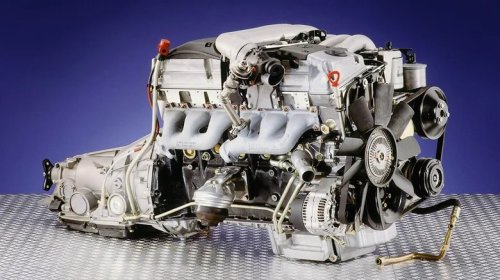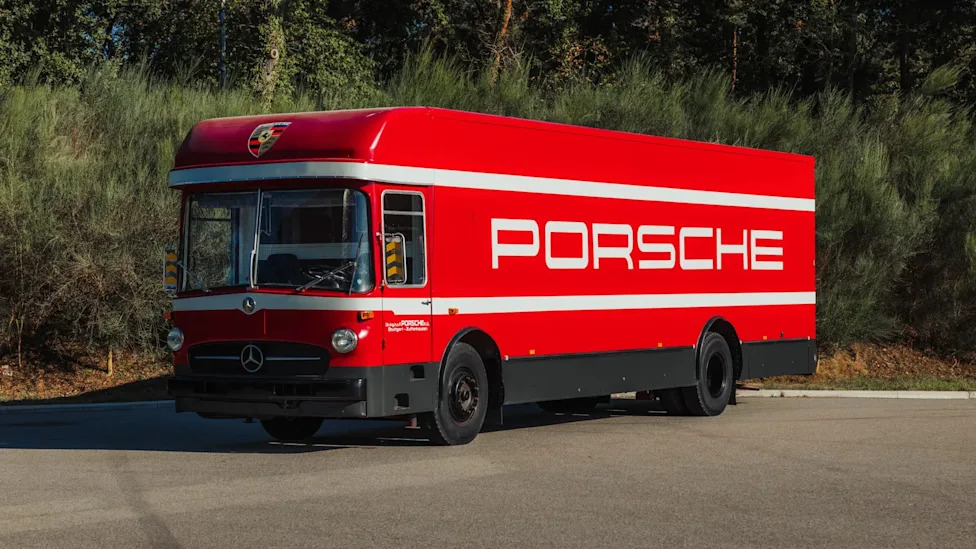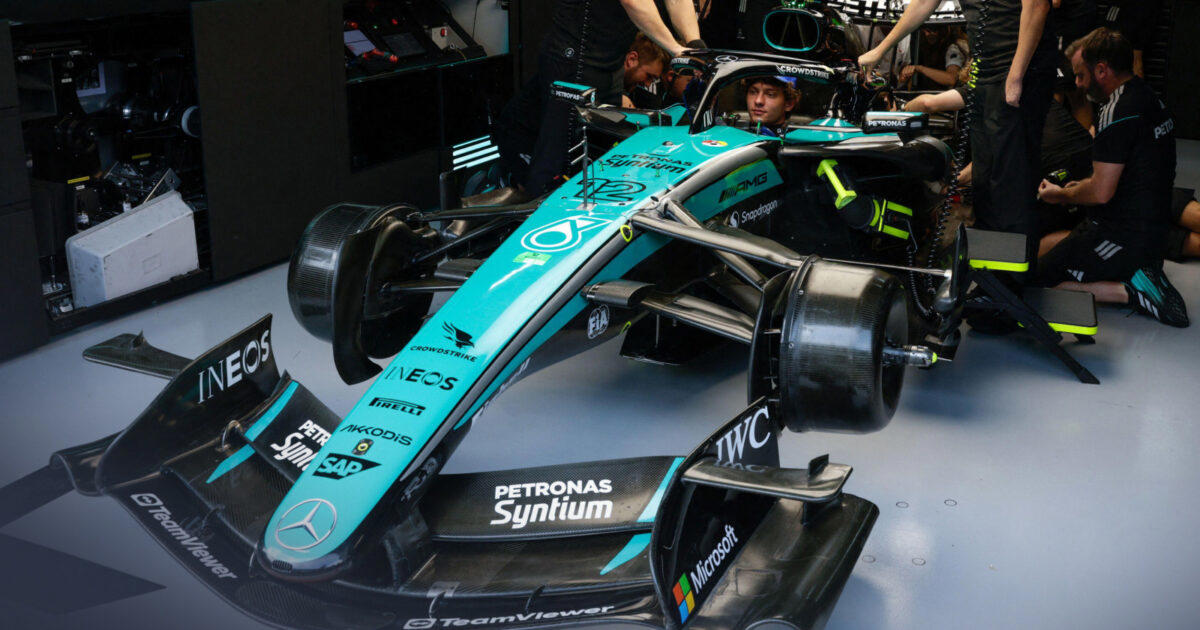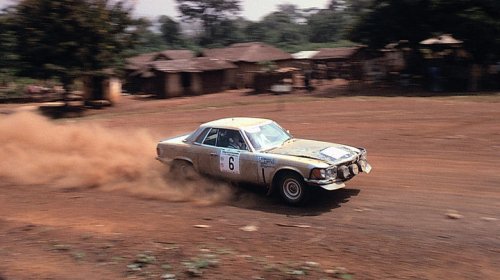

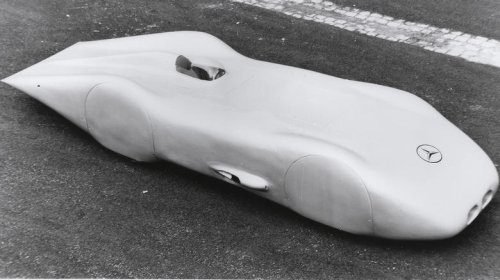
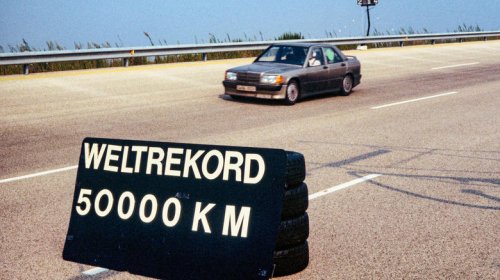

















Building a World Rally Championship car... and winningMercedes-Benz has a long and storied racing heritage, the vast majority of which is rooted in competing on asphalt. Not all of it, though: In the late '70s, the automaker made the decision to homologate a car for the World Rally Championship, unveiling the 450 SLC 5.0. The car made extensive use of aluminum both for the body panels and for the 5.0L V8 engine, in a bid to keep it as light as possible. In total, 19 examples of the car were made.Surprisingly given the brand's lack of top-flight rallying experience, the 450 SLC 5.0 proved a very competitive car. In the 1979 WRC season, future drivers' champion Hannu Mikkola took the car to a second-place finish at the Safari Rally Kenya, then won the Ivory Coast rally later the same year. The latter was a particularly impressive performance for Mercedes, with 450 SLC 5.0 entries finishing first, second, third, and fourth in a truly dominant performance.Mercedes' rally team also saw success in non-WRC rallies, winning the grueling South America Rally in 1978. However, by 1980, increasingly tough competition meant that the 450 SLC 5.0 was no longer capable of keeping up with its rivals, and so funding for the works team was pulled before the 1981 season.Taxis that run on canola oilAlthough EVs have emerged in recent years as the predominant green technology for automakers looking to cut their carbon emissions, plenty of research has been done into other methods over the decades. In the early '90s, as part of a program into environmentally friendly fuels, Mercedes-Benz built and leased a fleet of taxis in the city of Freiburg, Germany. Each one was built to run on rapeseed oil, more commonly known as canola oil in the U.S.The taxis operated for a full year, first deployed in 1992. Ultimately, the trial didn't result in more widespread development of the technology, but Mercedes has continued to conduct smaller-scale studies concerning the viability of biofuel in the years since. Most recently, the Mercedes-AMG Petronas Formula One team used Hydrotreated Vegetable Oil fuel to power its race support trucks, conducting multiple runs between race events in 2023 using primarily biofuel. The emissions savings were significant, with the team reporting reductions of 89% across the test runs. However, the lack of availability of biofuel has prevented the team from using it as a permanent alternative to diesel for now.Mercedes-Benz built a 269 mph car in 1938The Bugatti Veyron became the first production road car to break the 250 mph barrier in 2005, ushering in a new golden era for automotive performance in the process. At the time, this was hailed a groundbreaking achievement — and it was — but Mercedes-Benz had actually set an even faster speed record close to 70 years before. In 1938, a specially developed version of the Mercedes-Benz W125, dubbed the "Rekordwagen," hit 269 mph on an autobahn near Frankfurt.The car featured unique streamlined bodywork and a 5.6L V12 engine making a reported 725 hp. Its radiator had to be submerged in ice to keep it cool enough to make the record attempt with racing driver Rudolf Caracciola at the wheel. Several previous attempts had ended in failure, with the car suffering from lift problems and various mechanical faults, and the open road setting was extremely dangerous.One of Caracciola's competitors had already died after veering off the road and crashing, but that didn't stop him from returning for what would prove to be the record-breaking run. The Rekordwagen was built as a one-off and therefore not eligible for the fastest production car title, but it retained the title of reaching the fastest speed ever recorded on a public road until Koenigsegg's Agera RS speed record in 2017.A Mercedes-Benz drove over 30,000 miles in eight daysReliability can often be a difficult thing for a manufacturer to prove, especially when unveiling a new product. To showcase to customers just how reliable its new 2.3L four-cylinder engine was, Mercedes took its range-topping 190 E 2.3-16 to the Nardò ring in Italy and drove it, to quote the automaker, "more than around the world in eight and a half days." Three cars lined up at the start line and didn't stop lapping the circuit until they'd completed roughly 31,000 miles. All three completed the full distance without issue.In order to keep the cars running reliably, the team had to complete a full service and tire change on the cars during the race. That meant there was no time for any of them to cool down — an issue amplified by the hot Italian summer, which saw air temperatures reach over 100 Fahrenheit. The team was forced to complete the service on the hot engine, and did so in remarkably quick time, taking just five minutes per car. The stunt not only demonstrated the brand's engine build quality as intended but also set a new speed record — the fastest time for any car to complete 50,000 km. It's a record that remains unbroken to this day.The logo could have been a four-pointed starThe three-pointed star present on all Mercedes-Benz vehicles is one of the most recognizable logos of any automaker, but it wasn't always guaranteed to be that way. Daimler first applied for two design trademarks in 1909, being granted the license to use them exclusively in 1911. One was the three-pointed star that is famous today, albeit without the encasing ring present in the modern-day logo.The other trademark looked extremely similar, but featured a four-pointed star. It's not known exactly why Daimler bosses opted for the three-pointed star, but the company retained the trademarks for both even after making its decision. Eventually, in 1989, a full 80 years after the designs were originally filed, the four-pointed star logo was used at a Daimler-Benz subsidiary company, Deutsche Aerospace AG. The logo was short-lived, however, as Deutsche Aerospace later merged into what is today the Airbus Group.The company's first customer was the Sultan of MoroccoThe modern Mercedes-Benz was formed in 1926 with the merging of two leading German automakers to create Daimler-Benz AG. However, Daimler had already been building cars for many years prior, and Benz focused primarily on the production of engines. As such, Mercedes-Benz today considers its earliest cars to be those sold under the Daimler name. The very first of those Daimler cars was sold in 1892, back when the motor car industry itself was still in its infancy.As some of the most cutting-edge technology of its era, the automobile was an exclusive luxury only affordable to the most deep-pocketed buyers. According to Daimler's records, the very first of those buyers was the Sultan of Morocco, who ordered what was then still simply referred to as the "Motor Car." Alongside the car, the Sultan also reportedly ordered a motor boat, which used the same two-cylinder engine and produced just two horsepower.