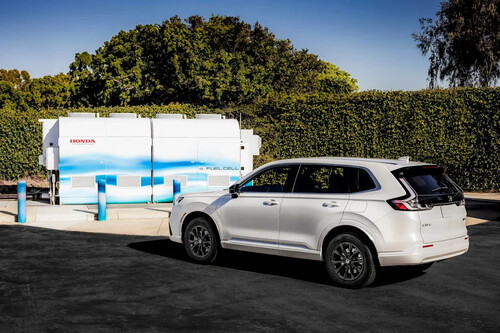
Autoblog and Yahoo may earn commission from links in this article.Despite electrification taking the lead as an alternative source of propulsion, some automakers, including Toyota, Honda, and Hyundai, are still researching hydrogen as a fuel source. Hydrogen has already proven to be cleaner than gasoline, with water serving as its only emission in modern systems. Mazda has done its fair share of research into the world of hydrogen, but not in the same vein as other automakers. Rather, the Japanese automaker developed a hydrogen rotary engine that generates power via combustion.Mazda USAWankel rotary engines and hydrogenWhen it comes to engines, the Wankel rotary is one of the lightest and smallest there is, not to mention it's simpler than a standard piston engine. It features a spinning-triangle design that minimizes moving parts, effectively reducing mechanical complications. The rotary engine isn't perfect, though. It isn't as efficient as a traditional piston engine, and they tend to burn oil. As a result, most automakers abandoned the rotary design long ago.Mazda USAInterestingly, swapping from gasoline to hydrogen as a fuel source negates all of the Wankel rotary engine's pitfalls. In 2003, Mazda developed a hydrogen rotary engine that could do just that. Three years later, the 1.3-liter rotary engine was fitted into an RX-8 and approved for sale, although the dual-fuel model was short-lived and limited to Japan.AdvertisementAdvertisementSwapping between fuel types has its own downfalls though. Gasoline proves to be the better of the two as far as performance goes, offering 206 horsepower and 164 lb-ft of torque in the 1.3-liter rotary engine. When using hydrogen as a fuel source, the twin-rotor Wankel engine saw its output drop to just 107 horsepower and 103 lb-ft of torque.MazdaThinking about selling your car? Get an instant cash offer online now. Click here to get started.Hydrogen as a fuel sourceModern hydrogen systems rely on fuel cells that convert hydrogen into electricity in order to power an electric motor. In a hydrogen rotary engine, hydrogen is used directly as the fuel source to create mechanical power. Ultimately, beyond their fuel type, the two couldn't be more different, with variations in moving parts, complex systems, and emissions.HondaIn terms of function, hydrogen fuel cell vehicles work in a similar manner to all-electric vehicles. They have fewer moving parts, require less lubricants, and are generally a low-maintenance system. Hydrogen rotary engines are nearly identical to your standard piston engine in operation, with moving parts that need attended to.Emissions prove to be a major difference between modern hydrogen fuel cells and rotary engines. While a modern fuel cell vehicle emits only water vapor and heat, hydrogen rotary engines produce nitrogen oxides due to the heat, which means a rather complex catalytic converter is in order. On the flipside, while hydrogen fuel cells require pure hydrogen to preserve the membranes, dual-fuel rotary engines can utilize lower-quality hydrogen without any issues.No matter what way you cut it, any modern hydrogen rotary engine will face the same major issue as hydrogen fuel cell vehicles: a lack of refueling infrastructure. I've covered this topic at length before, and even paid a visit to Millenium Reign Energy, a company that's attempting to offer a solution to the infrastructure problem. In short, there are just 54 public hydrogen fueling stations operating in the United States and Canada. Of those, 47 are located in the United States, and they're all in California.AdvertisementAdvertisementCurrently, there are no hydrogen rotary engines in production, but there are several examples of hydrogen fuel cell vehicles on the road. Models like the Toyota Mirai and Honda CR-V eFCEV serve as proof of concept, although the limited infrastructure restricts where and how far owners can travel. Hyundai utilizes a fleet of 21 XCIENT hydrogen semitrucks at the Hyundai Motor Group Metaplant America in Georgia. The Korean automaker is also developing a hydrogen production and dispensing station near Savannah, Georgia.HondaShopping for a new car? Click here to get a great deal on your next vehicle. Powered by Carvana, no haggle pricing, 100% online.Final thoughtsAt a glance, Mazda's hydrogen rotary engines seem dead in the water, but they serve as proof of concept in more ways than one. Not only do they preserve and utilize existing internal combustion engine technology, but hydrogen rotary engines also keep the aspects of engines that most drivers are familiar with. While full electrification has come a long way and is making steady gains in the passenger vehicle market, the cost and unfamiliarity remain an issue, causing many drivers to opt for hybrids instead.In addition to the familiar driving feel, the Mazda RX-8's dual-fuel engine effectively solves the limited hydrogen refueling structure issue, as it can simply switch to gasoline when hydrogen isn't available. As a range extender, a rotary engine makes plenty of sense, and replacing gas with hydrogen could create a low-emission solution. In fact, Mazda showed off a MX-30 e-Skyactive R-EV equipped with a standard rotary engine that acted as a generator for an electric motor not long ago.MazdaShould hydrogen fuel ever become more widely available, a hydrogen rotary engine could fill a new niche. It doesn't need purified hydrogen to operate, and there's not a steep learning curve on the mechanical side of the equation like there is in other alternative powertrain systems. In short, the lessons learned on the engineering side could pay dividends in the future. For now, however, it's clear that Mazda's hydrogen rotary engine is little more than an experiment in automotive propulsion.AdvertisementAdvertisementDisclaimer: Autoblog aims to feature only the best products and services. If you buy something via one of our links, we may earn a commission.This story was originally published by Autoblog on Jun 30, 2026, where it first appeared in the Features section. Add Autoblog as a Preferred Source by clicking here.