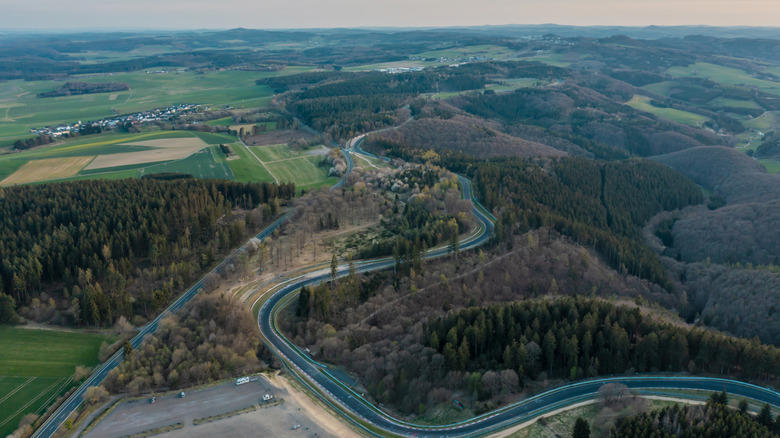
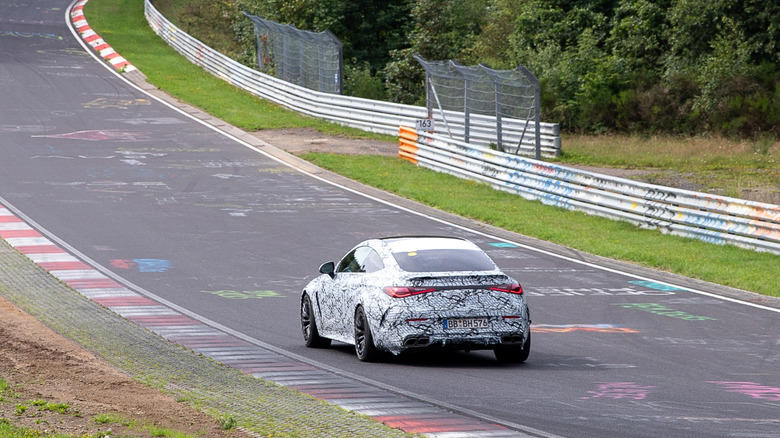
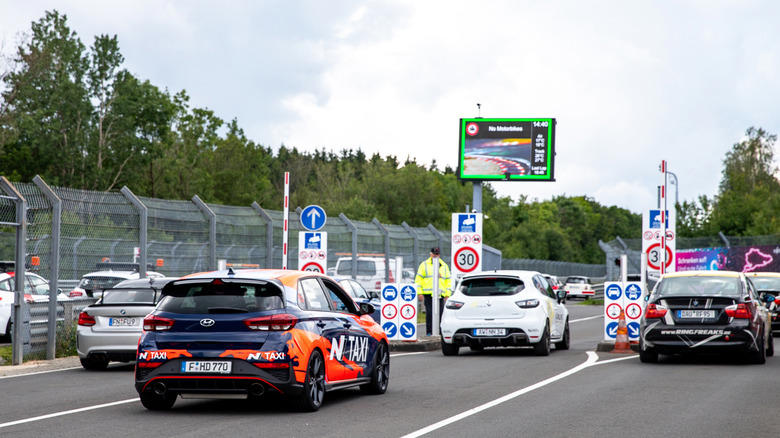

















Nachteule/Getty Images Automakers build their own private test environments all over the planet to put their cars through the ringer before bringing them to market — places like Ford's Lommel Proving Ground in Belgium, or Toyota's Arizona Proving Ground out in the middle of the desert. Yet car companies still roll out test mules, dressed up in funky camo duds, to test at the Nürburgring, a publicly accessible track tucked into the forests of Germany, that Jackie Stewart christened the "Green Hell" back in 1968. Enthusiasts know its reputation, but others may wonder, what gives? One reason has become as conspicuous as those psychedelic camouflage wraps: to take a swing at being among the fastest production cars to lap the Nordschleife – the 12.943-mile circuit itself — and let everyone know about it. Claiming a 'Ring record comes with some bragging rights, precisely because it's a shared facility that enables such comparisons. These claims also have a marketing halo effect that, for some, transcends the practical limits of actual, everyday driving. The real engineering draw is the range of challenges the Nürburgring presents, all in one place, that translate into very tangible benefits on real roads worldwide. We're talking 73 corners, flat-out straights, and 1,000 feet worth of elevation difference. That's roughly the height of the Chrysler Building, and more than any other pro motorsports track on earth. Proving durability, and exposing weaknesses Caroline Ericson/Shutterstock Desert or cold-climate testing is useful in benchmarking a vehicle's limits at the extreme ends of the climate spectrum. It's not Baja or the Arctic, but the Nürburgring can certainly see some hardcore weather. Its real strength is that it uniquely replicates a great variety of extreme circumstances, lap after lap, that are brutal on automotive components. All those twists and turns, for example, are excellent for helping engineers sort out suspension settings. They can fine-tune dampers and spring rates for optimal comfort or cornering, calibrate stability software, and tinker with different tire combinations. Obviously, a lot of tracks can offer that, but on a single Nürburgring lap, a car will also have to climb an 18% grade and descend an 11% grade. In scientific terms, that equates to 18 feet up or 11 feet down for every 100 feet traveled. In casual terms, that's steep as hell, coming and going. Mountain pass steep. But on a race track. How does a transmission deal with pulling up that hill? Does the cooling system go kaput? What about brake fade over all those undulations and turns, or thermal energy management in EV batteries? Sure, modern cars are reliable, but are they durable? The Nürburgring gives engineers a playground to holistically evaluate both. That makes efficient use of testing time and development dollars, so they can do their best to address pre-production weaknesses. Put all of that together, and this is why more than 40 different companies share these proving grounds. A circuit that stands alone, and welcomes all Caroline Ericson/Shutterstock The Nürburgring opened in 1927, and has seen its share of triumph and tragedy. Sadly, driver Juha Miettinen recently perished while racing here. It's also where Niki Lauda's fiery crash occurred in 1976 – the year of the last Formula 1 race on the Nordschleife circuit. A modern Grand Prix track opened in 1984, and the facility's two tracks can combine to create a 15.5-mile mega track. Technically, you can drive on the Monaco Grand Prix or 24 Hours of Le Mans circuits, because their tracks use public streets. You can rock your own ride under supervision at Daytona, or register through a third-party for Open Raceway Days at Laguna Seca. The Nürburgring is different. Barring bad weather or being booked for racing, the Nordschleife is open to the public for a few hours or more almost daily throughout the warmer months of the year — no reservations required. Licensed drivers can show up and pay for Tourist Drives, as long as their vehicle complies with the German Road Traffic Licensing Regulations and can top a bit over 80 mph (130 km/h). People track everything from production cars like the Volkswagen Golf GTI Edition 50, to minivans and buses, right where manufacturers test their vehicles. If you get the chance to enjoy it, have fun, and be safe. And if you're not into driving, the Green Hell still has you covered. There's also an ATV Offroad Park for corporate events, a concert venue, a bowling alley, kart racing, and a wedding room on site.