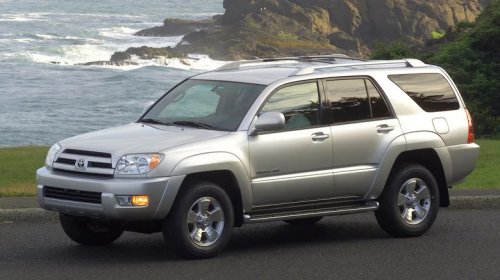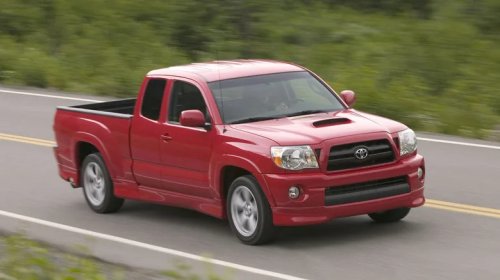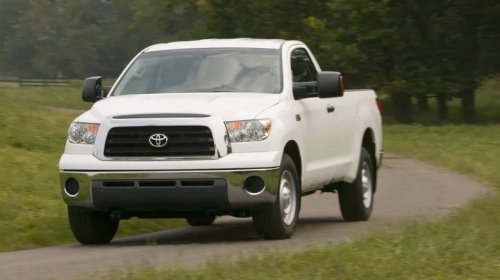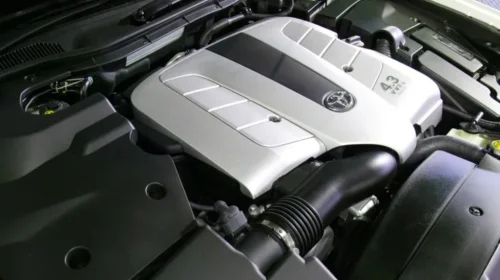
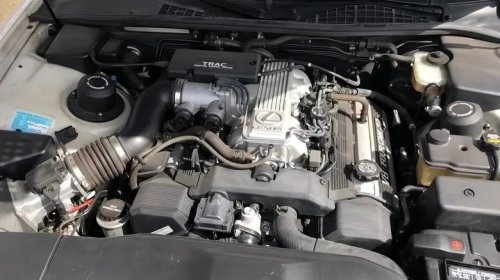
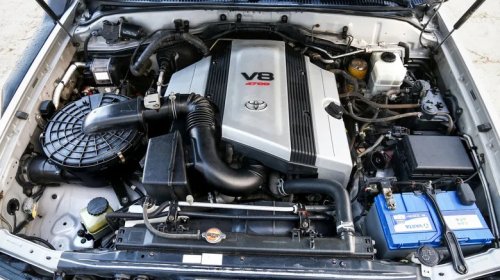
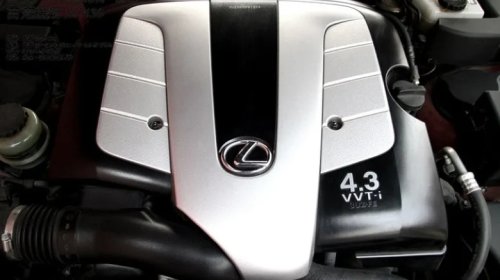



















A Toyota 3UZ-FE engine with a silver and black cover - Tennen-Gas/Wikimedia CommonsToyota has produced some of the world's most reliable car engines, be it the VZ family of V6s nestled beneath the hoods of the Tundras and Tacomas of old or the straight-4 ZZ units found in smaller cars such as the Corolla, Celica, Lotus Elise (which is already getting the restomod treatment), and the very underrated Pontiac Vibe. But perhaps the most reliable of them all is the UZ engine family that powers large trucks and SUVs, as well as luxury and performance cars from Lexus and Toyota. Production of the engines ran from 1989 to 2013, with three generations produced in that time. The range developed from the highly tunable 1UZ-FE to the largely bulletproof 2UZ-FE, and finally, the ultra-smooth 3UZ-FE. From the factory, the engines made 250 to 300 horsepower and 260 to 325 pound-feet of torque, depending on the version. On paper, the three UZ power plants have similarities. For starters, they're all belt-driven quad-camshaft four-valve-per-cylinder naturally aspirated engines — though shoppers could option the 2UZ with a bolt-on supercharger kit from the Toyota Racing Development at one point (adding this kit helped raise output to 350 hp). AdvertisementAdvertisementAll three also feature the same 90-degree V8 architecture along with a water-cooled cooling system. However, there are also some clear differences among the Toyota V8 power trains, especially in terms of their displacements, power, and the materials used for each. Read more: 11 Huge Engines With Surprisingly Low Horsepower1UZ-FE: Toyota's first dual overhead camshaft V8 engineA Toyota 1UZ engine in the 1990 Lexus LS400 engine bay - Doug DeMuro/YouTubeAs the howling heart of Lexus' first-ever car, the LS 400, the 1UZ-FE had to help prove Toyota could not only build a competitive luxury car but also instill its classic ethos of reliability into it. Thus, the Japanese automaker spared no expense in ensuring the 1UZ V8 lived up to the billing and didn't compromise the sedan in any way. Engineers utilized race-engine-grade internals, including a forged steel crankshaft held in place by a set of six cross-bolted main caps, forged steel connecting rods, and quad camshafts, with the engine block and cylinder heads both made from aluminum.The result of that effort is a smooth-running power train displacing 4.0 liters, owing to its bore of 3.44 inches and 3.25 inches of stroke. The original engine had a compression ratio of 10.0:1, but this was bumped up to 10.4:1 ahead of the 1995 model year as part of some big changes that also saw engineers implement lighter pistons and connecting rods. Also, the multi-port fuel injection that debuted with the original engine was jettisoned in favor of a sequential multiport fuel injection system. AdvertisementAdvertisementTwo years later, Toyota integrated intelligent variable valve timing technology (VVT-i) in an effort to boost output, fuel economy, and reduce emissions. Changes to the engine in 1997 also included an increased compression ratio of 10.5:1. Non VVT-i variants of the engine made 250 to 261 hp and 260 to 269 lb-ft of torque, while VVT-i-equipped variants generated 290 to 300 hp and 300 to 310 lb-ft. In addition to the LS 400, the 1UZ V8 engine powered the Lexus GS 400 and SC 400, and the Toyota Crown, Soarer, Celsior, and Aristo.2UZ-FE: the largest member of the Toyota UZ engine familyA Toyota 2UZ-FE V8 engine nestled in a Toyota Land Cruiser 100 Series engine bay - Art Konovalov/ShutterstockWhere the 1UZ was meant for cars, the 2UZ was designed for use by Toyota and Lexus body-on-frame SUVs and pickup trucks. So, rather than aluminum, the engine block was made from cast iron to provide the engine with the immense strength and durability it would need to deliver powerful torque. The engine first appeared beneath the hood of the 1998 Toyota Land Cruiser 100 and remained in production until 2012. It had a bore of 3.7 inches and a stroke of 3.31 inches, which gave it a much larger displacement of 4.7 liters — enough to make it the largest Toyota UZ engine. Besides the displacement and block, there are numerous other differences between the 1UZ and 2UZ V8 engines. For example, the 2UZ uses a steel crankshaft, as opposed to the 1UZ's forged steel crankshaft. The original 2UZ V8 engines were non-VVT-i and had a compression ratio of 9.6:1, but this was eventually raised to 10.0:1 with the introduction of VVT-i 2UZ versions in 2005.Unsurprisingly, its choice of cast iron for the block meant that the 2UZ was heavier than the 1UZ, weighing in at 485 pounds. The 2UZ came with a direct ignition system with coilpacks for each of the eight cylinders, while the 1UZ originally had a distributor-based ignition system (VVT-i versions of the 1UZ V8 had a direct ignition system).AdvertisementAdvertisementThe 2UZ powered the Lexus LX 470 and GX 470, and the Toyota Tundra, Sequoia, and Land Cruiser, as well as the sought-after V8 Toyota 4Runner. Non-VVT-i versions of the engine developed 230 to 245 hp and 300 to 315 lb-ft, while VVT-i-equipped models were good for 271 to 282 hp and 315 to 325 lb-ft.3UZ-FE: the most efficient member of the Toyota UZ engine familyA Toyota 3UZ-FE V8 sitting in the engine bay of a Lexus car - Tim Wang/Wikimedia CommonsIntroduced in the 2001 Lexus LS 430, the 3UZ builds on the VVT-i version of the 1UZ V8 engine. So like the 1UZ, it comes with an aluminum block, cylinder head, and pistons, plus a forged steel crankshaft and connecting rods, all of which contribute to making it much lighter than the 2UZ at 386 pounds. Both engines also feature cast-iron cylinder liners owing to cast iron's exceptional strength and heat resistance. Early versions of the 3UZ came with single VVT-i. Later, in the pursuit of increased torque response, higher fuel efficiency, and lower emissions, the engine was offered with a Dual VVT-i system. As for its internal size, the 3UZ's stroke length is the same 3.25 inches as was used for the 1UZ V8, but the block's bore was increased by 0.14 inches to 3.58, raising the displacement from 4.0 liters for the 1UZ to around 4.3 liters. The 3UZ matches the VVT-i 1UZ when it comes to the subject of compression ratios, however, with both engines having the same ratio of 10.5:1. AdvertisementAdvertisementCars powered by the 3UZ engine include the Lexus LS 430, SC 430, and GS 430, plus the Toyota Soarer, Supra GT500, and Crown Majesta. The 3UZ made between 276 and 300 horsepower and up to 325 lb-ft of torque. The ultra-rare factory-modified Modellista Supercharged Toyota Crown Majesta UZS186 C made 340 horsepower, up from 276 hp in the standard versions.Want more like this? Join the Jalopnik newsletter to get the latest auto news sent straight to your inbox, and add us as a preferred search source on Google.Read the original article on Jalopnik.