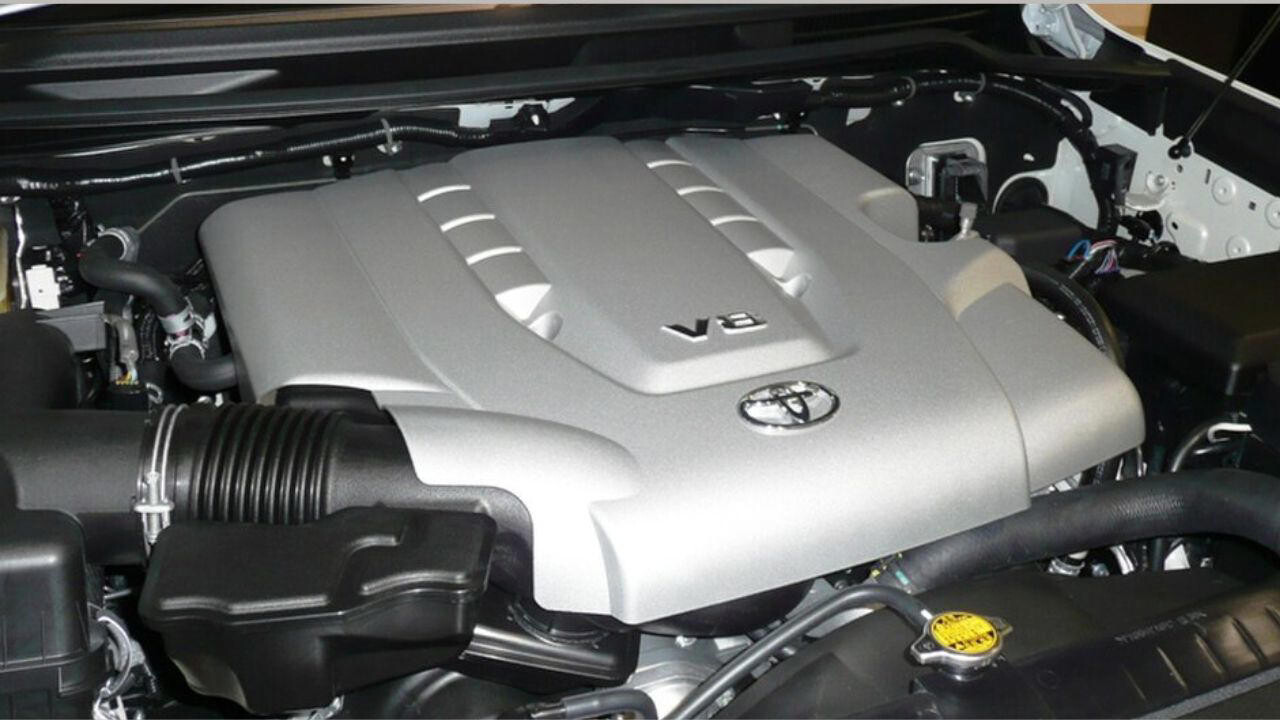
The Toyota RAV4 is unquestionably one of the most popular vehicles in the United States, an observation one can make by simply looking around on a highway and counting them by the dozen. They're a fairly universal vehicle — compact enough to be good in a city, yet spacious enough to comfortably fit a family of five plus groceries. It's the default choice if you're shopping for a crossover. Bland, appliance-like, but undeniably functional. One would assume that such a vehicle would be extremely in-demand, and it is. But it's not the most in-demand; in fact, its popularity is waning. That title belongs to another Toyota product — the Lexus IS 500, of all things. The Lexus IS 500 represents the top trim level of the Lexus IS line, which itself has no direct Toyota equivalent. Or it used to, before Lexus axed the 5.0L V8 from its lineup, leaving just the 3.5L turbo V6 in the IS F Sport as the sole remaining option. This likely plays an important role as to why the IS 500 is so desirable. But how desirable, exactly? Well, it obviously didn't sell as well as an F-150 in terms of sheer numbers. But it did sell extremely quickly — quicker than anything else in September 2026 to the tune of spending just 24.3 days on the market, according to iSeeCars. That means, if one comes up for sale, it's gone in just over three weeks on average. By comparison, the average across all used vehicles is 53.4 days, with the RAV4 taking 55 days to sell. But why is this luxury sedan apparently so sought after? Let's discuss. What is the Lexus IS 500? Lexus First thing's first: Let's break down the basics of the Lexus IS 500. As previously mentioned, it's defined by the 5.0L V8 sitting under the hood, hence the "500" in the name — the IS 350 is the 3.5L V6 variant, for instance. Note that this isn't a hybrid, or indeed even a turbo. It's a naturally-aspirated V8 pushing a healthy 472 hp, accelerating the IS to 60 in a brisk 4.4 seconds. Not bad for a midsize sedan packed to the brim with luxury appointments. Of course, being a huge V8, one wouldn't expect a particularly refined experience on the surface, certainly not an efficient one. And yeah, you're looking at a grueling 17 MPG city in today's fuel crisis, which isn't ideal. But let's be real, nobody's buying a 472 hp V8 sports sedan expecting it to sip gas. They're buying it because stepping on the throttle pedal is an excellent way to produce all sorts of noises, from the symphony of a naturally-aspirated V8 to the alarmed gasps of your passengers. Ultimately, then, a Lexus IS 500 combines that quintessentially Japanese understated luxury with the savagery of a roaring V8. It's not an outright hyper-saloon like an Audi RS e-tron GT, rather it comfortably sits as a mid-range budget option for a well-appointed midsize sports saloon. Used examples typically sit in the high-five digit range, with well-optioned 2025 models — its final production year — being around $80,000 as of November 2026. But luxury vehicles are notorious for their depreciation; while Lexus tends to hold its value well, expect prices to fluctuate. Why is it so sought after? Lexus The short answer: the engine. It's all about the V8. The Cadillac Blackwing, Audi S6 and A8, Mercedes-Benz E63 AMG, and more have all been discontinued — along with many other coupes and wagons — with companies shifting priorities away from these V8 super saloons in favor of alternative flagship models, typically hybrids or turbo V6s. And sure, such models may be more popular on paper, especially with how much money a brand new top-of-the-line V8 super saloon of any marque is. But that also leaves enthusiasts at an impasse. The simple fact is that the Lexus IS 500 represents one of a dying breed, and a particularly fine example, at that. It's a beloved platform, with a hearty engine to boot. Much like the E63 AMG, it's a proper sleeper of a car as well, with only a relatively subtle body kit and badging to give it away (until the engine revs up, anyway). Plus, let's be real, big V8s are frankly just cool, especially when you can enjoy the perks of one in the supple comfort of a Lexus. Therefore, it's likely a combination of different factors. For one, not many of them exist in the first place, so they're fairly unique — when one pops up, it's not like you're spoiled for choice. The concept of a V8-powered luxury saloon isn't going to be around forever, and Lexus has been the benchmark of this formula since the company's inception with the 1989 LS 400. You're combining a stellar reputation with artificial scarcity, adding in the fear of missing out and, bluntly, an amazing car behind it all. It's no wonder people want it so badly.