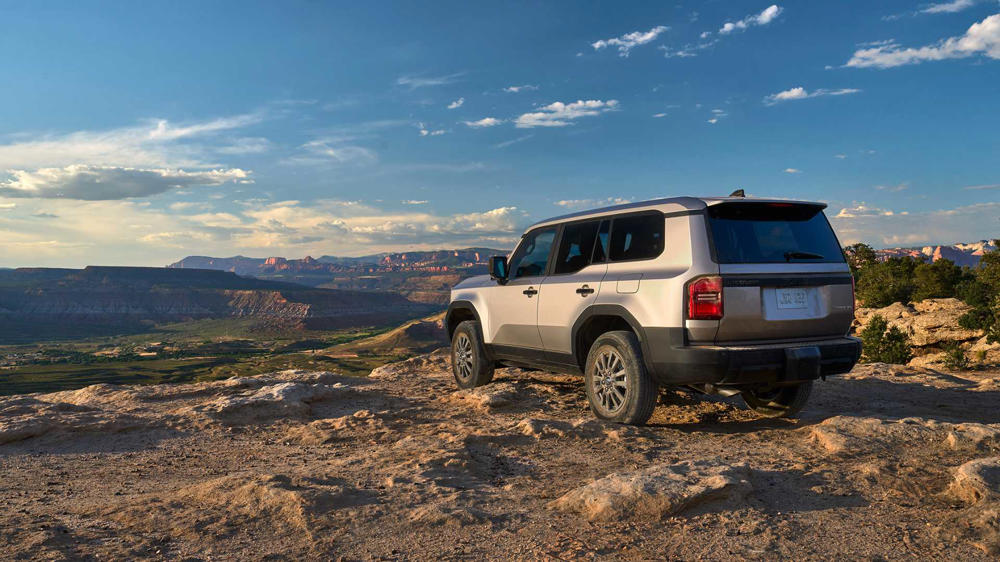
American SUV consumers face a tough financial choice in today's automotive market. Average new car prices hover above $51,000, while interest rates remain elevated. Consumers must now weigh immediate monthly affordability against long-term asset ownership. Leasing appeals to budget-conscious motorists because payments only cover expected depreciation over two or three years. However, lessees accept strict mileage limits and build zero equity. Financing a purchase requires higher monthly outlays upfront, yet buyers gain unrestricted driving and full ownership once the loan ends. Meanwhile, aggressive manufacturer incentives andshifting resale values continue to complicate the math across American dealerships. The 2027 Land Cruiser's Lease Conundrum Typically, you would expect outgoing model years to offer the lowest monthly payments. Toyota displays an opposite trend, with regional deal pages showing a significant lease discount for the 2027 Land Cruiser. Factory lease offers for the brand-new 2027 Land Cruiser 1958 start at $479 or $489 per month for 39 months with $3,999 due at signing. Meanwhile, third-party broker listings for leftover 2026 models run between $659 and $809 per month. This gap occurs because factory subvention drives down monthly lease costs on new arrivals. Automakers routinely subsidize money factors and bolster residual values on incoming models to spark early showroom traffic. Independent broker rates for outgoing 2026 stock also reflect unsubsidized market conditions or different trim configurations. Additionally, national aggregator data places average 2027 lease payments closer to $613 or $718 per month depending on down payments and mileage allowances. This means that you have to compare identical trims and cash-due figures before assuming every 2027 model beats a 2026 clearance unit. Weighing Up The Key Costs Navigating the 2027 Land Cruiser pricing structure requires scrutiny when it comes to understanding destination fees and regional listings. Toyota North America lists a $57,880 starting MSRP for the 1958 trim, while consumer regional deal pages list $58,180. The brand's destination fee bumps this up to $59,375. Compared to the 2026 1958 base price of $57,600, the 2027 entry point represents a modest $580 bump on regional portals. Stepping up to the standard Land Cruiser grade increases the financial commitment. Regional descriptions list the 2027 standard trim at $64,255, increasing to $65,450 with destination included. Furthermore, popular option packages quickly erode the appeal of a low base sticker. Toyota raises the Premium Package price by $550 for 2027, bringing that bundle to $4,905. Adding the new stand-alone High Mounted Air Intake costs another $980. Buyers who check both boxes add $5,885 to the bottom line, pushing a mid-tier build well past $70,000. What The 1958 Specification Gets You Toyota introduces targeted hardware and comfort upgrades for the 2027 model year of the 1958 trim to justify the slight price increase. Alongside the optional $980 High Mounted Air Intake, upper trims gain heated and ventilated second-row outboard seats. The exterior color palette also expands with a new shade called Inked. Every 2027 modelretains the 326-horsepower 2.4-liter turbocharged hybrid powertrain, center and rear locking differentials, and 23 MPG EPA-estimated combined fuel economy rating. Dealerships clear remaining 2026 inventory using traditional finance incentives rather than aggressive lease cash. Regional Toyota portals advertise clearance APRs starting at 4.99% for 48 months on 2026 models. Buyers who plan to purchase outright and hold their vehicles long term benefit directly from low interest rates. However, shoppers evaluating 2026 inventory should verify open service campaigns, as federal records note one fuel system recall alongside eight owner complaints for the 2026 model year. Residual Value Affects Your Final Outcome Long-term depreciation projections explain why Toyota supports low monthly lease payments on the 2027 Land Cruiser. Residual value directly dictates lease costs because lessees only pay for the depreciation occurring during their term. CarEdge projects theLand Cruiser retains roughly 84 percent of its value after three years and 65 percent after five years. On a $47,205 baseline valuation estimate, that three-year retention equals $39,497 in remaining equity. Strong resale math vindicates buyers who favor sensible, body-on-frame Toyota utility over flashier luxury crossovers. High projected residual values allow Toyota Financial Services to keep 39-month lease payments under $500 on base 1958 trims. Shoppers who lease for three years should pursue the factory-subsidized 2027 1958 deals, provided they avoid expensive option packages and verify local dealer participation. Conversely, cash buyers or traditional borrowers who want lower interest charges will find better value targeting discounted 2026 stock with 4.99 percent APR financing. Either path confirms that disciplined pricing and durable resale values keep the Land Cruiser a rational financial choice. Other Factors You Have To Consider When Leasing Looking beyond advertised monthly payments reveals critical hidden variables in any Land Cruiser transaction. When evaluating a lease, you must examine the money factor, which acts as the equivalent interest rate. Dealers can mark up this figure above the factory buy rate, inflating total finance charges without altering the sticker price. Furthermore, putting $4,000 down on a lease carries substantial financial risk. If the vehicle is totaled or stolen early in the term, insurance reimburses the leasing company rather than the driver, forfeiting that upfront cash. Smart lessees minimize cash due at signing or use refundable multiple security deposits to lower their financing rates safely. Mileage allowances and wear standards also govern real-world ownership costs. Most promotional lease contracts cap annual driving at 10,000 or 12,000 miles. Exceeding that limit triggers per-mile penalties at turn-in, which quickly erodes initial monthly savings for off-road enthusiasts or long-distance commuters. Trail-ready SUVs like the Land Cruiser also face scrutiny during lease-end inspections for undercarriage scrapes, windshield chips, and tire tread depth. Purchasing the vehicle eliminates these restrictions and allows unrestricted aftermarket modifications without penalty. Strong residual values also create a strategic lease-end buyout opportunity. Because Toyota retains roughly 84 percent of its value after three years, the market value of a well-maintained Land Cruiser often exceeds its predetermined contract buyout price. Lessees can purchase the vehicle at the end of the 39-month term and capture that positive equity, either by keeping a reliable SUV long term or trading it toward their next purchase. You also have to consider that if economic shifts depress used prices, the lessee simply hands back the keys and walks away, leaving you to absorb the depreciation loss. Checking these contract details ensures buyers capture genuine value rather than falling for a low monthly headline. Sources: Toyota, CarEdge, and the EPA.

 Liked by Lauren Campbell, Emma Clark











 Liked by Lauren Campbell, Emma Clark