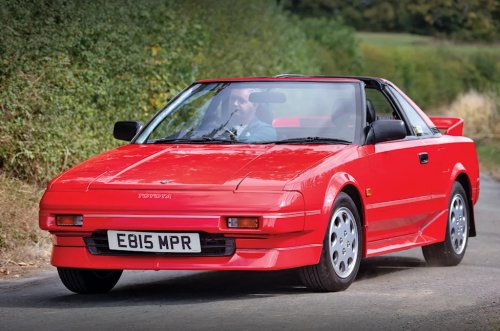
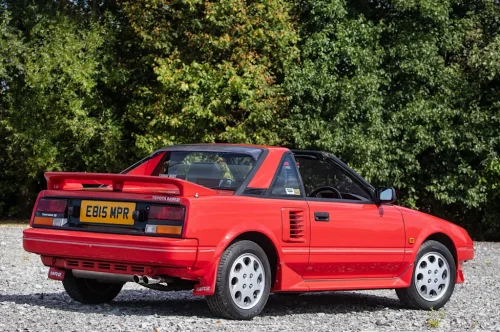
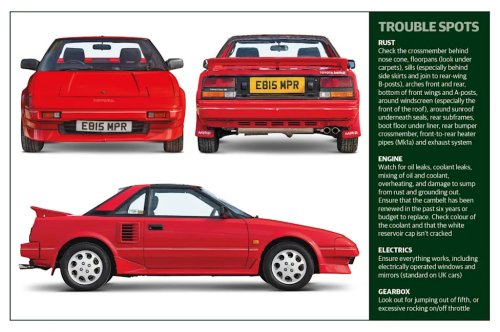
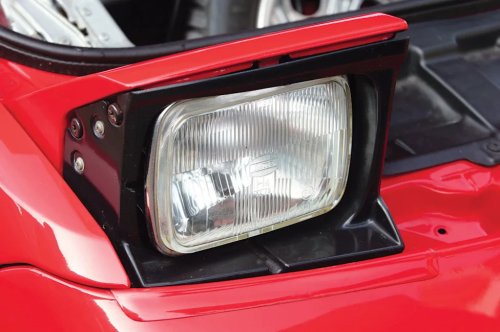
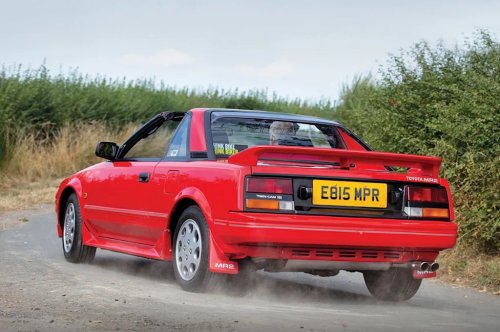
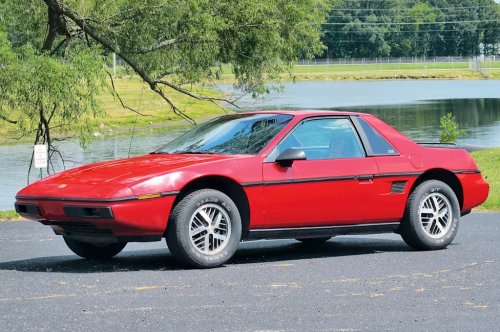
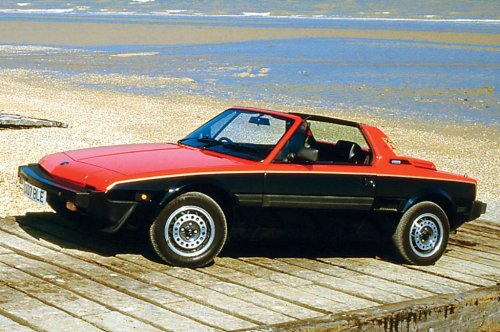
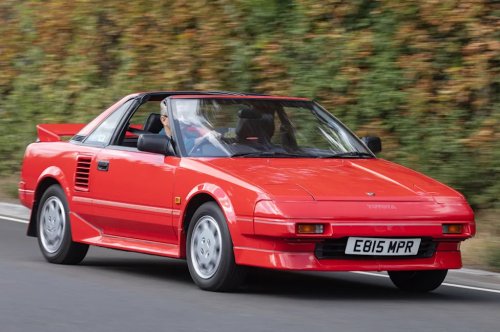
Classic & Sports Car – Buyer’s guide: Toyota MR2 (Mk1)Why you'd want a Toyota MR2 Mk1Toyota took a lesson from the Fiat X1/9, scaling the concept up just enough to capture the former MGB market sector with a beautifully balanced, mid-engined coupé powered by an oversquare, twin-cam, four-cylinder engine.The Yamaha-designed, 16-valve heads for the 123kg (271lb) 4A-GE engine were brand-new in 1983, and Toyota's Variable Induction System (T-VIS) used fewer ports at low revs to speed gas flow and aid flexibility of the high-revving unit.AdvertisementAdvertisementThis was Japan's first mid-engined, mass-production car, and it boosted worldwide sales of the layout far beyond the X1/9.Toyota part-owned Lotus, but insisted the MR2 was wholly in-house engineered (although Roger Becker of Lotus was later widely credited with input, along with racer Dan Gurney).The 44% front, 56% rear weight distribution gave superb traction and great balance, with only a slight susceptibility to crosswinds.The Toyota was a brilliant cross-country car and a capable cruiser, but care was needed on wet roads.The MR2 was perfectly proportioned for two, with an ensconcing cabin. The sunroof lifted out and could be stored in the front boot (later T-bar sections would fit behind the seats), and there was a decent rear boot for luggage.Classic & Sports Car – Buyer’s guide: Toyota MR2 (Mk1)In the UK, only the normally aspirated 1587cc with a five-speed manual 'box was sold, but in Japan the same engine was offered with a four-speed auto. Also for the home market was a single-overhead-cam, 1452cc economy model and, from mid-'85, a supercharged 1.6.AdvertisementAdvertisementBy this time, Toyota had perfected frequent component changes without affecting profit margins, so details were constantly evolving in addition to the bigger alterations that followed – marque guru Neil Jones has noted no fewer than seven different versions of the T-VIS intake during MR2 Mk1 production.With a reliable, durable drivetrain, mostly shared across many models, the MR2's biggest challenge has been rust.Now, 37 years after the last Mk1s were built, most survivors have been extensively repaired and many have had component changes, for expediency or more performance.Valued highest are originality and low mileages, but tasteful improvements are still popular. There is far more choice in the market with upgraded cars and Japanese imports, especially of supercharged models.AdvertisementAdvertisementImages: James MannToyota MR2 Mk1: what to look forClassic & Sports Car – Buyer’s guide: Toyota MR2 (Mk1)Trouble spotsPlease see above for what to look for when you check out any Mk1 Toyota MR2s for sale.EngineThe superb Toyota twin-cam engine gave a healthy 122bhp and a good spread of power aided by the T-VIS intake, revving smoothly to 7500rpm; the block was stiffened in 1986.Check the service history for frequent oil changes and thorough maintenance; look for oil and coolant leaks, also filler caps for signs of mixing.Suspension and brakesThe Mk1b has tougher suspension and brakes, often retrofitted to earlier cars whose discs could warp.Check the steering and suspension bushes for excess wear.Classic & Sports Car – Buyer’s guide: Toyota MR2 (Mk1)Pop-up lights and corrosionAdvertisementAdvertisementCheck that the pop-up lights work and frames are not corroded.Look in the crossmember and behind the nosecone for rust, and also inspect the radiator top and below front boot liner.InteriorUnusually, in Mk1 Toyota MR2s the cloth seats are more durable than the leather ones: those in this car have been very well retrimmed.The removable roof sections can leak, but new seals are available.GearboxThe gearbox was complimented when this model was new for a precise, slick change; jumping out of fifth on the overrun and excessive movement on/off throttle is evidence of wear.Toyota MR2 Mk1: before you buyClassic & Sports Car – Buyer’s guide: Toyota MR2 (Mk1)Toyota MR2 Mk1 engines are very durable if well maintained – service intervals are 5000 miles (Mk1a), 6000 miles (Mk1b), plus cambelt and tensioner at 60,000 miles; belt failures are rare, and it's a non-interference unit.AdvertisementAdvertisementThe early engine (to August 1986) is the 'blue top' – silver cam covers with lettering in black and blue.From August 1986 to May '89, the blue lettering changed to red: this engine had larger big ends and seven reinforcing ribs on the back of the block instead of three.The third generation is the 'red top', with all cam-cover lettering in red and no black: this version had smaller intake ports and a higher compression ratio.Classic & Sports Car – Buyer’s guide: Toyota MR2 (Mk1)Oil leaks around the distributor are common, caused by failed O-rings; the rocker-cover gasket is another common fail point. The oil-pressure gauge should read about ½ at idle and ¾ at speed.AdvertisementAdvertisementOn the test drive, check that the heater works – bleeding the cooling system is a complex process and airlocks are common, so overheating might only be this.Listen for clonks from worn suspension and steering bushes.When checking for the gearbox jumping out of fifth, feel for any clutch slip.Many cars have been upgraded, which may be as simple as fitting the later brakes to cure brake judder or more complex changes such as supercharger transplants into standard cars; some even have Mk2 turbo engines retrofitted.If the performance has been uprated, check the brakes and suspension have, too, and run it all past your insurer before buying.AdvertisementAdvertisementToyota MR2 Mk1 price guideRestoration/average/showMk1: £2000/5-6500/15,000Supercharged: £3000/7-10,000/20,000Prices correct at date of original publicationToyota MR2 Mk1 history1983 SV-3 concept at Tokyo motor show1984 MR2 launched in Japan: 4A-GE 1587cc (G-Limited) or (Japan-only) 3A-U 1452cc1985 UK launch. June Colour-coded trim, optional side skirts, 'Toyota' rear-window sunshade, leather trim option, bigger flywheel/clutch; Japan-only supercharged option with uprated drivetrain, twin servos1986 Aug Facelifted Mk1b: new front lip/ bumper, two-piece spoiler, stiffer engine, uprated brakes/dampers/springs, front strut-brace, repositioned rear suspension arms, ½in-wider wheels, T-bar roof optionAdvertisementAdvertisement1987 Standard side skirts, colour-coded mirrors; supercharged option in USA1988 Revised exterior trim, LED spoiler brake light, opaque T-bar glass1989 Production endsThe owner's viewClassic & Sports Car – Buyer’s guide: Toyota MR2 (Mk1)"When I worked in a quarry," recalls Jim Rogers, "my boss had a T-bar MR2. I loved it but could never afford one at the time."I've always had sporty cars. I had to sell my Ford Escort RS 2000 Mk2 when I got married, then I had a Metro Turbo that was always getting stolen like the XR2i that followed it, then an XR3i…"Last year, I finally achieved my dream: I took the money out of my savings account, then went and bought the MR2.AdvertisementAdvertisement"It surprised my wife because it's my first classic and my first true sports car and I was amazed to be complimented on it at a petrol station on the day I bought it! My daughters love it, too."I'm planning to keep on top of it, because they're known for rusting out. T-bars are also prone to leaking, but you can still buy a new set of seals."Both the body and the engine were restored in 2014 for the previous owner, and it won a car show in 2016."Also considerClassic & Sports Car – Buyer’s guide: Toyota MR2 (Mk1)Classic & Sports Car – Buyer’s guide: Toyota MR2 (Mk1)PONTIAC FIEROThis model was not sold in the UK and was a bold move for the august American car maker. This spaceframed, glassfibre-bodied, mid-engined Fiero had double the MR2's sales, but was sluggish in comparison.Sold 1983-'88 • No. built 370,168 • Price now £1500-12,500*FIAT X1/9The Fiat X1/9 is narrower and lower but a little longer than the Toyota MR2. It is both fun and lively, however it is not in the Toyota's league, but it's a mid-engined sports-car innovator. Most have since rusted away. Sold 1972-'89 • No. built c180,000 • Price now £2500-17,500**Prices correct at date of original publicationToyota MR2 Mk1: the Classic & Sports Car verdictClassic & Sports Car – Buyer’s guide: Toyota MR2 (Mk1)With upgrades common and a number of Japanese domestic-market cars also now in the mix, it is important to check that what you're looking at is what its seller claims it to be.Even more crucially, ensure that past repairs and any modifications to a prospective Toyota MR2 purchase have been competently and comprehensively well executed.For now, values remain low for a genuine classic car that has become scarce, so be prepared to travel to find the perfect example for you: get the right MR2 and it will reward you for many years to come.FOR Combining legendary Toyota reliability (some have done 250,000 miles without major work) with a brilliant driving experienceThe Mk1 MR2 is increasingly revered as the first of a legendary sports-car lineAGAINSTRust repairs and correcting poor modifications can easily run up bills that are far higher than the car's current value, so buy with caution Toyota MR2 Mk1 specificationsSold/number built 1984-'90/166,104Construction steel monocoqueEngine iron-block, alloy-head, dohc, 16-valve 1587cc 'four', Denso fuel injectionMax power 122bhp @ 6600rpm to 145bhp @ 6400rpmMax torque 105lb ft @ 5000rpm to 137lb ft @ 4400rpmTransmission five-speed manual or four-speed automatic, RWDSuspension independent, at front by triangulated lower links rear transverse and trailing links; MacPherson struts, anti-roll bar f/rSteering rack and pinionBrakes vented front, solid rear discs, with servoLength 12ft 10½in (3925mm)Width 5ft 5½in (1665mm)Height 4ft 1¼in (1250mm)Wheelbase 7ft 7⅓in (2320mm)Weight 2244-2494lb (1020-1131kg)0-60mph 8-6.5 secsTop speed 122-130mphMpg 30-40Price new £11,499/11,999 (GT/T-bar, 1987)READ MOREAll Classic & Sports Car buyer's guidesWe hope you enjoyed reading. Please click the 'Follow' button for more super stories from Classic & Sports Car.




















 +39 others