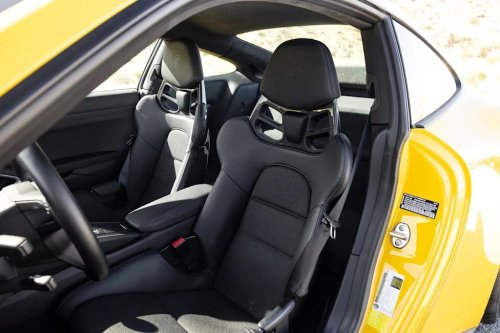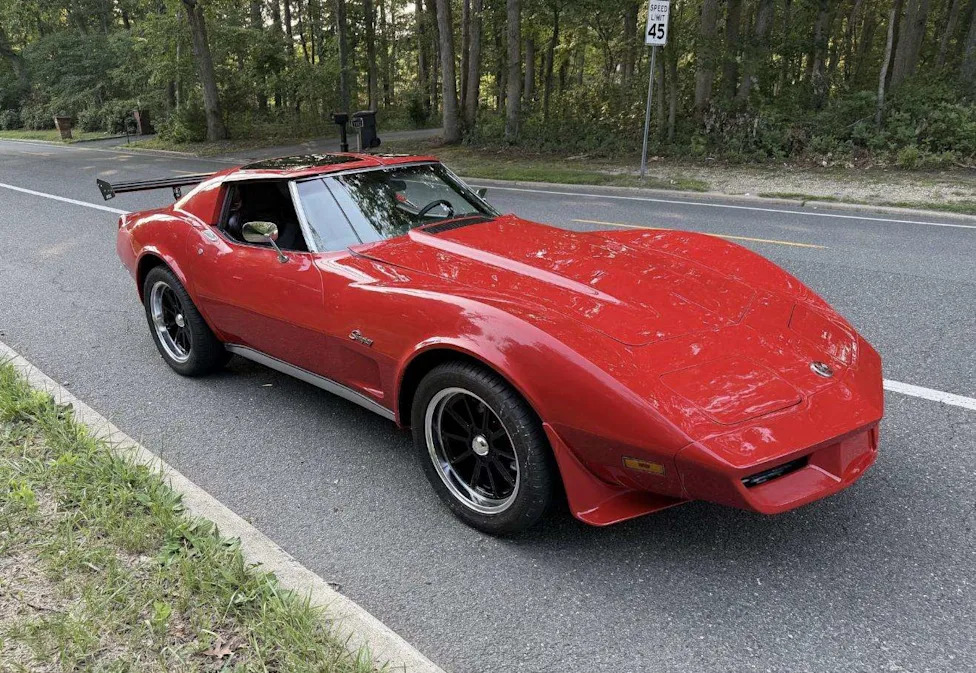
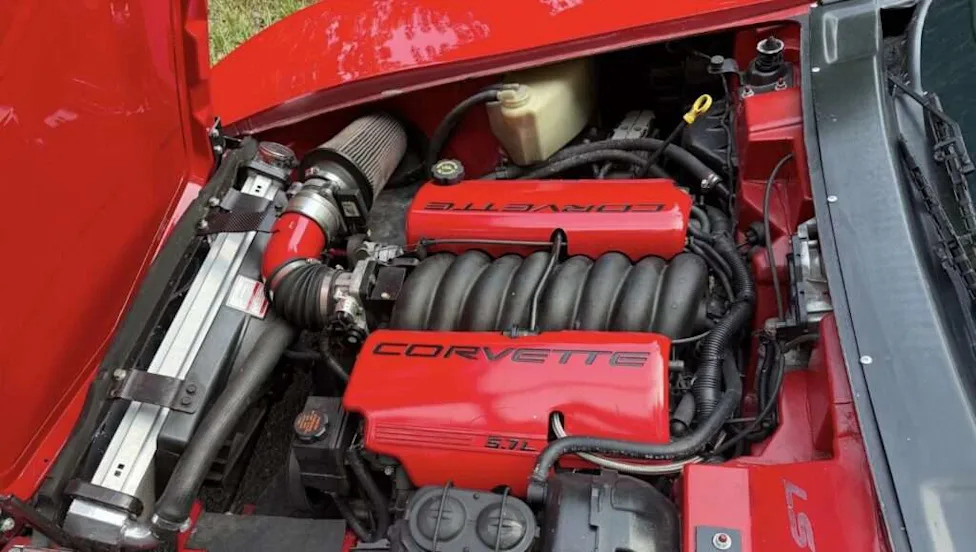



















This 1975 Corvette Pro Touring Build Makes the Case for Modifying the Right CarLot FR0033 at GAA Classic Cars' July auction in Greensboro is a 1975 Chevrolet Corvette coupe, finished in red over black, and it will not be marketed as original. It cannot be. The car left the St. Louis assembly plant with a smog-strangled 350 under its hood and a set of drum-era expectations. The car crossing the block this month carries an upgraded LS1 5.7-liter V8, a four-speed manual gearbox, Wilwood brakes at all four corners, fresh wheels and tires, racing seats, and an upgraded audio system tucked behind a subwoofer box. Its glass T-tops and one-piece hardtop are included, but the drivetrain underneath them owes nothing to 1975.The factory-original 350 is long gone. In its place: an LS1 5.7-liter V8, the engine that defines this build's entire philosophy.For a certain kind of buyer, that alone disqualifies the car from serious consideration. For a growing number of collectors, it is precisely the point. The interesting question isn't whether this Corvette is original. It plainly isn't. The interesting question is whether that matters here the way it would on almost any other Corvette — and the answer says a great deal about how the resto-mod market actually works.Why 1975 Is the Year Collectors Modify Instead of PreserveEvery Corvette built for the 1975 model year rolled out of the same St. Louis, Missouri plant that had assembled every Corvette since 1954. That much connects this car to the marque's most collectible era. Almost nothing else does. By 1975, catalytic converters had arrived across the GM lineup, unleaded fuel was mandatory, and horsepower ratings for the C3 Corvette had fallen to their lowest point of the entire generation — a base L48 rated at 165 horsepower, with the optional L82 managing 205. It was also the final year Chevrolet offered a Corvette convertible until the body style returned for 1986, which gives 1975 a genuine footnote in Corvette history. It does not, however, give the era's coupes the kind of factory performance pedigree that drives numbers-matching premiums.AdvertisementAdvertisementThat distinction matters because what "matching numbers" actually means to a collector car's value depends entirely on what the original components were worth preserving in the first place. A numbers-matching 1967 L88 or a solid-lifter 1970 LT-1 carries a factory drivetrain that was exceptional when new and remains scarce today. A numbers-matching 1975 base coupe carries a factory drivetrain that was compromised when new by design, built to satisfy emissions regulations rather than to perform. Preserving it earns respect for originality, but it was never going to command the kind of premium collectors pay for a car whose original specification was already special.That is the calculation this car's builder made, whether consciously or not. Modifying a numbers-matching L88 destroys value that can never be recovered. Modifying a smog-era base coupe trades a modest, largely theoretical originality premium for a car that is dramatically more usable. The floor wasn't very high to begin with, which is exactly why the ceiling created by a quality build can rise above it.What Actually Changed, and Why It Was the Right CallThe LS1 is the default engine swap for this kind of build for good reason. It is compact, well documented, supported by a mature aftermarket, and dramatically more powerful and more reliable than anything GM offered in a Corvette engine bay in 1975. Pairing it with a manual gearbox keeps the car in the tradition of the C3 as a driver's Corvette rather than converting it into something automatic-only enthusiasts would object to. Wilwood brakes and a new set of wheels and tires aren't cosmetic decisions; they are the components that let a car with modern horsepower actually stop and turn the way a car with modern horsepower needs to. Racing seats and an upgraded stereo point toward a build intended for regular use, not toward a trailer queen.None of this makes the car rare. It makes the car coherent. The most common failure in the resto-mod space isn't the decision to modify a car — it's modifying it inconsistently, upgrading the engine while leaving 1975-spec brakes and suspension to cope with the extra power. A build that addresses drivetrain, stopping power, and handling together, as this one does, reads as a considered project rather than a parts-bin exercise.Pro Touring Has Become Its Own Market, Not a CompromiseA decade ago, a modified Corvette at a major auction was often treated as a lesser alternative to an original example — priced as a curiosity rather than judged on its own terms. That has changed. Pro-touring builds now draw dedicated interest at Barrett-Jackson, Mecum, and GAA precisely because a meaningful segment of today's collectors, many of them younger than the traditional Corvette buyer, want a car engineered to be driven hard on modern roads rather than trailered to a concours lawn. A recent LS3-powered 1962 Corvette restomod made a similar case in a very different context: that car reinvented an early Corvette rather than simply improving it, and the market rewarded the ambition rather than punishing the departure from originality.AdvertisementAdvertisementThe distinction worth drawing is that a 1962 Corvette carries far more original value at risk than a 1975 coupe does. Modifying a solid-axle C1 is a bigger gamble on originality than modifying a malaise-era C3, which is exactly why buyers should evaluate each resto-mod on the specific car being altered, not on a blanket rule about originality versus modification. Rarity and originality only create a value ceiling worth protecting when the original specification earned that ceiling in the first place.What Serious Buyers Should Actually EvaluateA pro-touring Corvette like this one should be judged the way a knowledgeable buyer judges any modified car: on the quality and documentation of the work, not on the fact that work was done. That means asking who performed the LS1 installation and whether build records, receipts, or shop documentation accompany the sale. It means confirming the title and VIN are clean and that the swap has been handled in a way that doesn't complicate registration or future resale. It means inspecting the quality of the wiring, the fabrication around the engine bay, and whether the chassis was addressed to handle the added power, rather than simply dropped in. And it means understanding that resale value on a build like this tracks the quality of execution and the reputation of the shop that performed it — there is no numbers-matching formula to fall back on, which places far more weight on due diligence than a numbers-matching purchase would.Buyers weighing a modified C3 against other Corvette generations should also keep the broader market in view. Later Corvettes like the C5 raise a related question about investment potential across the model's history — and the honest answer, generation to generation, is that Corvette collectibility has never been one story. It is several overlapping markets: numbers-matching originals, documented factory-original survivors, and increasingly, well-executed resto-mods judged on their own merits.The Real Story HereThis Corvette will not set an auction record, and it isn't trying to. Its significance lies elsewhere. It is a clean illustration of a principle serious collectors already understand intuitively but rarely state outright: originality only creates value when the original specification was worth keeping. A numbers-matching 1975 base coupe is a preserved piece of history, but it is not a performance car by any modern measure, and pretending otherwise doesn't serve the collector market. Converting it into a properly sorted, LS1-powered driver doesn't erase a meaningful premium — it replaces a modest one with genuine usability.AdvertisementAdvertisementCollectors rarely pay a premium for horsepower alone. They pay for moments in history, or for cars that reward them every time they turn the key. A malaise-era Corvette was never going to offer the first. A well-built pro-touring example can reliably offer the second, and that is a legitimate form of collector value in its own right — not a lesser one.Join our Newsletter, follow our Instagram page, and follow us on Facebook.