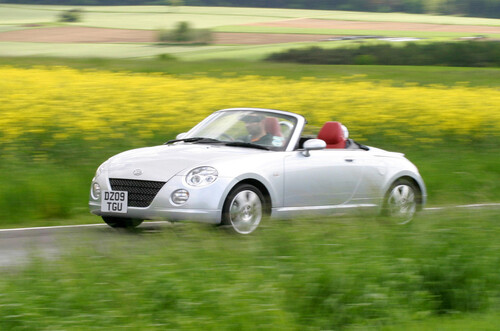
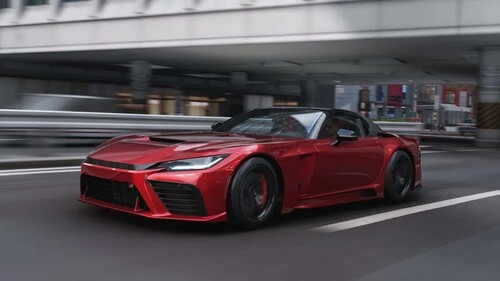
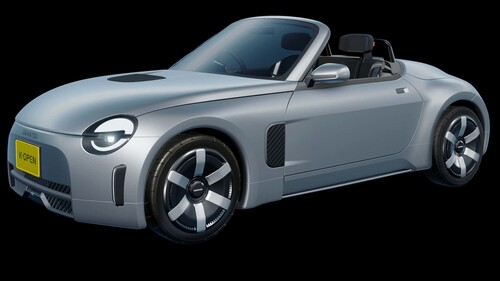
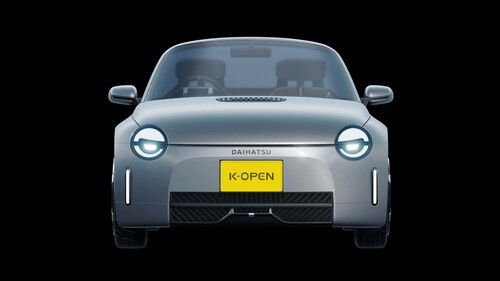
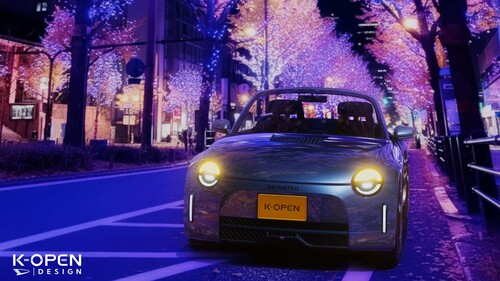
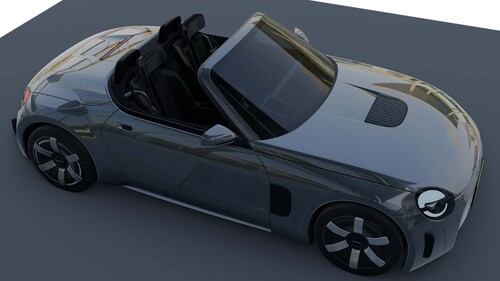
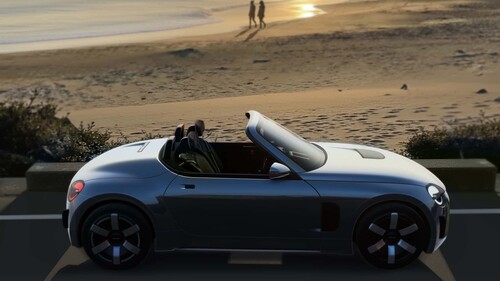
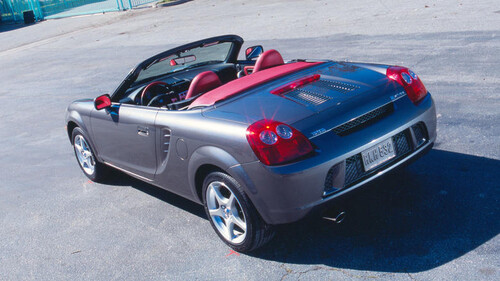
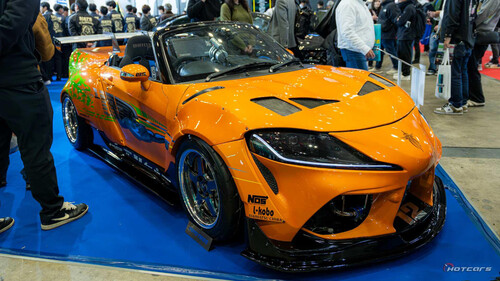
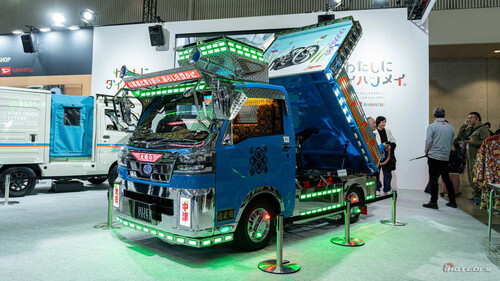
The new Daihatsu K-Open concept, seen here, will lend its rear-drive architecture to the next-gen Suzuki Cappuccino ultra-lightweight sports car.Photo by Peter LyonIn an automotive world obsessed with electric SUVs the size of studio apartments, Suzuki appears ready to remind enthusiasts that driving pleasure has little to do with horsepower—and everything to do with weight, balance and that wind-in-the-hair thrill factor.Nearly thirty years after the original 660-cc turbocharged 64hp ultra-lightweight Cappuccino disappeared from showrooms, the Japanese mini roadster looks poised for a dramatic comeback. Better still, it may be based on one of the most intriguing concepts shown at the 2025 Japan Mobility Show. That's right, Suzuki's next-gen compact rear-wheel-drive sports car is being developed alongside Daihatsu's prototype, a vehicle nicknamed the "K-Open" after its resemblance to the Daihatsu Copen.The original Cappuccino from 1991 was a cult heroSuzuki to team up with DaihatsuSo, if we break this story down into its most basic components—it is virtually impossible in today's market for one carmaker to design, build and sell a compact sports car. The numbers just don't work. In other words, Daihatsu by itself cannot launch its next-gen Copen and expect it to make a profit. Especially given that the upcoming model will not be sold in the U.S.AdvertisementAdvertisementIf we look at Mazda's compact MX-5, for example, just over 40% of all MX-5s produced (that's around 1.25M units) since 1989 were sold in North America, totaling just on 533,000 units. For the record, the Cappuccino was exported to certain European countries including the UK, Germany and France, but it only sold in small numbers. And given the introduction of the high profile electric Honda Super-N ultra-lightweight Kei-car launched in Europe recently, we can expect the new Cappuccino to land there as well.So, getting back to the crux of the story—the only way to make the numbers work for Daihatsu and generate a profit—according to page 7 of the August 26th edition of Japan's biggest-selling car magazine Best Car (which does not have an English language website)—is to share its rear-wheel-drive architecture with Suzuki and allow it to make an all-new Cappuccino, which of course means partnering up with not only Daihatsu, but its parent company Toyota as well.If production plans come together, the reborn Cappuccino could become one of the most affordable rear-wheel-drive sports cars on sale anywhere. Given that the new Copen—that could be named 'K-Open'—will hover at around $15,000, we expect the sportier and more highly tuned Cappuccino to rest in the $17,000 territory.And that's a refreshing proposition.Cult heroThe original Cappuccino, launched in 1991, became something of a cult hero, even though it only sold roughly 26,500 units over the next seven years. Tiny enough to qualify as a Japanese kei car, it weighed less than 730 kg, featured near-perfect 50:50 weight distribution and packed a turbocharged three-cylinder engine driving the rear wheels through a 5-speed manual gearbox.AdvertisementAdvertisementIts modest output of just 64 horsepower—Japan's kei-car limit—never mattered. Not when you weigh little more than three big Sumo wrestlers. The car's appeal lay in its willingness to entertain at low speeds.Today's performance cars often require at least 500 horsepower before anyone pays attention. The Cappuccino proved that fun begins long before triple-digit power figures kick in. The next-generation model looks set to embrace that philosophy again with a new take on that kei-car formula.Toyota S-FR concept revealed at the 2015 Tokyo Motor ShowToyota's inputAs mentioned above, Toyota already owns Daihatsu and holds a strategic stake in Suzuki, creating opportunities to spread development costs while keeping niche enthusiast cars financially viable.The biggest question surrounds the powertrain.AdvertisementAdvertisementCarview, Japan's most influential online and well-respected auto publication, reported in its July 3rd story (on its Japanese language website) that the new Cappuccino, in addition to employing the same rear-drive platform as the new Daihatsu Copen, should employ a revised version of Suzuki Jimny's turbocharged 660c 3-cylinder engine generating 64hp but with slightly beefed up torque for the Japanese market.To make the car more entertaining while making it appealing enough for discerning overseas buyers, and therefore convince Suzuki's beancounters that a new Cappuccino would be viable, one commentator close to Suzuki, has also suggested the the export model could employ the Jimny's 1.5-liter naturally aspirated 4-cylinder engine pumping out 100hp.Meanwhile Carscoops in 2025 suggested that Suzuki—to make the car profitable—may be looking to employ a revised version of the Toyota S-FR, a compact rear-drive 2-door concept which debuted at the 2015 Tokyo Motor Show. That roadster could be powered by a 1.3-liter naturally aspirated 4-cylinder engine pumping out 120-150 hp.Those numbers may not sound spectacular. But in a car expected to weigh well under 1800 lbs, however, they could deliver the sort of agility that increasingly heavy electric performance cars struggle to match.AdvertisementAdvertisementLightness has become something of a lost art.Every additional battery cell, safety system, turbo, bigger brake package, and luxury feature adds weight, making modern sports cars faster but often less involving. Suzuki has long excelled at extracting maximum enjoyment from minimal mass, and the Cappuccino would fit squarely within that tradition.The new Cappuccino will attract young buyersThe timing also feels surprisingly good. Mazda's MX-5 continues to prove there is still demand for compact roadsters, while Toyota's GR86 and Subaru BRZ demonstrate that affordable rear-wheel-drive sports cars can still find loyal buyers. What none of those cars offers is the sheer compactness that made the original Cappuccino so distinctive.That could become Suzuki's greatest competitive advantage.AdvertisementAdvertisementThe company has built its reputation not by chasing the highest horsepower figures, but by delivering modest power and clever engineering at attainable prices. If it can position the new Cappuccino below the MX-5 while retaining classic rear-wheel-drive dynamics, it could attract younger buyers priced out of today's increasingly expensive performance market.There is also a nostalgia factor working in Suzuki's favour.The original Cappuccino enjoys near-mythical status among enthusiasts, especially as Japanese domestic-market classics continue to rise in value worldwide. A modern interpretation that captures the spirit—rather than merely the styling—of the original could tap into both nostalgic buyers and an entirely new generation discovering lightweight sports cars for the first time.For Suzuki, the reborn Cappuccino would represent more than a new model. It would be a reminder that, even in an era dominated by electrification and software, the simple joy of driving still matters.This article was originally published on Forbes.com