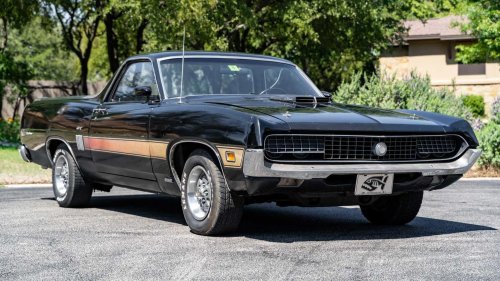
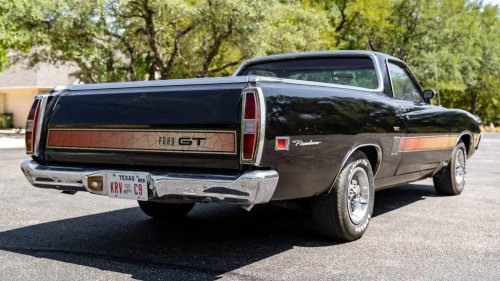
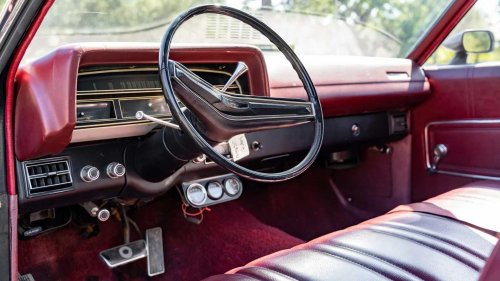
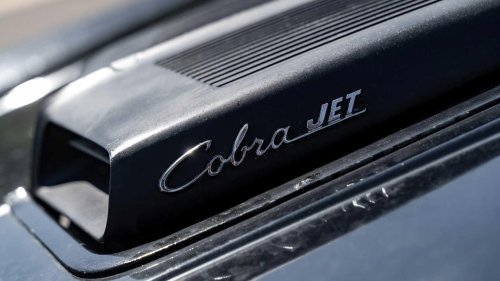
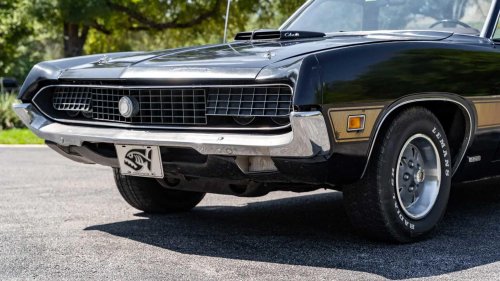
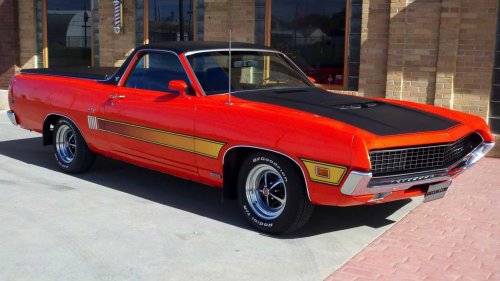
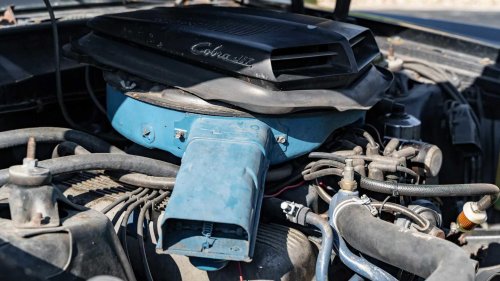
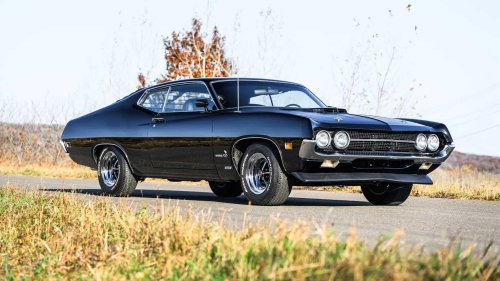



















During the '60s and '70s, Ford, like so many other automakers of the day, put out a number of incredible muscle car hits. However, these days, the Blue Oval is mostly remembered for the Mustang. The car commanded the spotlight (in its day and even now) because of appearances in films like Goldfinger and Bullit, just as much as because of what was under the hood. In becoming a symbol of American performance, the Mustang inevitably dominated Ford's narrative.And it's a shame – even though some of these other under-the-radar Fords – like the Fairlane, the Falcon, or even the Maverick – didn't command the same sort of enduring widespread appeal as the iconic pony car, they're just as deserving of your admiration. We thought hard about Ford's legacy of overlooked muscle cars, considering price as well as relative cultural importance, and we feel that we may have found the most underappreciated of them all. The Ranchero GT Is The Most Underrated Ford Muscle Car Ever Btring a Trailer While there are countless examples of underappreciated Ford models, we felt that the Ranchero GT ranked as the most underrated of them all. For one, it wasn’t even intended as a muscle car at the time of its debut; the Torino-based pickup hybrid was a workhorse first and foremost, and Ford turned it into a muscle car by way of a 429 Cobra Jet big block. What makes the Ranchero even more underappreciated, though, is that it actually predated the ever-popular El Camino. Inspired by the utility of the Ford, Chevy introduced its own competitor to capitalize on the market potential.Still, the Ranchero GT is an option worth your consideration -- especially in the case of the 1970-1971 model years. Between the bold coke bottle styling, the unique utility, and the purebred Ford performance (in the case of the 429-powered GTs), it's a muscle car through and through, even if it stands among the more unlikely candidates. For prospective buyers, at least, this means that you can pick one up for a relative bargain compared to other options from the golden era. A Muscle Car With Workhorse Origins Btring a Trailer Ford originally aimed the Ranchero at blue collar workers, marketing it as an innovative hybrid that combined the modernity of a car – highlighting things like comfort and style – with the light-duty hauling capabilities of a pickup truck. The Courier-based design was practical, but it offered the perfect compromise between work and play. Much like today's crossover trucks, Ford hoped to capitalize on the potential for utility; the Ranchero was to be a versatile vehicle that was wide-ranging in its appeal.Throughout the 1960s, however, the Ranchero gradually shook off its humble appearance and adopted more imposing facades with the Fairlane and the Torino platforms. As the coupe utility grew in size, so too did its engine options. Muscle car culture had the industry in its grasp, prompting manufacturers like Ford and Chevy to throw enormous V8s under the hood of cars like the Ranchero and the El Camino. With raw power, performance upgrades, and aggressive styling, the Ranchero broke free from its original workhorse intent, offering utility with an added dose of muscle car thrills. Living In The Shadow Of The El Camino Btring a Trailer Ford debuted the Ranchero in 1957, and Chevrolet followed up with its Brookwood-based El Camino just two years later in 1959. While Ford's coupe utility was the first to create the new class of vehicles, the Chevy proved to be considerably more popular during its day – especially once it ditched its station wagon underpinnings and adopted the Chevelle's good looks. Ford sold about half a million Rancheros over 23 years, while Chevy managed to do nearly double that with the El Camino during the same time.For many, it's the fact that going with the Chevelle allows you to getChevrolet's legendary LS6 at discounted El Camino prices. In fact, Hagerty ran an assessment just a few years back, giving each coupe utility a Hagerty Vehicle Rating based on a 0-100 scale. In considering vehicles insured with relation to auction activity and private sales, Hagerty determined that the third-generation El Camino was trending upwards at 83 while the Ranchero was sliding with a score of 50. In practice, this means that the Ford is trending downward, making it vastly underappreciated in today's market. The GT Offered Cobra Jet-Powered Performance Bring a TrailerFord Ranchero GT SpecsFord offered a variety of V8s in the Ranchero throughout its production, including the 260, the 289, the 302, the 351, the 428, and the 400, but the 429 was the cream of the crop from a performance standpoint. Available in Thunder Jet and Cobra Jet guise – just as it was in the Mustang and the Torino Cobra – the 7.0-liter engine produced anywhere from 360 to 375 horsepower and 450 lb-ft of torque. The thing is, Ford probably fudged the numbers a bit, and the Cobra Jet was making more like 400 ponies from the factory.Assuming you wanted to take your Ranchero to even greater horsepower heights, Ford would also sell you the Super Cobra Jet and Drag Pack options. Along with four-bolt mains, high-compression aluminum pistons, and a solid lifter camshaft, the SCJ added a 780 CFM Holley four-barrel and an external oil cooler. In other words, if the above Cobra Jet was under-advertised, Ford was definitely not giving the Super Cobra Jet enough credit. Though all 429s came standard with a Hurst-shifted T-10, the Drag Pack gave buyers the option of a Traction-Lok 3.91:1 or Detroit Locker 4.30:1 rear end.If you have to do a quick search, you'll find that real-world 429 Ranchero 0-60 mph times are few and far between. For this reason, let's consider the Torino. MotorTrend lists the 1970 Ranchero 429 at 3,446 lbs, while the Torino Cobra of the same year tips the scales at 3,586 lbs. Even assuming some numbers weren't crunched correctly, it's safe to say the two are fairly comparable. Considering the Torino Cobra will do 0-60 mph in 5.8 seconds and run the quarter in 13.99, we'd expect the Ranchero to be within spitting distance. Ranchero GT Engine Options Btring a Trailer For 1970 and 1971, Ford's engine offerings for the Ranchero differed slightly. Buyers had the option of the Thunder Jet, Cobra Jet, and Super Cobra Jet in 1970 The Thunder Jet and Drag Pack options were not offered in 1971 201 Ranchero GTs were built with the Cobra Jet in 1970 60 of those cars were equipped with the Drag Pack, two of which were Twisters Ford's Ranchero Remains A Cheaper El Camino Alternative Mecum Auctions When running the numbers, you’ll find that the 1970 Ranchero comes out a fair shake more affordable than an El Camino 454 of the same era – especially in the case of the LS6. Per Hagerty’s price tool for a ‘Good Condition’ car, the Ford will run you $17,300. By contrast, a 1970 El Camino with an LS6 is valued at $69,100; even assuming you’re willing to go for an LS5, there’s still a significant premium at $48,100. In fact, by Hagerty’s estimation, you could go for a concours condition Ranchero GT Super Cobra Jet and still spend comparably at $64,600.For 1970, Ford built some 21,640 Rancheros, with 3,905 of those being the 429-equipped GT. Chevrolet's numbers are a bit trickier to assess, given that they lumped A-body build figures together. In any case, of the 8,773 SS 454 El Caminos and Chevelles built in 1970, 4,298 had the LS5, and 4,475 featured the LS6 engine. We'd expect Chevelles to be the more popular option, but it still makes for an interesting point of comparison in light of Ford's relative bargain in the Ranchero. Ford Ranchero GT Vs. El Camino SS 454 Hagerty Values Btring a TrailerClassic.com, Hagerty Distinguishing Ranchero Characteristics Ford offered the Ranchero in several trims, but we're mostly concerned with the GT on account of its engine. Compared to the base and the 500 models, it boasted: A unique hood with an integrated scoop GT emblems and Chevrons Laser stripes Optional hidden headlamps, vinyl roof, and Magnum 500 wheels The Torino: Another Overlooked Ford Muscle Car Bring a TrailerFord Torino Cobra SpecsIf you like the look of the Ranchero from the front, but you're not exactly sold on the bed in the back, try the Torino. As the basis for Ford's coupe utility, it doesn't have the highly divisive mullet configuration. We didn't feel that it was quite as underrated as the Ranchero, but it's still overlooked in our estimation, even if rare Twister models are worth a fortune these days. And it's a shame because it could be a Ford hit just as much as the Mustang.In styling alone, the car was a standout from the era, combining bold lines, a muscular stance, and a modern coke bottle design. Beyond its good looks, the Torino also benefited from some serious numbers thanks to big blocks like the 429. Left up to us, we'd have one of the Cobra models, but even the Torino GT featured the potent 7.0-liter V8. As with the Ranchero, it advertised some 360 horsepower and 450 lb-ft of torque to keep the insurance companies happy. Torino Cobra Production Numbers For all of its appeal, the Torino Cobra did not prove to be the sales success Ford had hoped it would be. On the contrary, it actually turned out to be a poor seller compared to the more luxurious GT: Ford sold 7,675 Torino Cobras for 1970 compared to some 56,819 GTs 3,488 Cobras were equipped with the J-code RamAir system