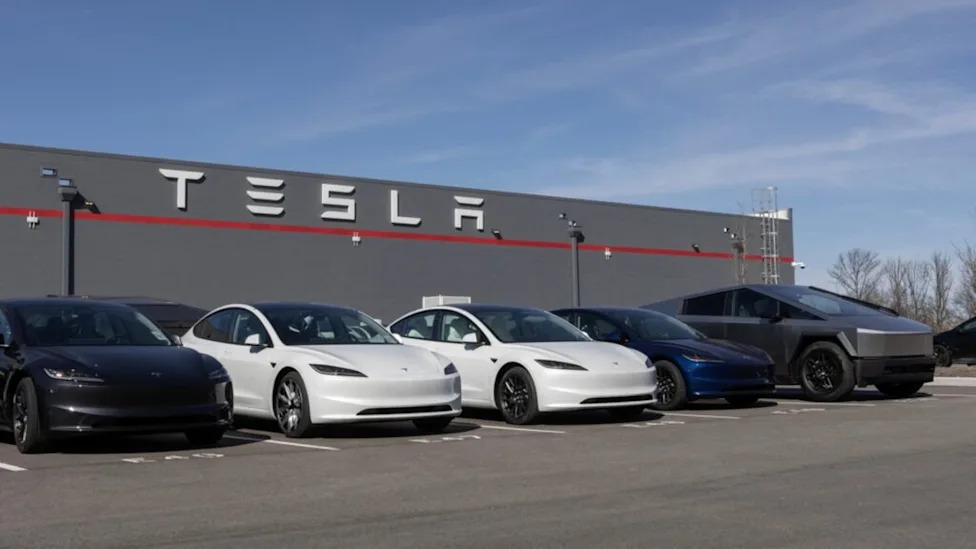
Tesla's Nearly 3 Million-Car China Recall: What It Means for the U.S. and the Rest of the WorldTesla is recalling nearly 3 million vehicles in China over an emergency-exit concern, while a second, overlapping campaign will update driver-attention monitoring on 2.74 million China-built Model 3 and Model Y vehicles. The announcement matters in the United States—but it does not mean a matching American recall has already been ordered.China's State Administration for Market Regulation, or SAMR, announced both actions on August 21, 2026. The first covers 2,975,910 vehicles whose mechanical emergency door releases may be difficult to identify and operate because they are close in color to the surrounding interior. The second covers 2,740,642 vehicles whose existing steering-wheel-based attention monitoring may not adequately warn a driver who looks away while combined driver assistance is active.Those figures should not be added together. The campaigns overlap heavily, so this is not a 5.7-million-vehicle recall. The primary source is SAMR's official recall notice.What China actually orderedThe door-release campaign, scheduled to begin September 25, includes:AdvertisementAdvertisement973,156 China-built Model 3 vehicles produced from March 4, 2019, through April 29, 2026;1,956,713 China-built Model Y vehicles produced from November 16, 2020, through April 30, 2026;35,590 imported Model 3 vehicles produced from August 22, 2018, through November 20, 2019;8,328 imported Model X vehicles produced from October 27, 2022, through February 13, 2026; and2,123 imported Model S vehicles produced from January 18, 2023, through February 10, 2026.SAMR says the problem emerges in an extreme event such as a severe crash that disables the vehicle's low-voltage electrical system. If occupants or rescuers cannot quickly recognize and operate the mechanical release, evacuation or rescue could be delayed.The remedy has both physical and software components. Tesla will apply warning labels to affected releases and deliver an over-the-air update that adds a post-crash window-lowering strategy. Vehicles already carrying the label will not need another one.The second campaign starts immediately and covers 2,740,642 China-built Model 3 and Model Y vehicles produced from March 4, 2019, through December 7, 2025. SAMR says the current attention-monitoring mechanism may fail to provide an adequate eyes-off-road warning while assisted steering is engaged as part of a combined driver-assistance system. The update will add cabin-camera monitoring to the existing steering-wheel torque check. Cars that cannot receive the update over the air will be handled through Tesla service centers.Why the door issue deserves U.S. attentionThe door campaign is the more important new signal for American owners because it concerns basic emergency egress and covers both Shanghai-built and imported vehicles. The inclusion of imported Model S, Model X and older Model 3 vehicles indicates that the Chinese regulator's concern is not limited to a single factory.AdvertisementAdvertisementThere is also an active American investigation in the same broad problem area. NHTSA opened Preliminary Evaluation PE25-010 in September 2025 after receiving nine complaints that exterior electronic door handles on model-year 2021 Model Y vehicles became inoperative when low-voltage battery power was insufficient. Four owners reported breaking a window to regain access, according to the official NHTSA opening resume.That investigation is not the same defect described by China. NHTSA is examining exterior re-entry after a low-voltage failure; SAMR is addressing the visibility and usability of interior mechanical releases after a severe crash. Still, both matters focus on what happens when Tesla's electrically operated doors lose low-voltage power. That overlap makes the Chinese filing highly relevant evidence for U.S. regulators.How likely is a matching U.S. recall?For the door-release concern: an exact U.S. recall is plausible, but not yet certain. The strongest near-term likelihood is additional NHTSA scrutiny rather than an immediate copy of China's order. U.S. regulators must first determine whether American-market vehicles use a substantially similar release, interior trim and crash-response strategy, and whether the condition constitutes a safety defect or a failure to comply with a federal standard.Federal reporting rules should force that comparison into the open. NHTSA says manufacturers must report a foreign safety recall within five working days when an identical or substantially similar vehicle is sold or offered for sale in the United States. The filing must identify the similar U.S. model and explain why a U.S. recall was not conducted, if one was not. That requirement is described on NHTSA's Foreign Recalls and Campaigns page.AdvertisementAdvertisementThe practical takeaway is that the next decisive document may be either a foreign-campaign filing explaining why U.S. vehicles differ, or a Part 573 safety-recall report covering American vehicles. Until one of those appears, claims that a U.S. recall is guaranteed—or impossible—go beyond the available record.For the driver-attention update: the United States has already traveled much of this road. In December 2023, Tesla recalled 2,031,220 U.S. vehicles under NHTSA campaign 23V-838 because Autosteer's controls might not be sufficient to prevent misuse. The affected population covered model-year 2012-2023 Model S, 2016-2023 Model X, 2017-2023 Model 3 and 2020-2023 Model Y vehicles equipped with Autosteer. Tesla's remedy added controls and alerts through an over-the-air update, according to the official Part 573 recall report.NHTSA did not close the book there. In April 2024 the agency opened Recall Query RQ24-009 to examine the effectiveness of that remedy, including the role of the cabin camera, after identifying post-remedy crashes and concerns about whether parts of the update could be reversed or controlled by the driver. The agency's official information request lays out the investigation.Because a broad U.S. Autosteer recall already exists, a second American campaign matching China vehicle-for-vehicle is less likely than a supplemental remedy, expanded population or software revision. Newer U.S. vehicles outside the original 2023 production cutoff remain the group to watch. Market-specific software and regulatory requirements may also explain why China's new campaign extends through December 2025.What this means worldwideChina's action does not automatically trigger recalls in Europe, the United Kingdom, Canada, Australia or other markets. Each regulator will compare the affected components, production dates, software and local safety rules. But the scale and cross-factory vehicle mix make it difficult to treat the door issue as a purely local anomaly.AdvertisementAdvertisementThe driver-monitoring campaign also lands as international rules for Level 2 assistance become more specific. United Nations Regulation No. 171, developed by the UNECE World Forum for Harmonization of Vehicle Regulations, entered into force in September 2024. It defines safety and performance requirements for driver-control assistance systems while emphasizing that the driver must continuously monitor the road and system. UNECE's official summary of Regulation No. 171 explains that framework.Markets applying UNECE-type approval rules may therefore focus on whether torque sensing alone provides adequate driver-availability monitoring, whether the cabin camera is active across relevant modes, and whether a remedy already deployed elsewhere should be harmonized. Regulators may reach different answers because the enabled features and software packages are not identical in every country.The remedies also show both the strength and limitation of software-defined vehicles. Camera monitoring and post-crash window behavior can be distributed quickly over the air, but the emergency-release warning label still requires a physical change. Owners of vehicles that cannot receive the software must be contacted and serviced conventionally.What U.S. Tesla owners should do nowDo not assume the Chinese campaign applies to a U.S. VIN. No matching U.S. door-release recall had been announced as of August 24, 2026.Check the vehicle's VIN through NHTSA's official recall lookup and recheck as foreign-campaign filings are processed.Keep the vehicle's software current, especially if it is included in the 23V-838 Autosteer recall.Review the owner's manual and make sure regular passengers know where the mechanical emergency releases are located before an emergency occurs.Report a door-power or egress failure to NHTSA. Complaints are one of the inputs the agency uses to identify defect trends.AdvertisementAdvertisementThe bottom line: China's attention-monitoring action partly parallels a U.S. recall that is already under a remedy-effectiveness investigation. The emergency-door campaign is the genuinely new development for America. A matching U.S. recall is not inevitable, but the combination of a nearly 3 million-vehicle foreign campaign, U.S.-built vehicles in the Chinese population and an existing NHTSA door investigation makes further American regulatory action a real possibility.Source note: All linked citations in this article are primary materials from China's State Administration for Market Regulation, the U.S. National Highway Traffic Safety Administration or the United Nations Economic Commission for Europe. No competing news reports were used.


















 +3 others