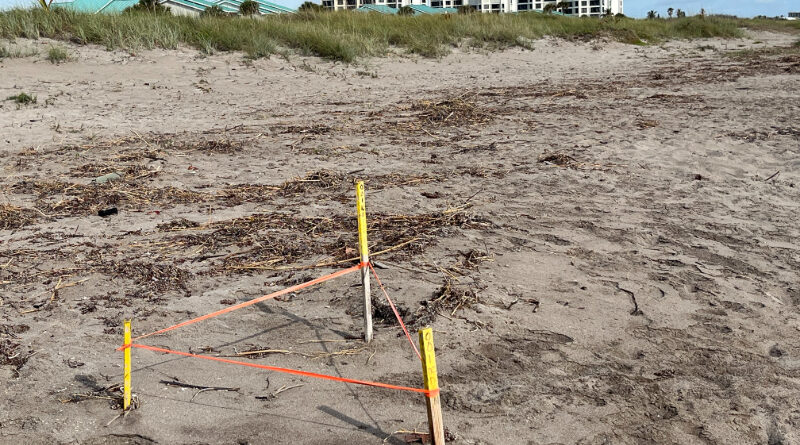


















In my flat Florida community I all-too-often see people exercising with a podcast playing in their ears. Earbuds allow non-stop entertainment, of course. I get that. It assuages boredom. Then again, listening to others’ thoughts removes us from awareness of the world around us. How do we enhance our ability to be more in tune with nature? We need to isolate our stimuli, to invite even the briefest interactions with nature. Then we’ll enjoy its restoration benefits. This is a week that celebrates the largest secular global holiday, Earth Day. My own private commemoration means I walk the beach, slowly and methodically, appreciating nature around me. Earbuds left back at home, I am making a conscious effort to slow my thinking and to experience the important world beyond my usual way of knowing my world. As I walk, I feel the humid breezes and touch the moist sand between my toes, yet I am doing more than indulging: I am becoming more conscious of the crucial role humans play in our planetary life. I am practicing mindfulness. Mindfulness is the practice of purposely focusing our attention on the present moment — and accepting it with patience and without judgment. We focus and relax, deliberately paying attention to thoughts and sensations. We work to achieve a state of alert. The rejuvenative nature of mindfulness helps us to gain insights into the small moments of life. It makes us think beyond immediate positive reinforcement and can lead us along paths to become more in touch with the gifts around us. There is a lot of jargon floating around these days about mindfulness. Sanctuary. Abundance. A core community heartbeat. Outdoor meditations. Embodied awareness. Can such elusive concepts actually be a prescription for mind-body connections? Many people like me set the mindfulness jargon aside and, instead, focus on connecting with nature. We breathe more deeply, listen more intently, and, through an intentional process, become restored by the wondrous beauty that surrounds us. Nature becomes our teacher, a mirror to invite reflection as humans in a complex world. Mindfulness on this mild spring morning invites me to rediscover joy, wisdom, and marvel. It does not come easily to me; I must work to immerse myself in the moment. The rewards are worth it. I pass one woman, who is sitting languidly on her beach chair, watching me stoop to pick up litter that has washed in with the tide. I cross paths with a woman who has a very full bag of refuse. “There is a bag of litter to be picked up every day here,” she mutters briefly and continues her downward scan. I see four-wheeler tracks sunken into the sand, and I know that the morning patrol has been here, looking for evidence of sea turtle nesting. It’s early in the season for eggs, but we have to protect these ancient creatures in every way we can. I think about the lives of marine animals who might have ingested these pieces of human production, how sea turtles struggle to withstand the impacts of plastics. Plastic can cause physical damage to their intestines, lead to blockages, or trick the turtles into feeling full when they are not — all of which can cause sea turtles to become sick or even to die. I am drawn to think about the inter-relationships among humans, physical forces, and ecosystems. I am conscious of the healing and stimulating effects that emerge through direct or indirect nature exposure. This contact with nature enhances my well-being through what’s known as “augmented” or “directed” attention. It takes effort and my conscious participation. It’s hard work! The restorative capacity of natural settings arises from their fascinating nature, which captures attention and encourages interpretation and investigation. Nature nurtures us, particularly when aligned with each of our individual preferences, interests, or objectives. There is a wrack line of sargassum at the high watermark. While it’s thick in that area, it’s more diffuse below. I’ve read the headlines about the difficulty many communities have in removing it from their summer beaches. We are lucky here that the open sea and high tides mix with the sand and strengthen rather than destabilize our beach — at least for now. I see pieces of dead coral on the beach. The dead coral and the sargassum make me think about the warming climate. I’m keenly conscious that building resilience in the face of the planetary climate emergency depends on more than my individual rejection of earbuds: it takes societal transformation towards sustainability. Yes, reducing emissions requires individual changes on our parts but also vast and collective behavioral society transformations. But mindfulness can be an awakening, a starting point, so that our individual psychological well-being becomes influenced by how we see the natural environment. We start to become cognitively supportive of a net zero life through this non-evaluative process. The sun‘s rays are thinner than usual this morning, projecting some rain. But I continue to feel the sun‘s piercing warmth. The reminder hovers that our subtropical climate will soon become increasingly more humid and hot beyond our daily comfort. It is then that we become much like our southern neighbors, with shadowy naps in the heat of the afternoon, but also extreme and devastating storms. On this spring day, though, the forecast is merely for occasional showers and thunderstorms. Many neighbors seem concerned that their pickleball and tennis competitions will be disrupted by the incoming weather. To me, I look up at the dune, still somewhat parched from the early February freeze, and I feel hope for more returning green sprouts. I feel the cool wash of the tide on my feet, and I am refreshed. It looks like a blue gray green color palette in front of me, yet I know that the ocean is much more than that. There are hundreds and thousands of life forms under the surface. The low roar of the surf is constant and rhythmic and will continue on well passed my morning walk. As the surf recedes, little bubbles pop on the sand’s surface, feeding and replenishing crabs and other creatures who live immediately below the surface. It is this hidden life that is so compelling. It is not just sights to which I am more alert as I walk this Sunday morning without entertainment in my ears. In my attempt to reject earbuds and be mindful, I slow down to recognize my sensory perceptions: sights, sounds, smells, tastes, and touches. I hear a small plane overhead, and I wonder about its passengers, their lives and destinations, and the trail of burnt fuel the plane emits. I see a small group of brown pelicans, flying along the shoreline, diving and rising and floating along the offshore surf channels, seeking out their daily caloric needs. They have an endurance that is not common to humans — at least to we Westerners. Their lives are based in the lowest levels of Blooms taxonomy: to survive. As someone who summered on Cape Cod to self-finance my college education, I relish the aroma of low tide and vergence of sea oats and seaweeds. It is a marker of the growth that takes place in the enormous ocean, without which our planet would certainly warm beyond levels. Earth would be unhabitable for humans without the ocean’s gifts. I feel at peace as I head toward the crossover and away from the beach. I am infused with a feeling that life is good, that I can make a difference. Through my intentional mindfulness, I’ve increased more metacognitive awareness. I’ve read that I’m not alone in this benefit: by being mindful, I have integrated aspects of well-being, positive mental health, and psychological resilience into my mind map. We have to draw upon our psychological and cognitive processes so we enhance our well-being. It can spark meaning-making and, possibly, eventually, spur us to participate in sustainable action and climate adaptation. Resources “Into the wild or into the library? Perceived restorativeness of natural and built environments.” Marta Stragà, et al. Journal of Environmental Psychology. 2023. “Mindfulness and connectedness to nature: A meta-analytic investigation.” N.S. Schutte & J.M. Malouff. Personality and Individual Differences. 2018. “Psychological resilience to climate change: The role of self-efficacy, mindfulness, perceived nature, restorativeness, and subjective well-being.” Anastasia Gkargkavouzi and George E. Halkos. Sustainable Development. October 2025.