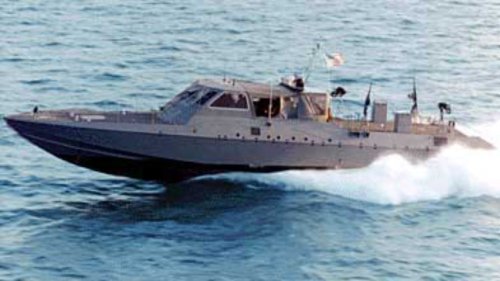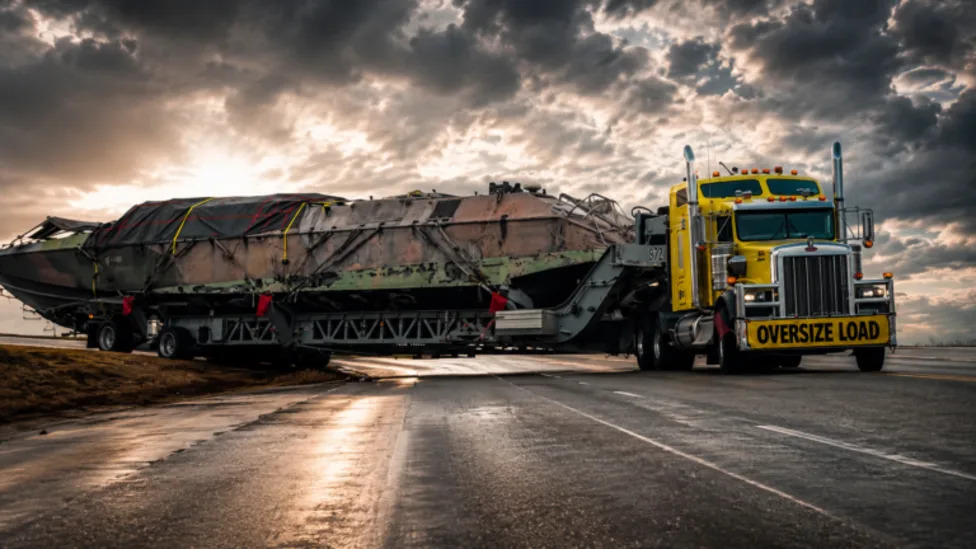



















$1 Million Navy SEAL War Machine Hauled Across America After It Sat in Virginia for 15 YearsThe Mark V Special Operations Craft is not a boat you stumble across at a marina. The Navy commissioned 20 of them at a unit cost of $3.7 million each.The type was retired in 2015, replaced by the Combatant Craft Assault, Combatant Craft Medium, and Combatant Craft Heavy.Most were disposed of. Only a handful survived. And one of them had been sitting on a trailer in Williamsburg, Virginia for roughly 15 years – covered in lichen, wheels deep in the Virginia clay – until the team at P45 Equipment showed up with a truck, a mechanic named Chris, and a plan to drive it 1,200 miles to Northern Michigan.AdvertisementAdvertisementThe Mark V SOC is an 82-foot, 52-plus-ton vessel that operated as a medium-range insertion and extraction platform for special operations forces. It carries up to sixteen fully equipped SEALs on missions 500 miles from base.Twin MTU 12-cylinder turbodiesel engines deliver enough combined output to push the hull past 50 knots, with power routed through four KaMeWa waterjet drives.Its angled profile gives it a low radar signature.The Navy used it to sneak SEALs into hostile coastlines at midnight. Now P45 Equipment had to sneak it out of Virginia before Tuesday – because Michigan frost laws were coming into effect, and they were already behind schedule.Getting a War Machine Off the Ground FirstBefore the Mark V could go anywhere, the team had to deal with the transport truck that came with it. The rig had been sitting untouched for nine years, and it took a round of replacement batteries to get it started.AdvertisementAdvertisementA seized starter Bendix, a missing ECM fuse, and a shifter that had welded itself shut from years of inactivity – the team eventually coaxed it to life by hammering directly on the starter to break the Bendix loose and spraying brake cleaner into the intake. Not the approved method. But effective.The auxiliary power unit on the trailer had its own ideas. The fuel lines had been disconnected and the fuel filter was packed with ice.A trip to the auto parts store sorted that. Then came the bigger problem: the remote control for the trailer's steerable rear axles was missing, and at 82 feet long and 18 feet wide, the rig needed those axles to make any meaningful turn. The team wired a makeshift toggle switch directly into the relay box to restore steering control.The Mark V was originally designed to be loaded onto a USAF C-5 Galaxy and deployed anywhere in the world within 48 hours – moving it down public American highways with improvised controls and a missing remote was considerably less elegant.AdvertisementAdvertisementDay two brought more fixes before the convoy could leave: rotted wooden bunks on the trailer had allowed the keel to sink directly onto the frame, requiring the boat to be jacked up and shimmed before any highway miles. With permits, pilot cars, and police escorts already lined up, the pressure to move was real.The journey through Pennsylvania turned into the kind of driving footage that makes CDL instructors age ten years in real time. Narrow double-yellow mountain roads through Latrobe required the pilot cars to shut down both lanes of traffic so the 18-foot-wide load could occupy the full road. Two back-to-back 90-degree turns, a bridge that the height pole clipped on the approach, and a school bus that required a full stop in the middle of an intersection – all of it negotiated at roughly jogging speed.Only 12 Left in the World, and P45 Has OneOhio brought a new problem.Things got hairy navigating tight mountain roads, and a pothole on an on-ramp snapped a tie rod on the trailer's steering axle.AdvertisementAdvertisementThe team sourced a replacement – a Dodge tie rod end, as it turned out – from a local auto parts store and got the repair done roadside in under an hour. Michigan's frost law deadline meant there was no margin to slow down. Those seasonal weight restrictions, which go into effect when the frozen ground begins to thaw and roads lose load-bearing strength, were set to kick in at 6 p.m. the next day. The convoy crossed the Ohio-Michigan border with enough daylight left to push a few miles past the state line before stopping for the weekend.The final push on Tuesday – roughly 240 miles of Michigan two-lane roads, a police escort through Lansing, and a hard 6 p.m. cutoff – came together. The Mark V rolled into its new home in Charlevoix, Michigan, doors closed, trip over."I've been eyeballing the Mark V since I probably saw the first one online and read about it when I was 16," the P45 owner said. "It's been a dream of mine to get one since then."The restoration plan involves servicing the twin MTU diesels – P45 Equipment is performing a comprehensive restoration that includes full mechanical inspection of the MTU twin-turbo diesel engines and the KaMeWa waterjet propulsion systems.AdvertisementAdvertisementEach oil change on those motors takes roughly 55 gallons. "I think this proves that nothing's too big for us," the owner laughed. The goal is to have the boat in the water for testing by early May, with a sandblast and repaint before then.With only 20 ever built and most now gone, the P45 team claims there are around a dozen Mark Vs left in existence. One of them now sits in a building in Northern Michigan, waiting to run again.The vessel will be offered for sale upon completion of restoration, which means whoever buys it will get a fully operational, million-dollar Navy SEAL insertion craft. Probably the world's most capable vessel for sneaking up on a sandbar.