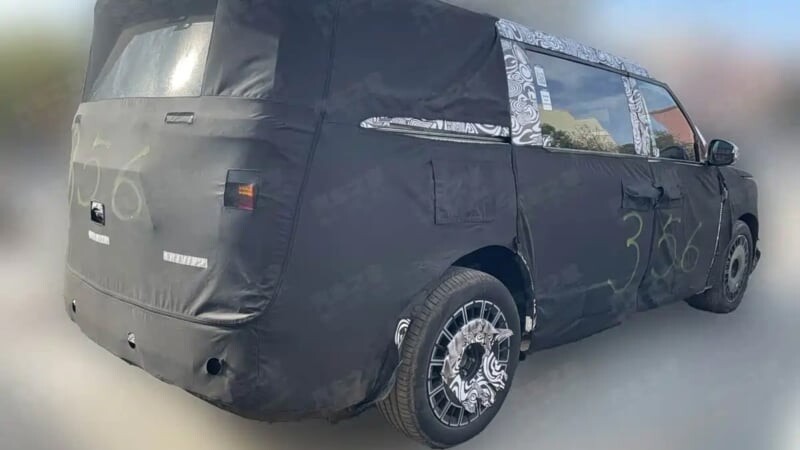
Andrew Davidson of Kent Survival started with a Renault Twizy, an electric quadricycle measuring 2.34 meters long and 1.24 meters wide, and asked whether it could double as overnight shelter. Secondary reporting from TechEBlog indicates the conversion succeeded on those terms, though the more honest assessment requires a closer look at the numbers. A Vehicle Built to Minimum Specification Renault's documentation confirms the Twizy's dimensions, weight, and storage figures, and each one underscores how constrained the project really is. Image: Kent Survival via Youtube Renault's own brochure puts the Twizy at 1.45 meters tall and 474 kilograms at kerb weight, battery included. Its upward-opening doors swing to a height of approximately 1.82 to 1.98 meters, which is among the more striking details of a vehicle this compact. The build Davidson used appears to be a Cargo configuration, according to TechEBlog's reporting, though that trim detail is unconfirmed. Where a standard Twizy offers roughly 31 liters of rear storage, the Cargo variant's lockable rear compartment reaches up to 180 liters depending on specification; these are not interchangeable figures. One Seat Out, One Night In Seat removal is the project's defining modification, and its reversibility is the clearest signal of what this conversion actually is. Davidson's core modification is straightforward: remove the driver's seat to create a continuous interior surface for a sleeping mat. The cabin becomes a shelter, and the floor becomes a bed. According to TechEBlog's reporting of the project, the arrangement is a reversible hack rather than a permanent build. The seat must be returned before the vehicle goes back on the road, which is the most accurate indication of what this project represents. Image: Kent Survival via Youtube Where the Battery Becomes the Constraint The Twizy's 6.1 kWh lithium-ion pack was sized for lightweight urban mobility, not for powering a campsite. The pack powers a motor producing up to 13 kW, or roughly 17 horsepower, and supports a claimed range of up to 62 miles under test conditions. It charges from a standard three-pin outlet in approximately 3.5 hours. A separate portable power station could cover lights or small electronics overnight, but it would compete directly with the already limited payload and sleeping space. In the Cargo configuration, the rear compartment reaches up to 180 liters; camping essentials like bedding, clothing, food, and cooking equipment still present a genuine packing problem in a vehicle this small. What the Experiment Actually Proves The Twizy demonstrates that overnight shelter is possible at the absolute minimum scale of a road-legal electric vehicle, not that the result is practical. The Twizy can keep a person sheltered for a night. It cannot replicate the practicality of a conventional camper van, and the conversion makes no serious claim that it does. The project's value is conceptual: it locates an extreme lower bound for vehicle-based camping in a road-legal electric quadricycle. That boundary turns out to be surprisingly low. A Claim Without Certification The "world's smallest car camper" description comes from published reporting, not from an independent certifying body. Davidson's build has been described as the world's smallest car camper. No certification from an independent body was located in the available reporting, so the phrase should be read as a descriptive characterization rather than an established title. What is verifiable is simpler. This is a 2.34-meter electric quadricycle, adapted with a removable seat and a sleeping mat, in which someone spent a night.

 Liked by Liam Smith, Hannah Moreau















 Liked by Liam Smith, Hannah Moreau