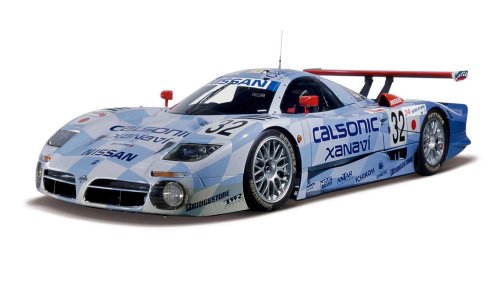
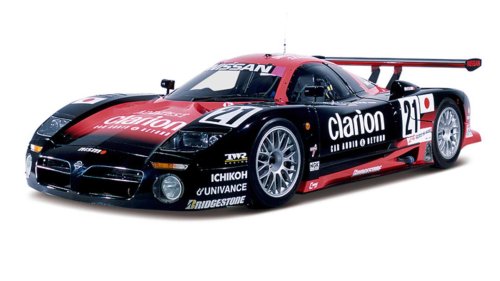
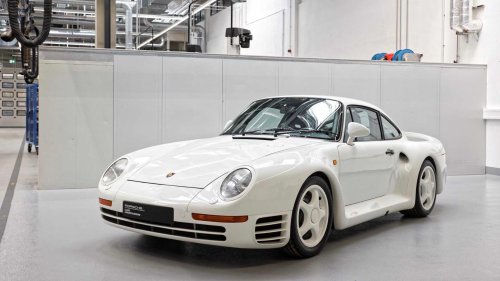
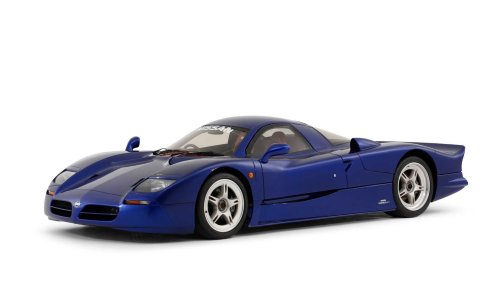
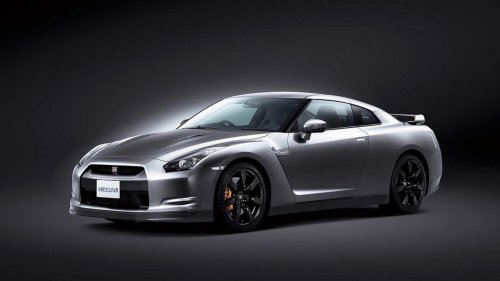



















Japan has created some amazing performance engines over the years. Toyota's 2JZ GTE springs to mind, which became a tuning icon through the mighty Supra. Mazda also made the rotary engine legendary through its successes at Le Mans and the subsequent street-car thrills. Meanwhile, Nissan can also be proud of its redoubtable RB26DETT, which became inseparable from the Skyline GT-R. And the Yokohama-based company should have had another road-car icon to lean on, with this one powered by an entirely different engine altogether.In this case, the company had created a 3.5-liter twin-turbo V8 to power its R390 GT1 entry at Le Mans, and the VRH35L even had a road-going pilot car built around it. But unlike Porsche, which showed what can happen when translating race-engine credibility into successful road-going form, Nissan dropped the ball. Nissan Had The Engine For A Supercar Legend Nissan HeritageNissan’s VRH35L was not a production engine waiting for the company's styling department to find it a home. Instead, the company purpose-built this unit for competition use on the R390 GT1. This was a time, in the late 1990s, when manufacturers could stretch grand touring rules to make barely disguised prototype machines. And the company’s dramatic-looking result turned out to be one of its most successful racing ventures ever.The R390 GT1 had the looks of a genuine endurance racing exotic, but the real story was sitting behind the cabin. Here, the VRH35L was a 3.5-liter DOHC V8 with twin turbochargers that, under the full 1997 racing specification, produced more than 640 horsepower and 521 lb-ft of torque. There was even a slight increase in power output for 1998 aboard the long-tailed version of the GT1.Armed with such a potent engine, many people thought Nissan would create a new iconic road car in its wake. After all, the VRH35 didn't lack authenticity, and other automakers would ordinarily spend years developing that kind of powerplant for a new road car. So, it's strange to see that Nissan restricted this engine to its most exotic competition program, before quietly letting it fade into specialist memory. The R390 Proved The V8 At Le Mans Nissan Global To satisfy homologation requirements in the late 1990s, manufacturers had to meet certain standards, but in this heady GT1 era, the line between road cars and racing prototypes was unusually thin. Competition was also strong, with Porsche fielding its 911 GT1, Mercedes its CLK GTR, and Toyota its GT-One. And against that opposition, Nissan decided to enter the fight with its R390 GT1.To make its entry as competitive as possible, Nissan teamed up with Tom Walkinshaw Racing and other big names from the sports car world. The resulting machine made it crystal clear that Nissan was chasing outright credibility at Le Mans and not simply making up the numbers. The 1997 R390 GT1 weighed in at around 2,200 lbs and came with an Xtrac six-speed transmission, with power going to the rear wheels.For Nissan, success came in the form of a third overall finish at the 1998 24 Hours of Le Mans. Crucially, however, all four R390 GT1 entries finished in the top ten at the end of that race. That showed that the R390 GT1 was no fragile prototype, and that a third-place finish was no fluke. Instead, Nissan had put forward a credible works effort, securing the company's best-ever Le Mans finish at that point.Nissan proved that the VRH35L engine wasn't just a high-output unit with an impressive dyno sheet. When fitted to the GT1 car, this engine finished Le Mans, one of the toughest endurance races in the world, and put its manufacturer on the overall podium. Many manufacturers would love to have had that type of result with a race-proven engine in the midst of a dramatic supercar, with real endurance racing results as well. But rather than capitalize on those achievements in the road car world, Nissan simply turned the other way. Porsche Shows Why That Kind Of Engine Story Matters Porsche Other manufacturers have been able to fully cash in on their racing success, with Porsche and its 959 serving as a very clear example. Of course, the 959 was not the same type of car as the R390 GT1, and it did not come from the same rulebook. But it still showed how valuable success in racing engines can be for a manufacturer looking to move forward with an iconic road car.The 959 was a landmark, with its 2.8-liter sequential twin-turbo flat-six engine directly based on the successful 956 and 962 racing engine programs. This was one of the German company's greatest periods in endurance racing, and Porsche, unlike Nissan, decided to turn its race-engineering expertise into a technological flagship for the road. The resulting 959 was far more than just a fast 911 derivative. The vehicle showed what this company could do when it really doubled down on its racing knowledge. And the project also showed what can happen when cost and complexity don't necessarily drive decisions, but instead, ambition can rule the day.Nissan could have taken some of its serious racing hardware and turned the best parts of the R390 GT1 into a public-facing halo car. It had full Le Mans credibility, and due to the homologation rules, a road version already existed, albeit in rudimentary form. But Nissan never built the equivalent mythology. Nissan Built The Road Car, Then Barely Let It Exist Nissan Heritage If a manufacturer wanted to enter a machine into the GT class at Le Mans, it had to be based on a car that could be driven on public roads. This gave rise to the R390 GT1 road car, but only so Nissan could obtain official type approval for its race efforts. Nissan would never go on to market the GT1 road car, and as it was extremely rare, rumors suggest it could have been worth more than ¥100 million (or $670,000). It shared the same VRH35L 3.5-liter V8 engine as the race car, with official output listed at 345 hp and 361 lb-ft of torque. It also came with a six-speed sequential transmission and, with that detuned version of the race engine, had all the ingredients for a truly extraordinary production car. The GT-R Became Nissan's Different Answer Nissan Nissan eventually went on to build a modern performance legend in the form of the R35 GT-R, but it would not follow the R390's mid-engined, race-car-derived supercar path. Instead, Nissan chose a front-midship layout, a dual-clutch transmission, all-wheel drive, and, crucially, the VR38DETT twin-turbo V6.Each engine came out of a clean-room environment at the company's engine plant and was built by hand, but Nissan wasn't leaning on a Le Mans engine storyline. Instead, it wanted a modern interpretation of performance with launch traction, durability, and repeatable speed. As it turned out, that approach may have been the smarter choice. After all, a mid-engined R390 successor could have been more limited in its appeal, very expensive, and therefore difficult to justify. Instead, the GT-R was a different type of performance icon, preserving the GT-R name while being a more usable performance weapon for a broader audience. Nissan's Missed Opportunity Bring A Trailer The VRH35L is a bit of a forgotten hero today, mostly because Nissan never gave it the public-facing road car story it really deserved. The company decided not to seize this supercar moment and kept the engine in its lane, never expanding beyond homologation necessity or heritage collection fascination. Meanwhile, Porsche did quite the opposite, turning its endurance-racing credibility into a strong piece of brand mythology. And people certainly remember the 959 and the way it transferred Porsche's racing knowledge into a highly successful road car story.In the final analysis, Nissan simply lacked the commitment to turn its R390 GT1 into a credible and lasting halo car. Instead, the GT-R would eventually become Nissan's modern performance icon, even if the VRH35 deserved far more input into that conversation.Sources: Nissan, Toyota.