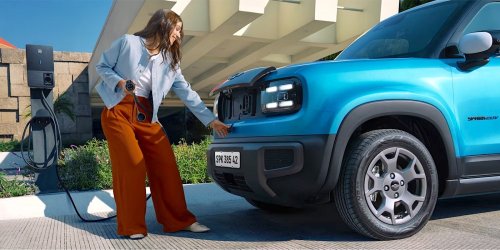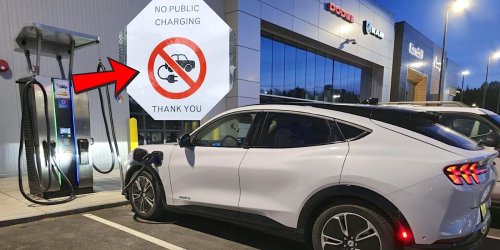




















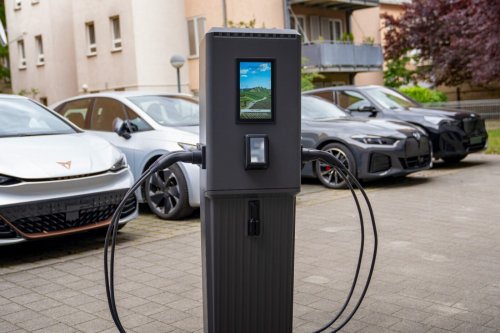

Despite all the gloom and doom following the premature death of the federal EV tax credit last fall, signs of an EV sales rebound continue to surface in the beleaguered US market. Vigorous activity in the public EV charging space also signals confidence in the future, but it’s not just a matter of growing the number of charging stations. Quality is also improving in the area of charging facilities for EVs only, shutting the door on gasmobiles. Rangeway EV Charging Stations: No Welcome Mat for Gasmobiles The California startup Rangeway offers one example of the new focus on quality. Instead of staking out unshaded, unwelcoming territory on the fringes of parking lots, the company is building spaces dedicated to the EV driving experience. The company launched its pre-seed funding effort last year, pitching a hospitality-focused strategy that leverages scenic highways and destinations for a suite of four different EV charging facilities. The options include Trailhead sheltered stations, fully enclosed lounge-style Waystation and Basecamp facilities, and a boutique motel experience with off-grid charging and modular rooms for overnight stays. In the meantime, Rangeway also assembled a technology team to support reliable service in disparate locations, including the driver assistance platform ChargeMate, the charging station reliability monitoring specialist WattsUp, the vision ID and payments firm Juice Serve, and the California energy firm Hywatts. “HyWatts provides modular Power-Plant-in-a-Box™ systems that integrate solar generation, advanced battery storage, and hydrogen-ready power modules. These turnkey solutions enable Rangeway to serve grid-constrained locations where traditional charging infrastructure would be impractical,” Rangeway explained. If you’re thinking green hydrogen is in play, well, maybe. As described by HyWatts, the Power-Plant-in-a-Box includes an integrated electrolysis and fuel cell system that deploys solar energy to push hydrogen from water, which can be stored for later use to produce electricity. If that rings a bell, you may be thinking of the Extreme E branch of Formula E racing, which has helicoptered a similar, transportable green hydrogen EV charging system into remote locations for its off-grid events. “There are incredible destinations along scenic corridors that lack the grid infrastructure for reliable fast charging. HyWatts changes that equation,” explained HyWatts CBO and co-founder Sam Ruben in a press statement last November. More EV Charging Stations For…Missouri? In the latest development, last month Rangeway announced that it has selected the St. Louis, Missouri area as a focus of it initial efforts. Politically speaking, Missouri seems an unlikely spot for a new charging station startup to pitch its tent. However, looks can be deceiving. Take the Southeast auto market, for example. Despite its red-state politics, Florida climbed into the #2 position for EV sales as of last year. What happens in Florida doesn’t stay in Florida as thousands of “snowbirds” decamp for cooler climates in the summer, so it’s no surprise to see charging stakeholders follow the money into the whole region. “The Southeast is one of the most dynamic EV charging markets in the country,” the President of the charging firm Kempower North America, Monil Malhotra, observed last October. Missouri occupies a different region of the US, located in the Midwest and bordered mainly by Illinois, Kansas, and Iowa alongside slivers of Nebraska and Oklahoma. The southern part of the state also bumps up against the Southeast states of Arkansas, Kentucky, and Tennessee. The state didn’t make things easier for EV sales when it began charging EVs an annual fee of $150 for passenger cars, which is scheduled to increase over the years. Still, St. Louis Mayor Lyda Krewson emerged as a vehicle electrification advocate upon election back in 2017, and she stepped up the city’s commitment in 2021 when she ordered electrification of the entire city fleet. Auto dealers in St. Louis have also noted that, while Missouri is not among the strongest states in EV sales, it is doing better than states at the other end of the scale. They draw attention to the growing number of EV charging stations in the state, with station density highest in St. Louis among other cities. Another sign of continuing EV interest in Missouri is local utility Ameren, which offers reduced rates for off-peak EV charging among other uses. The company has also pointed out that the average EV driver saves up to $1,300 per year on fuel and saves about 50% on maintenance costs over the life of the vehicle, offsetting the state’s EV fee many times over. Yes, Missouri All of the above helps explain why Rangeway has focused like a thousand points of light on locations in the St. Louis metro area. Stepping up its relationship with the sustainable building firm LoüTeq, in June Rangeway announced the formation of Rangeway St. Louis, a joint venture between itself and the builder. “The venture combines Rangeway’s hospitality-driven network model with LoüTeq’s sustainable building expertise to deliver Rangeway’s premium driver experience across the region,” Rangeway explains. As part of the arrangement, LoüTeq founder and CEO Luke Schuette takes up the post of Director of Design and Construction at Rangeway. “Luke has been working with us since the beginning,” Rangeway founder and CEO Zak Winnick explained in a press statement. “He thinks about hospitality-driven EV charging the same way we do, as a design and experience problem rather than an infrastructure problem.” Rangeway describes the St. Louis market as “one of the country’s most strategically located metropolitan areas,” so keep an eye out for the announcement of specific locations soon. They better act fast. The IONNA charging station consortium launched a generally similar plan in 2024, with a lounge-style aesthetic appealing to retro, mid-century modern tastes and a business model that embraces out-of-town EV excursions. The consortium currently lists the automakers BMW, GM, Honda, Hyundai, Kia, Mercedes-Benz, Stellantis, and Toyota among its members. While IONNA launched with a focus on standalone facilities catering exclusively to EV drivers, the company has also developed a branding strategy, aimed at integrating IONNA-branded charging stations into gasmobile locations. In April, the company announced a partnership with the sprawling Circle K empire. Under the brand “Rechargeries @ Circle K,” the plan calls for IONNA to take over and convert existing charging stations at 85 or so Circle K sites in the US, while also adding new stations at high-traffic Circle K sites that have been charger-less. IONNA expects Rechargeries @ Circle K to achieve initial startup later this year, with scaleup to follow in 2027. Image: What war on EVs? The EV charging station startup Rangeway is drawing lessons from the hospitality industry with a focus on attractive, standalone EV-only facilities (cropped, courtesy of Rangeway).