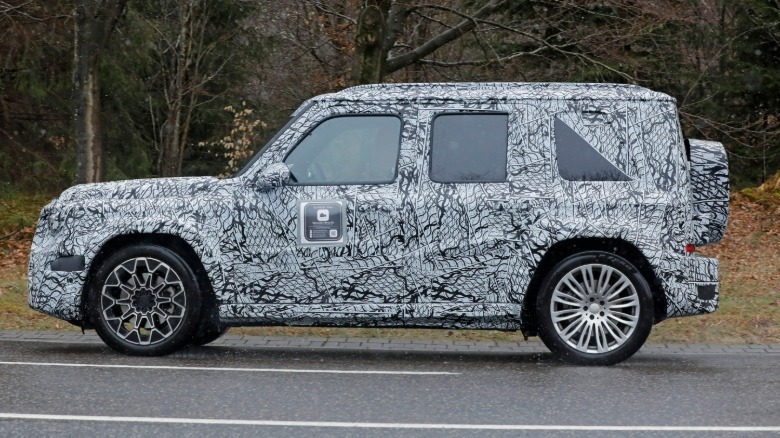
Mercedes' W17 has become harder to drive with upgrades Mercedes Technical Director James Allison has admitted the latter-season upgrades that the team introduced have triggered unexpected side effects to arise on its 2026 car. The Brackley-based squad romped to a championship double this year, clinching both titles over consecutive weekends in Mexico and Brazil with three races still remaining. Mercedes reveals vices from W17 upgrades However, Mercedes’ ninth Constructors’ crown has been largely indebted to a dominant beginning to the campaign, when it won all but one of the first seven rounds. Since the summer break, the chasing pack have reduced Mercedes’ initial advantage, culminating in the Silver Arrows only claiming four victories from the past nine races. Mercedes attempted to respond to rivals’ advances with a sizeable upgrade package in Sepang, but the changes to the W17 didn’t deliver the anticipated step, prompting the team to revert George Russell to the old-spec car at the subsequent race in Singapore. And while a revised front wing in Austin helped Kimi Antonelli to take a huge stride towards a maiden Drivers’ title, Mercedes boss Toto Wolff explained that Russell’s continued struggles were linked to the updates narrowing the car’s operating window. “We see this variability in results,” he began. “When we land the car in the way that suits him, he’s absolutely fast. But when it drops out of that operational window, he struggles, and he struggles more than maybe Kimi. And that is on us. “We just have to work it out with him, how there can be such a difference in performance, because George is not half a second slower, three-tenths slower than Kimi. It’s just absolutely not the case. “So what is it that he doesn’t like? What is it that we need to do in terms of modifying the car, setting it up in a different way for him to go fast? Because it’s all there: the intelligence, the ability, the determination.” Lewis Hamilton to miss Las Vegas Grand Prix FP1 as Ferrari junior steps in Williams targets ‘fundamental’ problems with F1 2027 car design That appeared to impact both drivers last time out in Brazil, as Antonelli and Russell complained about balance problems with their cars after suffering separate spins. Following the race at Interlagos – where the team still recaptured the Constructors’ Championship despite neither driver finishing on the podium for the first time all season – Allison divulged that Mercedes’ recent developments have improved the car’s overall performance ceiling but at the cost of the W17 becoming more challenging to drive. “Our final step of performance, our so-called ‘Update 18’, the thing we brought to the Sepang track and then followed up with the front wing in America… it has given us more downforce, but it has made the car more of a handful,” he conceded. “It’s got some areas where it has subtracted a bit of performance that we were not expecting.” Allison has contended that Mercedes’ superiority through the opening events owed a great deal to his credence that it was the sole team – at least among those at the front – to start Formula 1’s new rules cycle with a car operating at the minimum weight limit. Red Bull, notably, opened the campaign vastly above the 768-kilogram threshold, but since shedding excess weight from the RB22, the side has become a perennial fixture at the sharp end once more, with Max Verstappen winning three of the last five races. “We were also probably the only car on the weight limit at the start of the year,” Allison added. “All the folk we were competing with in the championship had a bit of timber to shift, and that was lap time that came to them that wasn’t available to us because we were already skinny and on the limit with the weight.”


 Liked by Daniel Walker, Matthew Gagnon







 Liked by Daniel Walker, Matthew Gagnon