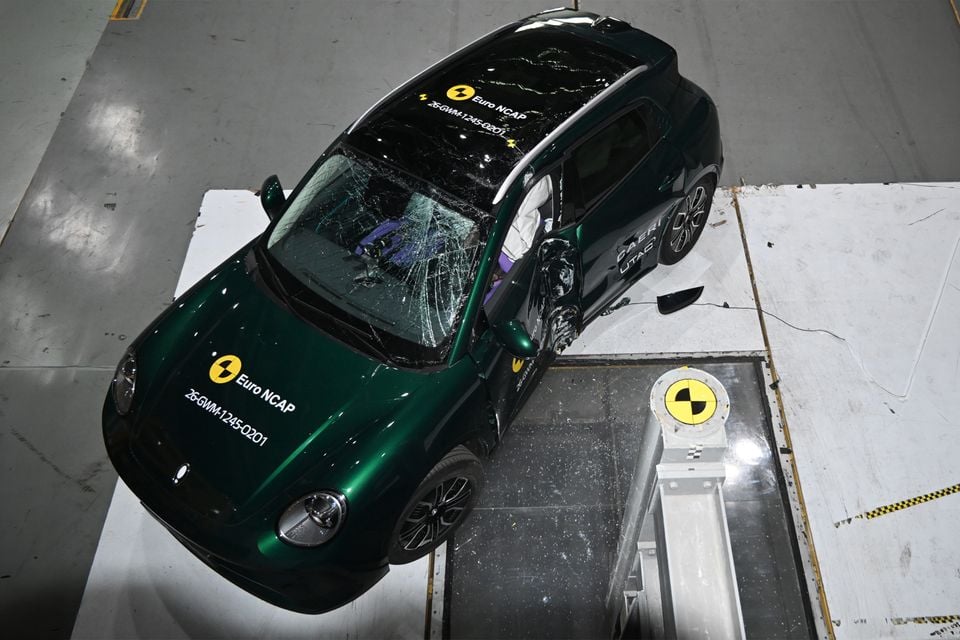
The latest European vehicle safety results have delivered an uncomfortable comparison for Nissan. The redesigned Leaf earned four stars in Euro NCAP's newest crash-test assessments, while nine competing SUVs achieved the maximum five-star rating. Released on November 18, 2026, the findings highlight significant differences in collision protection, accident prevention technology, and safety equipment across the automotive industry. The results are particularly notable because the Leaf performed well in several areas but lost valuable points for missing standard safety features. Meanwhile, vehicles from BMW, Mercedes-Benz, Škoda, Kia, GWM, and China's emerging Lepas brand demonstrated how manufacturers are adapting to tougher European safety requirements. For drivers and families comparing new vehicles, the results reveal why seemingly small engineering decisions can make a substantial difference. Nissan Leaf Earns Four Stars Despite Solid Crash Protection The Nissan Leaf received a four-star rating under Euro NCAP's revised 2026 testing system, making it the only vehicle in the latest group of ten to miss the top rating. Its results included 78% for Crash Protection, 85% for Post Crash Safety, 59% for Safe Driving, and 58% for Crash Avoidance. Although those scores reveal areas needing improvement, they also demonstrate that the electric vehicle provides meaningful protection in several important categories. Euro NCAP tested the European-market Leaf Engage+ equipped with a 75-kWh battery. The organization described its overall performance as creditable, with particularly encouraging results for certain occupant protection and emergency response measures. The Leaf automatically applies its brakes after a collision to reduce the risk of another impact and includes an advanced emergency calling system capable of communicating information to responders. Its four-star rating therefore reflects a combination of strengths and shortcomings rather than a complete failure of its safety engineering. Missing Safety Technology Proves Costly for Nissan The Leaf's biggest weakness was Crash Avoidance, where its 58% result trailed every five-star SUV in the latest assessments. Euro NCAP identified the absence of standard front corner radar sensors as a major disadvantage. Without those sensors, the tested vehicle performed poorly in several scenarios involving traffic crossing its path. Such situations can arise at busy intersections, where detecting an approaching car or motorcycle early enough to intervene can be particularly important. Additional deductions came from occupant protection technology. A centre airbag, designed to reduce contact between front occupants during a side collision, is optional rather than standard and was not assessed. Crash-test measurements also indicated marginal protection for the driver's chest in frontal impacts, while some pedestrian pelvis and upper-leg results were weak or poor. Nevertheless, the Leaf received full points for its use of physical controls and driver acceptance of its lane support system. Its speed assistance also correctly identified posted limits in 80% of cases during an approximately 2,000-kilometre European test drive. Those strengths make the result more nuanced than the headline rating alone suggests. Škoda Peaq Sets a New Benchmark With 94% Crash Protection The electric Škoda Peaq delivered the most impressive crash-protection performance in the November assessments. It achieved 94% in Crash Protection, the highest score recorded by any vehicle evaluated under Euro NCAP's 2026 testing standards. The SUV earned maximum points across the principal frontal and side collision tests, including full-width frontal impacts, offset frontal collisions, side-barrier impacts, and the demanding side-pole assessment. A standard centre airbag contributed to its strong performance by helping protect occupants from striking one another during a collision. The Peaq also achieved 78% for Crash Avoidance, 65% for Safe Driving, and 92% for Post Crash Safety. Its safety equipment includes cyclist dooring warnings and effective speed assistance, while the design of its physical driving and infotainment controls received full marks. However, the vehicle does not include child-presence detection or monitoring that recognizes occupants sitting in unusual positions. Even with those omissions, the Peaq demonstrates how careful body structure design, effective restraints, and modern collision-prevention technology can combine to deliver exceptional protection. Mercedes-Benz GLE Leads in Accident Prevention Technology The Mercedes-Benz GLE emerged as one of the strongest all-round performers, securing five stars and leading the latest group in two important categories. It achieved 74% for Safe Driving and 87% for Crash Avoidance, along with 90% for Crash Protection and 92% for Post Crash Safety. These results are particularly significant because Euro NCAP confirmed that the diesel-powered GLE already satisfies the requirements for a five-star rating under its more demanding 2027 standards. The GLE demonstrated particularly effective lane support and responses to vulnerable road users, including pedestrians and cyclists. Its occupant monitoring recognizes seatbelt misuse and passenger size, helping its restraint systems account for different occupants. The vehicle also performed strongly in side-impact testing, with a centre airbag providing effective head protection. However, testing identified adequate rather than good protection for the driver's chest in one frontal collision scenario, alongside weaknesses involving cyclist head impacts. The findings show that even among high-performing luxury vehicles, opportunities for safety improvements remain. BMW X5 Impresses With 97% Speed-Limit Recognition by Distance The BMW X5 distinguished itself through the effectiveness of its speed assistance technology. During an extensive European road test covering approximately 2,000 kilometres, its system correctly identified posted speed limits in 91% of observed cases, representing 97% of the total distance travelled. That performance addresses an important concern surrounding modern driver assistance systems: inaccurate speed-limit recognition can produce unnecessary warnings and reduce driver confidence in the technology. The X5 demonstrated how sophisticated electronic assistance can operate more reliably in everyday driving conditions. Its broader results were equally encouraging, with 71% for Safe Driving, 85% for Crash Avoidance, 87% for Crash Protection, and 92% for Post Crash Safety. The tested diesel-powered model performed well in challenging intersection scenarios and featured a system capable of preventing a door from opening when an approaching cyclist is detected. Still, Euro NCAP identified marginal chest protection for the driver in one frontal test and for a rear passenger in another, along with poor pedestrian pelvis protection. The result illustrates why strong electronic assistance must be accompanied by continued improvements in physical crash protection. GWM ORA 5 and H7 Both Secure Five-Star Ratings Chinese manufacturer Great Wall Motor placed two vehicles among the five-star performers: the electric GWM ORA 5 and the hybrid GWM H7. The smaller ORA 5 achieved 91% for Crash Protection and 92% for Post Crash Safety, alongside 70% for Safe Driving and 71% for Crash Avoidance. Its performance was particularly impressive in pedestrian impact testing, where it earned maximum points for pelvis and leg protection. The vehicle also includes a centre airbag and child-presence detection technology, demonstrating considerable attention to occupant safety. The larger GWM H7 delivered a similarly balanced result, earning 69% for Safe Driving, 76% for Crash Avoidance, 88% for Crash Protection, and 90% for Post Crash Safety. Its lane support system, side-impact protection, and child-presence detection all received strong evaluations. However, testers identified marginal protection for the driver's feet and ankles during a frontal offset impact, as well as concerns involving rear-passenger chest protection. The ORA 5 also lost points in some crossing-traffic emergency braking scenarios. Together, the vehicles demonstrate how Chinese manufacturers are achieving top European safety ratings while still facing detailed scrutiny of individual safety systems. Kia Seltos Earns Five Stars but Reveals Some Important Weaknesses The Kia Seltos secured a five-star rating, demonstrating that smaller SUVs can deliver competitive safety performance under Europe's tougher assessment standards. The tested gasoline-powered model achieved 67% for Safe Driving, 71% for Crash Avoidance, 84% for Crash Protection, and 90% for Post Crash Safety. One of its strongest features was occupant monitoring. The Seltos received full points for recognizing incorrect seatbelt use, identifying occupant size, and detecting when someone is sitting in an unusual position, such as a front passenger resting their feet on the dashboard. Those capabilities can help safety systems respond more appropriately to the people travelling inside the vehicle. However, the Seltos was not without shortcomings. Crash testing identified weak chest protection for the front passenger in an offset frontal collision, while pedestrian pelvis protection was particularly disappointing, scoring just 5% in that specific assessment. The vehicle also lacks child-presence detection. On the positive side, its speed assistance correctly identified road limits in 87% of cases, covering 94% of the distance driven during testing. The overall result represents a strong safety achievement, although the detailed findings leave Kia with several areas to improve. Three Lepas SUVs Deliver Five-Star Results for Chinese Automaker Chery Lepas, a newer automotive brand within China's Chery group, achieved five-star ratings for three SUVs: the electric L4, electric L6, and plug-in hybrid L8. The L4 recorded 90% for Crash Protection and 84% for Crash Avoidance, demonstrating particularly good performance in frontal and side impacts as well as challenging automatic emergency braking scenarios. Its overall scores also included 64% for Safe Driving and 92% for Post Crash Safety. However, the vehicle lost points for pedestrian femur protection and the behaviour of its lane assistance system. The L6 and L8 PHEV each achieved 62% for Safe Driving, 78% for Crash Avoidance, 87% for Crash Protection, and an impressive 95% for Post Crash Safety, the highest result in that category among the newly assessed vehicles. The L8's evaluation was largely based on testing of the structurally related L6 and L6 PHEV rather than an entirely separate series of crash tests. Euro NCAP also identified weaknesses involving occupant classification, seatbelt misuse detection, and child-presence monitoring requirements. Nevertheless, three five-star results in one release represent a notable achievement for Chery's expanding portfolio of automotive brands. Tougher European Tests Raise the Stakes for Nissan and Other Automakers The November results reflect a major transformation in how Euro NCAP evaluates modern vehicles. Beginning in 2026, the organization introduced its largest overhaul of safety assessment procedures since 2009. Vehicles are now evaluated across four separate stages: Safe Driving, Crash Avoidance, Crash Protection, and Post Crash Safety. The updated tests place greater emphasis on everyday hazards, including distracted driving, intersection collisions, vulnerable road users, and the challenges emergency responders face after serious accidents. Manufacturers must therefore demonstrate more than a strong passenger compartment to achieve the highest ratings. For Nissan, the Leaf's four-star result highlights the importance of making advanced safety equipment standard rather than optional. Its performance is respectable in several categories, but the nine five-star results show that competitors are meeting a higher overall benchmark. The distinction matters for Canadian consumers as well, although European ratings should not automatically be treated as identical to Canadian-market assessments, since equipment and vehicle specifications can differ. Euro NCAP also cautions against direct comparisons between vehicles of substantially different sizes and weights. Ultimately, the latest findings reinforce a broader lesson: vehicle safety increasingly depends on how effectively manufacturers combine crash protection, collision avoidance, occupant monitoring, and emergency response technology.


 Liked by Gabriel White, Nicole Poirier

















 Liked by Gabriel White, Nicole Poirier