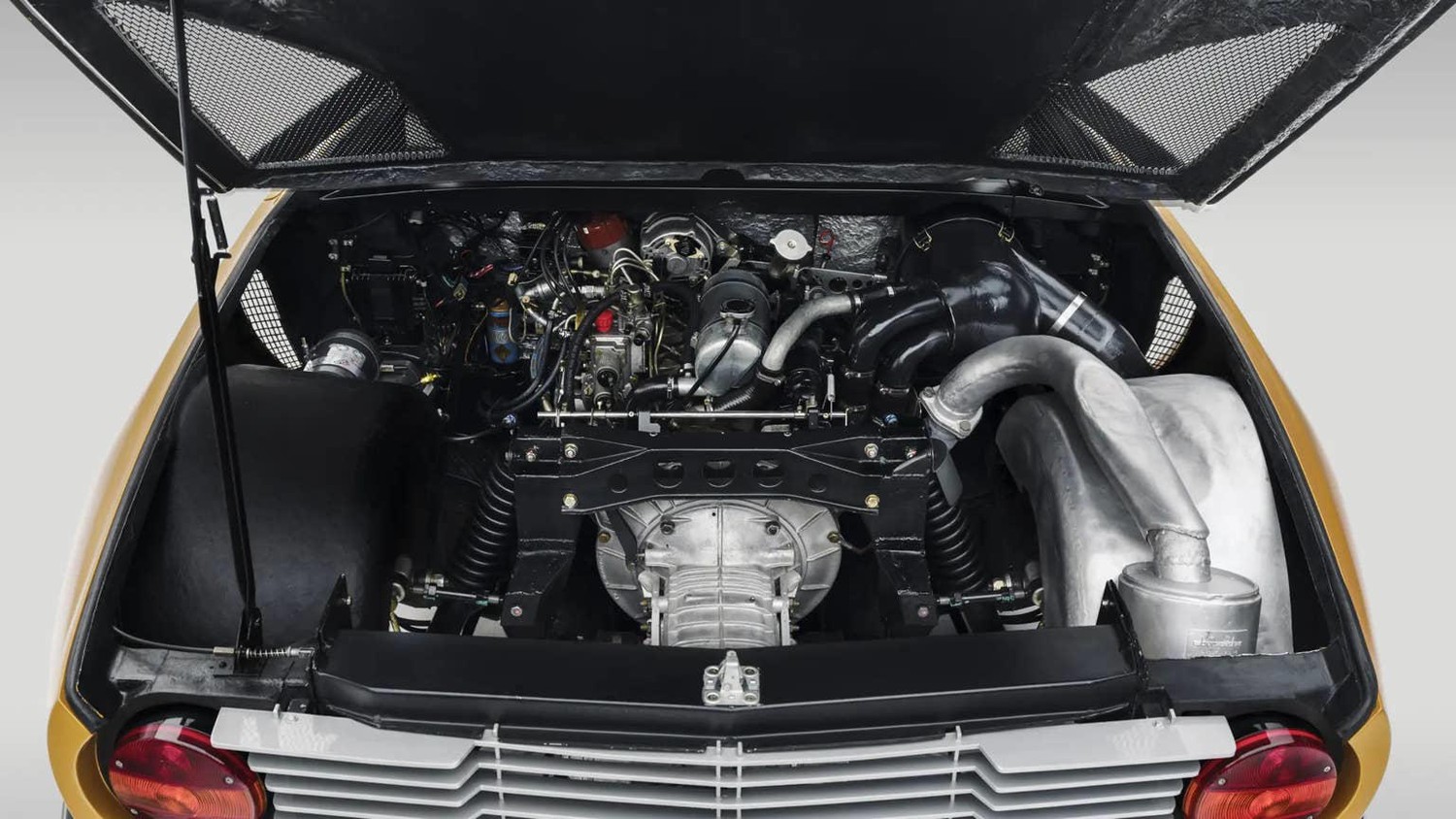
“Is that a new prototype?” asked the bartender at the Mercedes-Benz dealership in midtown Manhattan. He was pointing to a sleek and bright orange supercar with gullwing doors that could indeed be a forthcoming model. But instead it was a 1970 C111, car number 33, one of just 16 built, and equipped with a then-revolutionary 2.4-liter four-rotor Wankel rotary engine, connected to a five-speed ZF manual transmission, that produced 350 horsepower. Mercedes has until now retained ownership of all of the C111 experimental cars, first seen in Frankfurt in 1969, including examples powered by diesel and V8 gas engines. The cars set speed records in their day—a C111 reached 210 mph at the Nardö Ring in 1978. And they were admired by celebrity passengers such as conductor Herbert von Karajan of the Berlin Philharmonic and the crew of Apollo 14. For the first time, Mercedes is selling a C111, at an RM Sotheby’s auction in Paris on February 3, 2027, accompanying the big annual Rétromobile show. That show launched a beachhead in New York this week, which is one of the reasons for the November 17 New York press event. The C111 is expected to bring “in excess of €25 million,” said Gord Duff, president of RM Sotheby’s. Marcus Breitschwerdt, CEO of Mercedes-Benz Heritage, said the sale will benefit Museum 2.0, an expansion of the company’s Stuttgart facility that includes a digital tour. “The C111 is an icon, sure enough,” Breitschwerdt said. “The model has been captivating people since 1969. For half a century it’s been an absolute dream car.” He said the museum receives a million visitors a year, and needs to add extra galleries to display more recent classics. Car 33 took up residence in the museum in 2006, and was shown at Pebble Beach in 2024. The flawlessly restored (also in 2024) two-seater dream car was at the New York press event, its gullwing doors open to expose what looked like a production-ready interior, complete with grey and white houndstooth-pattern seats and vertically mounted Becker Europa cassette stereo. Car 33 is the second car in the second series, also known as C111-II. No other C111 will be sold for at least 25 years, Breitschwerdt said. Of the original 16, 13 are still extant. Car 33 was capable of 300 kilometers per hour (186 mph), and reached 62 mph in 4.8 seconds. With bodywork in bonded and riveted fiberglass-reinforced plastic, it weighed just 2,733 pounds. The gullwing doors could be said to be a nod to the 300 SL, but in fact they were a technical necessity because the wide sills were used to house a pair of balanced gas tanks. The C111, and especially this example of the longer-wheelbase second version, is sexy, which may explain its appearance in the first edition of German Playboy in 1972. Dennis Heck, head of collections at the Stuttgart museum, said the company had been looking to build a rear mid-engine sports car since 1965, and since it also secured the rights to the Wankel engine the C111 was born. A huge computer was employed, he said, shortening the development time for this new model to 2.5 years. The so-called father of the C111 was Rudolf Uhlenhaut, then head of passenger car development, who personally took part in testing the car. In fact, he celebrated his birthday with coffee and cake while sitting in the car trackside at Hockenheim. The C111s were frequently at race tracks for high-speed record tests, but were never raced. Another car recently de-acquisitioned from the Mercedes museum was also associated with the charismatic executive, the 1955 300 SLR Uhlenhaut Coupe, sold for a record-breaking $142 million in Stuttgart circa 2022. There might have been a production version of the C111, but the Wankel’s high fuel consumption during a time of gas-price anxiety ultimately doomed the motor once seen as Mercedes’ future of mobility. Mazda thought otherwise, and the rest is history. Car 33 has just 10,000 miles on its odometer, and Breitschwerdt said he hoped the new owner would actually take it out and use it. Recent videos shown at the press event had it rounding a test track with gusto. Jim Motavalli is an auto writer and author (nine books) who contributes to Autoweek and Barron’s Mansion Global. He has written two books on electric cars, Forward Drive (2000) and High Voltage (2010), and hosts the Plugging In podcast. Motavalli’s writing has appeared in the New York Times, CBS Moneywatch, Car Talk at NPR, Forbes, US News and World Report, Sierra Magazine, Audubon, and many more. In his spare time, he reviews books and jazz.