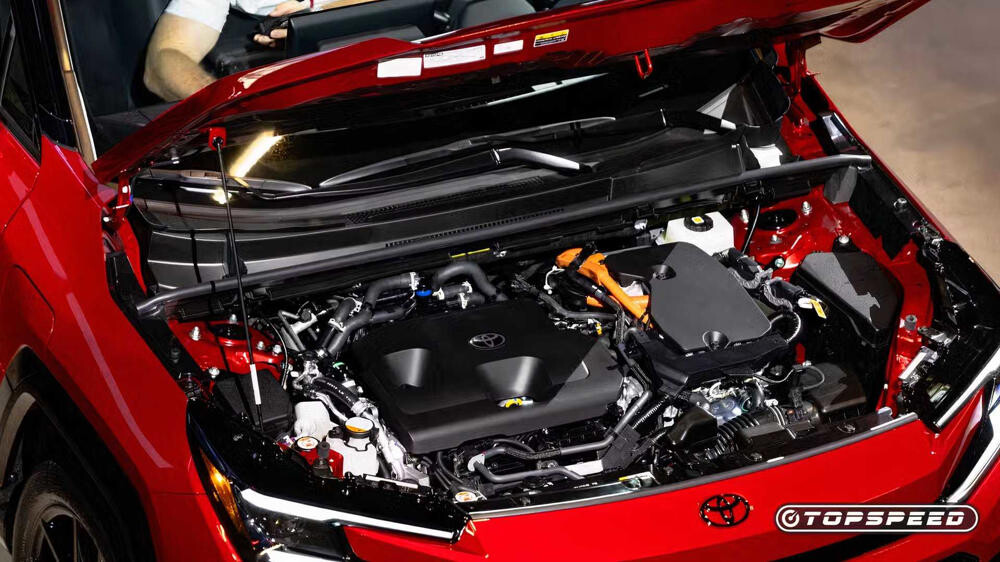
Continuously Variable Transmissions (CVTs) are not “gearboxes”, since they don’t have any gears, and this is the secret to their efficiency. The CVT was, in fact, invented by an American in 1879; Milton Reeves used it in his sawmilling plant, and before the turn of the century, he had started building automobiles using this transmission. The CVT only really saw mass adoption in the late ’50s in the Dutch DAF 600 (below) and today, they’re commonplace, especially among Japanese brands, with the exception of Mazda, who has been sticking to its Skyactiv-Drive automatic transmissions, which are tradtional planetary automatics with a torque converter. Some older JDM Mazdas such as the Demio and Axela were offered with belt-and-pulley CVTs, but no Mazda officially sold in the U.S. ever had a CVT. Jinba Ittai Has Kept CVTs Out of Mazdas for Years Mazda’s Jinbai Ittai engineering ideal can be translated as “horse and rider as one”, and Mazda cars have always been known to have an intimate connection with the driver. They are fun to drive, with carefully tuned suspension systems and the availability of manual transmissions in several of its models.It developed its 6-speed Skyactiv-Drive automatic transmission in-house in the 2010s, and it features a wide range of torque converter lockup in all six gears to give it the crisp and immediate type of torque transmission that you’d normally expect from a manual. Conversely, CVTs tend to exhibit a rubber-band or slipping-clutch effect that sends the engine revs soaring noisily while the car doesn’t seem to be accelerating in unison. While a CVT’s ability to keep the engine spinning in its most optimal rev range for excellent fuel efficiency is a definite advantage, the dreaded CVT drone detracts from driver enjoyment, so Mazda has avoided it. Traditional belt-and-pulley CVTs also have a patchy reliability record and need frequent oil changes in order to last. Yet now, you can buy a Mazda CX-50 with a CVT, and if you’ve never wondered about Mazda CVT transmission reliability before, this may be on your mind, given the reputation of some modern CVTs. No Ordinary CVT The e-CVT in the Mazda CX-50 is not a belt-and-pulley CVT at all, but one of the new generation of e-CVTs that work in a totally different way. They use two electric motors attached to a planetary gearset’s ring gear and planet carrier to give you infinite gear ratios, including reverse, without belts and pulleys. Jason Fense of Engineering Explained demonstrates the design and operation of an e-CVT brilliantly in this video: Why the e-CVT is the Most Reliable CVT of All The chain-link belt and its pulleys in a traditional CVT work under enormous clamping forces to transmit torque, and these components are subject to wear. Strict oil-change intervals are necessary to keep these transmissions reliable, and they are prone to overheating and premature wear when working very hard, like when towing in hot weather. In general, the conventional planetary automatic transmission is more durable and reliable than a CVT, long-term. Despite decades of design refinements, CVTs took a long time to become fairly reliable, and there have been many lawsuits over the years due to premature failures. Nissan’s CVTs have been particularly unreliable in the past, and Subaru CVTs had their fair share of troubles early on. Even the latest designs will not last if you don’t frequently replace their oil, and buying a used CVT with an unknown service history remains a gamble. An e-CVT has none of the belts and pulleys that can wear out. It has only a planetary gearset in constant mesh, with two electric motors manipulating the input and output speeds of the transmission. Because there are no clutch packs, brake bands, or belt friction on pulleys, the transmission oil stays clean and doesn’t require frequent changes. Electric motors are extremely reliable as well, and all these factors combine to make the e-CVT not just the most reliable type of CVT of all, but arguably the most reliable and maintenance-free type of automatic transmission, period. Adding additional peace of mind is that Mazda did not try to reinvent the wheel, but instead borrowed the e-CVT powertrain it uses in the CX-50 from Toyota. Because Mazda and Toyota both use 2.5-liter 4-cylinder engines, it’s easy to miss that the one in the CX-50 Hybrid with the e-CVT is actually the RAV4’s Toyota A25A-FXS 2.5-liter engine and not Mazda’s own Skyactiv-G PY-VPS engine. The only thing you may notice is that the CX-50 Hybrid is coarse and noisy, as the Toyota engine has a very long 4.07-inch stroke and is not known to be a smooth revver. The Mazda 2.5-liter engine is far more refined. Reliability Prospects: Stellar The RAV4’s Hybrid powertrain is proven, with a reliable engine and its attached e-CVT transmission, so long-term ownership should be as trouble-free as you can get with any car. Stick to the required service intervals, and the engine will probably do hundreds of thousands of miles. It has dual-injection, so additional manifold injectors help keep the intake valves free of carbon buildup for far longer, ensuring long-term peace of mind. As we’ve already mentioned, the e-CVT is beautiful for its relative simplicity and dearth of service requirements, with no belt or pulley wear to be concerned about. Don’t expect many Mazda CVT transmission problems from the CX-50 as it ages; it’s likely to follow the RAV4’s reliability example on this score. Driving Experience: Not So Stellar The hybrid powertrain in the CX-50 is from the previous-generation RAV4 and develops only 219 hp, so it’s not a quick car, getting to 60 mph in around eight seconds. Performance is perfectly adequate for general use, and pickup is clean with the electrical assistance, but refinement is the big problem. The standard CX-50 is a smooth operator, with a refined engine and crisp, responsive 6-speed automatic transmission, but the e-CVT often sends the unrefined Toyota engine revving, so the hated CVT drone is very much in evidence, detracting from the otherwise cultured and sweet-handling CX-50. Final Thoughts In a way, the CX-50 Hybrid was a stroke of genius from Mazda. Using a Toyota powertrain, thanks to the hybrid powertrain collaboration between the two brands, means that you can be sure of the durability of the mechanical components, as they’re proven in service in the most reliable brand on the market – Toyota. The only downside is that the powertrain is significantly more unrefined than Mazda’s own 2.5-liter engine, while the nature of the e-CVT is to still send the buzzy engine revving when you make heavy power demands. In all other circumstances, the CX-50 Hybrid is a most agreeable driving partner, and buyers can be assured of excellent long-term dependability and parts availability thanks to the Toyota connection.