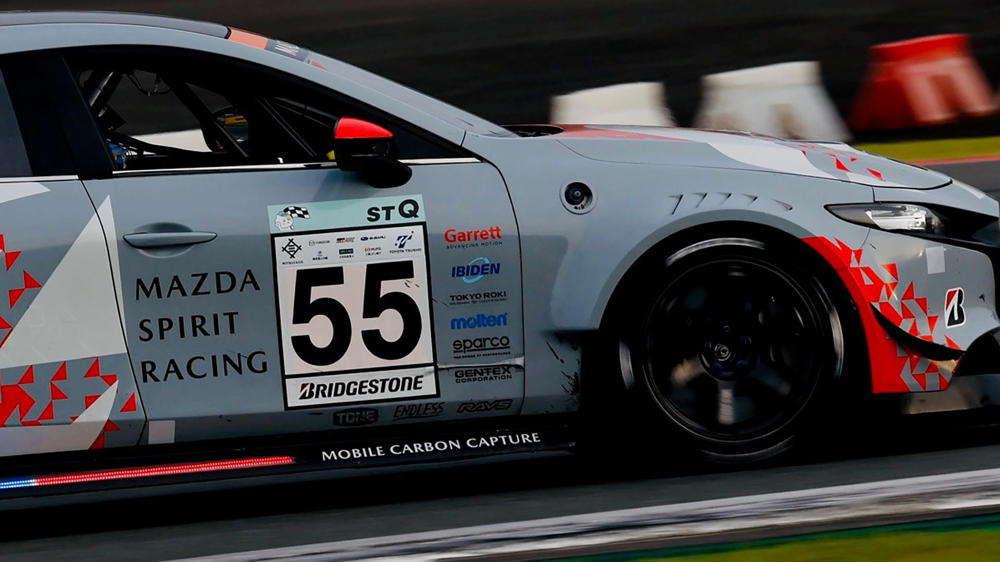
Mazda's in-car carbon capture system is about to make a huge leap forward. The automaker is reportedly set to begin testing the system, which it debuted on the track in an endurance racing car, on the street. The plan is to put it on the road starting in 2028, but it will be some time before Mazda has it available for production. Apparently, the steps Mazda has taken on the track are going pretty well. Carbon Capture Stops The Emissions At The Source Mazda first introduced its carbon capture technology in 2025, before demonstrating it in Japan's Super Taikyu endurance series at multiple races this year. Mazda said that the tests were effective, and in a race last June, the car was able to capture just under two pounds of CO2 from its exhaust during the 24-hour race. It's not great, but promising – especially since it was about 10 times what it captured in the first track test. Now, Mazda is planning to put a test car on public roads starting in 2028, Nikkei reports. The goal of race track testing was to show that it could work in a real car in extreme conditions. Testing it on the road would identify the problems and conditions that real drivers bring to the table, which can be tough in very different ways. The end goal is to bring it to production. The report says Mazda hopes to commercialize the system by 2035, but that there are some issues with economic feasibility. The idea behind carbon capture is a simple one, even if the execution is anything but simple. Run the car's exhaust through some sort of filter that can pull out the carbon dioxide, and store it for disposal or sequestration later. It cuts a car's carbon emissions, making a combustion car more climate-friendly. Can Mazda's System Capture Enough Carbon To Matter? Mazda's goals for exhaust capture are modest. The report says the automaker is looking to recover between 20% and 40% of carbon from the exhaust, which seems like a small amount. It's still significant, though, especially because Mazda is using it as part of a wider system. The car was fueled by hydrotreated vegetable oil, a biodiesel made from waste cooking oil. Because it's from plants, Mazda says it emits 90% less CO2 than traditional diesel – that's from the carbon captured by the plant during growth, not from lower direct emissions – so taking off another 20% would bring it down to a net negative for carbon emissions. Shooting for a 20-40% target also makes the carbon storage much easier. Burning a gallon of gas results in around 19 pounds of CO2, or roughly 200 pounds per tank. That's a lot of carbon dioxide to store in your car, but 40 pounds isn't quite such a problem. CarBuzz Insight – Why This Matters: Carbon capture is a popular idea when it comes to curbing atmospheric carbon because it doesn't require us to make any real changes. Technology does the work — the promise of the future. But as Mazda has shown, the technology is still very far away from reality. Capturing two pounds in 24 hours is like pouring a gallon of water into Lake Mead to help fight the drought conditions. Still, it's good to see someone working on it, even if it ends up as a way to keep older cars on the road. Source: Nikkei

 Liked by Evan Leblanc, Jenna Nelson
 Liked by Evan Leblanc, Jenna Nelson