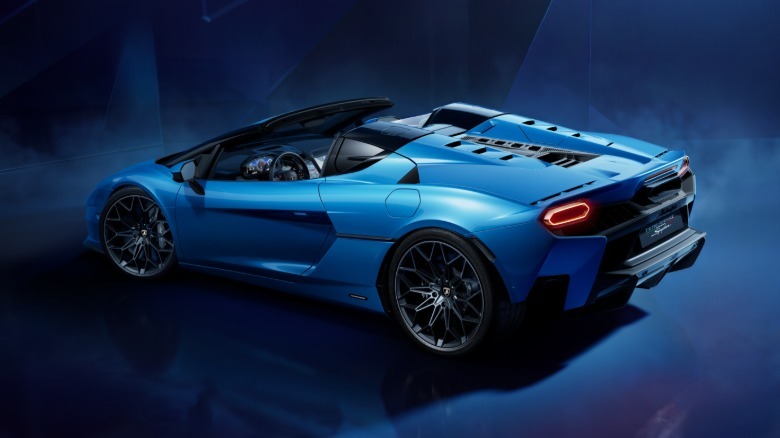
You may not have given it much thought, but Lamborghini has never truly produced a car with a retractable hardtop. That means besides power and performance, the Italian brand still has some tricks up its sleeve. In 1968, the Miura Roadster Concept became the basis for what would eventually be the car unveiled today in LA — a convertible with a retractable hardtop. Why should you care? Besides looking fantastic, the engineering required to build a car of this prowess is, in itself, quite fascinating. First Lambo To Retractable Hard Top Convertibles are inherently a trickier construction than coupes as they require more intentional structural rigidity due to the lack of a fixed roof. With the Temerario Spyder, we get well over 900 hp, and to do so safely. In a way that doesn’t compromise performance, torsional rigidity had to be taken strongly into account. Lamborghini accomplished this well in the Huracán Spyder, and dialed it in even further with a 6% increase in torsional rigidity in the Temerario Spyder. Another factor to take into account is the weight of the roof, which, although it may not seem substantial at first, makes a considerable difference as the weight shifts from the top of the car to behind the cockpit. To maintain weight balance, the hardtop folds into two pieces and slides vertically behind the cockpit, and it’s pretty cool to watch. Speaking of power, let’s dig into the insane performance this car has. If you find yourself stuck at a stoplight too long, you can launch yourself from 0-62 mph in 2.8 seconds. If you do, we aren't liable for any tickets you may receive from your local authorities. Top speed? 213 miles per hour. Unless you’re a professional driver, we hope you never get anywhere near that, but an amazing engineering flex nonetheless. Finally, power. From a hybrid-assisted, twin-turbo V8, we get over 900 hp, made genuinely drivable with torque vectoring and thoughtful improvements to the driving experience. That is borderline absurd to some degree, and that's coming from a certified horsepower junkie. Lamborghini doesn't cut corners, though, and in today's performance market, this surely fits the landscape. Lambo Presses Further Into Hybrid Territory If I’m being honest, I sit firmly in the V8 camp. Yes, the V10 was cool, and we own a pre-LP Gallardo, which is the flat-plane crank V10. The V10 gated R8 is also a favorite of mine. However, the interesting use of hybrid technology here with the twin-turbo V8 drivetrain isn’t to be ignored. One electric motor that sits between the engine and clutch prevents turbo lag, and the two electric motors on the front axle make this an all-wheel-drive monster that crawls up hillsides with brute force. My takeaway: I’ve never been much of a fan of convertibles. In my opinion, a lot of convertibles look a tad off, and it isn’t unusual to see disturbed body lines as a result. They’re fun, they can be problematic, and it’s not often I find myself choosing the spyder version of any car over the coupe. The Temerario, however, makes it hardly noticeable at all. Only a small portion of the roof lifts, just enough to create an open-air experience, but the black gloss paint gives the illusion that the roofline continues whether it is there or not. This creates a beautiful silhouette whether the top is up or down, and I was thrilled to see the final design look so flawless and intentional. Combine that with a beautiful symphony of sound from a flat-plane crank V8, and this supercar is a clear win for Lamborghini. P.S. If you find one wrecked for a low price, reach out to us over on the Buy.Fix.Drive. channel — you never know; it could be the next build in the series after our twin-turbo Gallardo.

 Liked by Lauren Wright, Samuel Turner














 Liked by Lauren Wright, Samuel Turner


