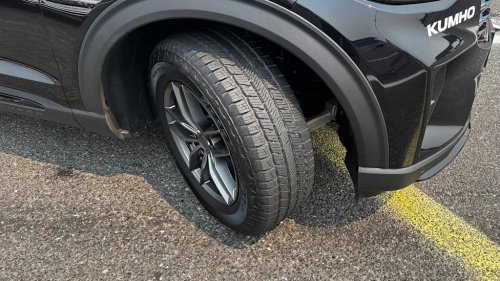
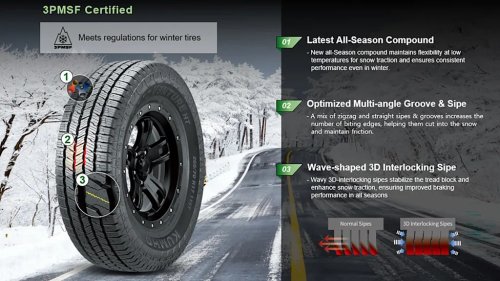
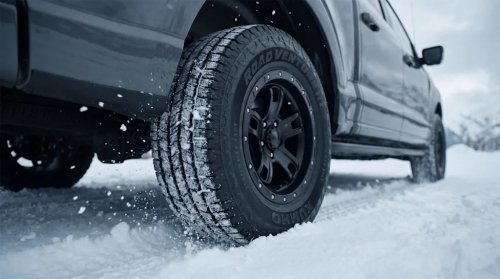
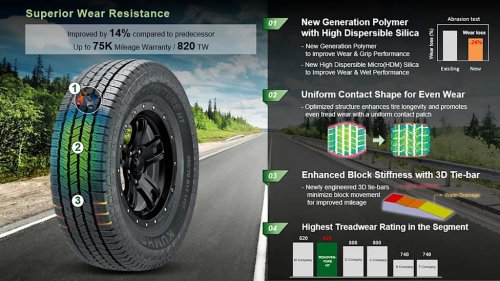
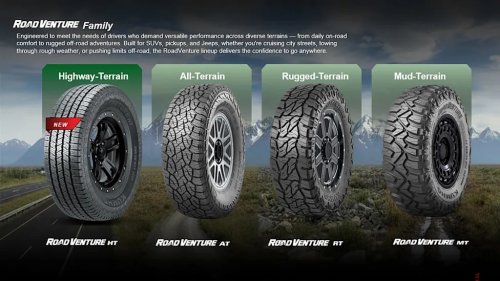
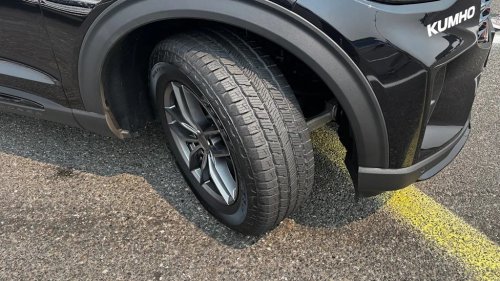
Kumho Road Venture HT Tire Review: Compromised?Kumho TireKumho Tire wants you to consider it a peer of top tire brands like Michelin, Bridgestone, and Continental—in other words, a leader in tire innovation and engineering. Toward that end, the brand has introduced a line of light truck and SUV tires that may allow a lot of northern-tier buyers to safely get by without a dedicated set of winter tires.Kumho's Place in the Tire BrandscapeReputation-wise, Michelin, Continental, and Bridgestone occupy the vanguard, outspending rivals in R&D and often introducing new tire technologies first. Goodyear, Pirelli, Yokohama, Hankook, Sumitomo/Falken, and now Kumho are premium challengers, known for excellent and improving engineering, although often optimized around particular strengths or price targets. Below them are Toyo, Cooper, General, Nexen, Giti, and others staking out the value space and offering fewer cutting-edge technologies. Kumho is about where Hyundai and Kia were a while back, hoping new breakout technologies can do for its brand what hiring design chief Peter Schreyer ended up doing for Hyundai and Kia brands' reputations.Kumho Tire3-Peak Mountain Snowflake Who has budget and garage space to buy and store a set of winter tires nowadays? You may realize those all-season tires your vehicle came with are kinda iffy on the five really bad days in your temperate snowbelt location, but you're just not down for the twice-annual tire swap. Well, the Kumho Road Venture HT tire may well come plenty close enough. It earns the 3-peak mountain snowflake (3PMSF) designation by passing a strict packed-snow traction test and demonstrating a 12-percent traction improvement over a reference tire.Historically, very few of Kumho's competitors have sought out this designation, because earning it has typically forced compromises in treadwear, steering precision, rolling resistance, ride comfort, and/or tread noise. But Kumho claims that its proprietary changes in compound chemistry, siping density, tread-block stiffness, and carcass design can reduce those compromises. Indeed the Road Venture HT tire carries a 75,000-mile warranty and the company claims it delivers low rolling resistance with EV compatibility, quiet highway manners, and improved wet performance.Trying Out the Road Venture HT We were invited to verify those last two claims at Evergreen Speedway, outside Seattle, Washington, on Toyota Tacoma SR5 pickups and Ford Explorer ST SUVs. The trials included 60-mph laps of a 5/8-mile oval track, plus wet and dry autocrosses set up in the figure-eight and road course areas of the infield.Kumho TireFor something nearing a snow tire, the wet and dry grip seemed impressive, and upon finishing the last dry autocross session of a day—during which lots of high-adrenaline one-upmanship had prompted copious tire noise—the outer shoulders of these tires (which we were assured had been set to tire placard pressures) looked remarkably fresh. And on the dry oval, the road noise seemed relatively near that of a stock fitment. Obviously, Seattle in August offered no opportunity to test its performance on snow (and note that ice driving really does require a proper winter tire).Sadly, no opportunity was offered to test the same cars on either the OE fitment tire or on any of the Road Venture HT's prime competitors (these include the Hankook Dynapro HT2, Continental TerrainContact H/T, Goodyear Wrangler Steadfast HT, Bridgestone Alenza AS Ultra, Michelin Defender LTX M/S2 in roughly that price order for a common fitment, with all rival brands costing roughly 10–40 percent more than the Kumho). So we are unable to comment authoritatively on their relative merits.Kumho TireKumho Crugen GT Pro We sampled a second new tire at Evergreen: the Kumho Crugen GT Pro (pronounced with a soft "g," as the name is a portmanteau of "cruise generation"). This one is an all-season touring tire aimed at today's crop of larger, heavier crossovers and SUVs prioritizing comfort, all-weather confidence, and a long treadwear warranty. It is launching in 85 sizes covering more than 85 percent of today's crossover and SUV market. It does not enjoy 3PMSF snow capability. The vehicles we tested it on (Audi Q5, BMW X5, and Mercedes GLC) were, not surprisingly, even more fun to fling around between the cones, hanging on considerably tighter in the wet and dry corners and showing no more shoulder wear at the end of the day than did the bigger vehicles shod in Road Venture HTs.Other Tire Learnings: Replacement Tires You may not know it, but tire store tires with the same writing on the sidewall as the ones that came on your car from the factory can differ a lot from those OE (original equipment) tires. So if a pothole or some other problem kills a tire on your new car, maybe consider hitting the dealer up for an exact replacement. Those tires were designed and spec'd to work harmoniously with your whole suspension system and were likely instrumental in achieving the vehicle's EPA fuel-economy ratings. So if you've driven only 5–6,000 miles or less than 10 percent of tread life used, definitely consider maintaining your OE spec, and you may get away with buying just one. Closer to 10K or 25 percent of initial tread depth, you really should replace them as a pair. Much above that wear level you should consider hitting the tire store for replacements to start transitioning your car to aftermarket tires.You May Like Aftermarket Tires Better Why might that be? An OEM's priority list may not coincide with an owner's. The impetus to maximize fuel-economy may result in compromises you don't love to improve rolling resistance—like shorter tread blocks that grip more poorly and wear out quicker. We had a good taste of this with our Toyota Tundra long-termer, which chewed through two OE sets in just 9,000 and 11,000 miles. After 10,000 miles on an aftermarket set of the Falken Wildpeaks (engineered to please the buyer), the tires appeared on track to survive most of their 60,000-mile tread-life warranty when we turned the truck in.The drive to maximize ride comfort and minimize noise, thereby winning showroom test-drivers over, can also drive decisions that compromise tire longevity—like a lower placard tire inflation number than optimal. (The Ford Explorer/Firestone controversy of the 1990s demonstrated just how complicated those trade-offs can become.)So aftermarket replacement rubber may lower your fuel economy a little and degrade comfort and noise marginally, but you can often expect longer life out of replacement tires.Kumho TireAdvertisementAdvertisementSquare Versus Round Contact Patch The Kumho engineers talked extensively about the lengths they go to in assuring a more square-shaped contact patch, which they contend yields lower noise and more even tread wear. By contrast, OEMs striving for crisp steering feel sometimes favor a bit of curvature on the leading and trailing edges of the contact patch.The orientation of the steel belts can influence contact-patch shape. A smaller angle between the cross plies and the centerline of the tire circumference improves squareness and, because such orientation limits tire growth at speed, top-speed performance is also improved. But this negatively impacts comfort, so SUV tires typically have a larger belt ply angle. Happily, that's not the only dial engineers can twist. There are tire curing tricks that can impact the footprint. Inflated curing is now the norm, but varying the pressure and mounting the new, still very hot tire on a wider or narrower rim can tweak this factor. And of course, novel tread patterns and tire compounds can compensate for many of the above conditions as well.Photo credit: Kumho TirePhoto credit: Kumho TirePhoto credit: Kumho TirePhoto credit: Kumho TireAdvertisementAdvertisementPhoto credit: Kumho TirePhoto credit: Kumho Tire