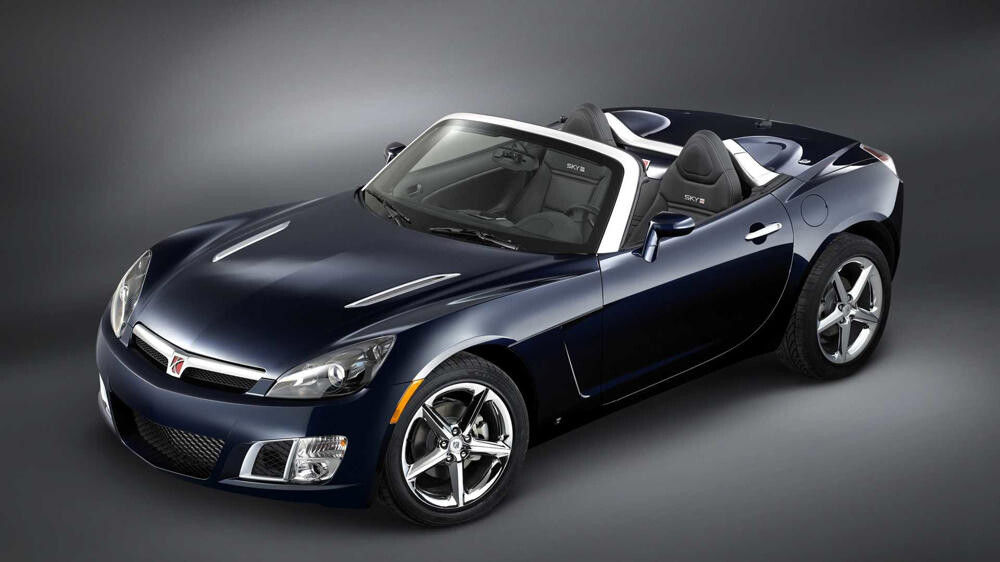
Q: I am the original owner of an Infiniti M30 convertible, which needs struts. They are no longer available from Infiniti. Any suggestions as to where I can obtain replacements? A: This car used a sophisticated suspension system and, unfortunately, there are no direct replacement struts available. After doing some research, I found an alternative. On various owner forums, enthusiasts have replaced the original struts with coil-over shocks designed for a Nissan Skyline R31. The rear units are generally a direct bolt-in, although the front may require some modification. The parts are not inexpensive, but if you plan on keeping the car, they may be a viable option and could even improve handling. 2009 Saturn Aura jumps to the side when hitting bumps Q: I have a 2009 Saturn Aura that runs well, but going over some bumps the car seems to jump to one side or the other. I took it into a shop, and they didn't find anything suspicious. Any ideas? I would like to hold on to this car as long as possible. A: I would want to inspect the suspension with the vehicle's weight on the tires as well as with the wheels hanging free. Worn shocks, strut mounts, suspension bushings or even incorrect tire pressure could cause the car to dart when hitting bumps. Since the first shop didn't find anything, I would consider a second opinion. In my experience, a fresh set of eyes can sometimes find what was missed the first time. Repair shop sent helpful video of recommended repairs Q: Recently, I took my 2021 Toyota C-HR in for tire replacement. The shop sent me a video of the tires and why they needed to be replaced. I thought this was an honest and quite nice way to treat a customer. What do you think? A: I like this, too. My only concern is that many technicians are paid a flat rate and often are not compensated for the extra time it takes to make videos. On the other hand, one reader sent me a video where the technician pointed out several repairs that were not actually needed. In that case, the video helped the customer make an informed decision and decline the repairs. Follow manufacturer's recommendation on tire pressure Q: A week ago, my dashboard gave a "check tire pressure" alert on my 2026 BMW 330. When I checked, all four tires were at 33 or 34 psi. The sticker on the door said the front tires should be 35 psi and the rear tires 40 psi. My mechanic said he thought the ride would be smoother at 34 psi all around and had set them that way. After some discussion, we compromised with 34 psi in the front and 37 psi in the rear. Are these pressures OK? Is it better to inflate the tires exactly as BMW recommends? Why would the rear tires require more pressure? A: If this were my BMW, I would follow the tire pressure recommendations on the door placard. BMW, as most manufacturers, uses tire pressure as part of the vehicle's overall engineering. Since this is a rear-drive-biased vehicle with low-profile tires, the engineers determined that a higher rear tire pressure provided the best balance of handling, ride quality and tire wear. Tire pressure is always a compromise, but I generally trust the manufacturer's recommendation. Steering wheel shakes in Jeep at speeds above 50 mph Q: My 2015 Jeep Patriot has an intermittent steering wheel shake above 50 mph. I've replaced tires, wheel bearings, ball joints and brakes and had an alignment. Braking stops the vibration temporarily. Any ideas on what to check next? A: I would try one more test. When the vibration occurs, shift into neutral. If the vibration goes away, that points toward a driveline issue, and I would be looking closely at a drive axle or CV joint. Another possibility is tire contamination. If a tire sealant such as Fix-a-Flat was ever used, I have seen it cause unusual vibrations. I have even seen water inside a tire create a similar symptom. Could it be suspension bushings or strut mounts? Possibly, but I would have expected those issues to be discovered when the ball joints were replaced. Is 1980s Rolls-Royce really a deal? Beware of costly repairs Q: I recently saw a Rolls-Royce from the mid-1980s sell for less than the price of a late-model Honda Accord. What am I missing? I was tempted to buy it. A: A Rolls-Royce is a great car, but the repairs can be outrageously expensive. The old saying is that a $20,000 Rolls-Royce is often still a $200,000 car when it comes to parts, service expectations and complex repairs. If you are truly considering one, find a shop to work on the car and budget at least several thousand dollars a year for maintenance and unexpected repairs.

 Liked by Leo Scott, Parker Lavoie


 Liked by Leo Scott, Parker Lavoie