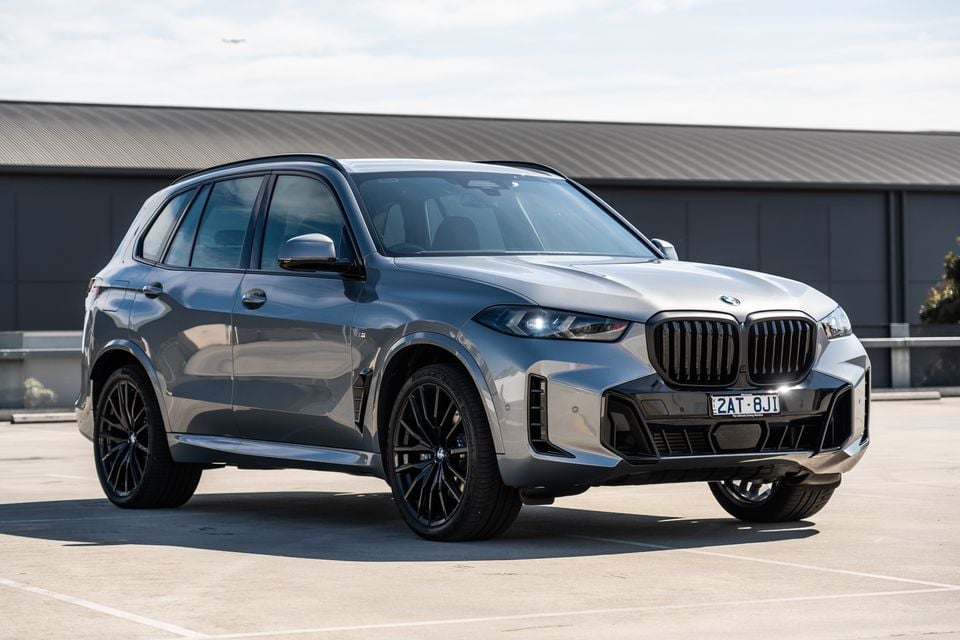
All future petrol and diesel BMWs launched in Australia will comply with the latest Euro 7 emissions standards, as automakers face mounting pressure to clean up their fleets under the New Vehicle Efficiency Standard (NVES). "We're getting the latest EU7 emission standard engines out of Munich... for all of our new internal combustion engine models that we launch from now on," confirmed BMW Australia head of product Brendan Michel. Euro 7 standards will apply to newly introduced light-duty vehicles sold in Europe from November 29, 2026, and all such vehicles from November 29, 2027. These standards include new limits on brake and tyre particle emissions, longer exhaust emissions compliance periods, expanded efficiency monitoring requirements, and tightened limits on smaller exhaust particles. However, the limits for major exhaust pollutants including nitrogen oxides (NOx) and carbon monoxide (CO) are unchanged from Euro 6. As such, BMW's commitment doesn't necessarily guarantee a significant improvement in engine efficiency in the short term. Take the new X5 SUV, for example. On sale now, the fifth-generation X5 retains the same 3.0-litre turbocharged inline-six petrol and diesel engines as the outgoing model, albeit with an uprated 48-volt mild-hybrid system. The petrol-powered X5 40 produces 196-213 grams of carbon dioxide (CO2) per kilometre, compared to 211g/km for the fourth-generation equivalent. The pair consume 8.6-9.3 litres of fuel per 100km and 9.3L/100km, respectively – another close run affair. That said, BMW has achieved strong efficiency gains for the new 40d diesel. Where the old 30d emitted 206g/km and used an average of 7.8L/100km on the combined cycle, the 40d manages 193g/km and 7.3L/100km, despite weighing 60kg more. Nevertheless, by adopting Euro 7 standards, BMW is future-proofing its internal combustion engines for both Europe and Australia, where less stringent Euro 6d-equivalent requirements only became mandatory for newly approved light vehicle models in December 2025. Those requirements won't extend to all new light vehicles sold Down Under until July 2028, and Australia has yet to announce a timeline for adopting Euro 7. Separately, the federal government's NVES is pushing manufacturers to reduce fleet-average CO2 emissions, with progressively tighter targets through to 2029. Despite these regulatory pressures, BMW still plans to sell petrol- and diesel-powered models well into the next decade, alongside its plug-in hybrid and electric offerings. The German automaker also plans to introduce hydrogen fuel-cell vehicles in overseas markets. BMW's approach reflects a broader industry trend, with several major manufacturers having scaled back ambitious electrification targets set earlier this decade. MORE: Explore the BMW showroom Ready to find the right new car at a great deal? Research cars in our Showroom, compare your options or let our New Car Specialists do the running around to find you a great deal.

 Liked by Madeleine White, Henry Green





 Liked by Madeleine White, Henry Green


