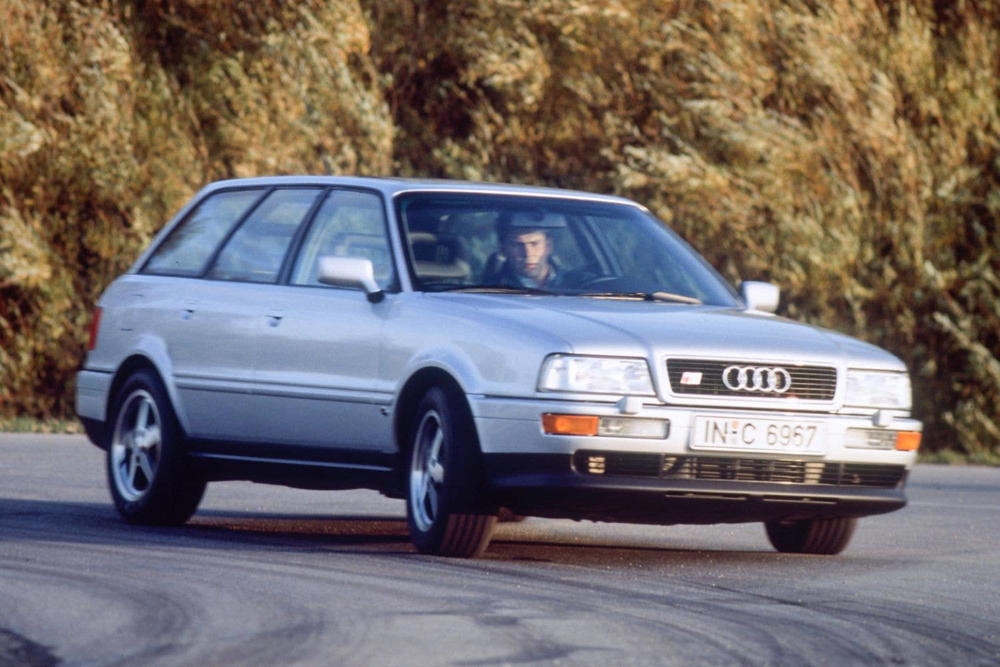
The Ur-Audi S Model A lot has been written about the histories of BMW M and Mercedes-Benz AMG. As for Audi S, the spotlight doesn’t often shine on its early beginnings. One could say that it’s largely overshadowed by the RS models, but without the first ‘ur-S’ models, there wouldn’t be cars like the RS 4, RS 5, and RS 6. Let’s not forget that the early S cars directly competed with M and AMG. In the U.S., the first Audi S car was the S4, but it wasn’t based on the A4. That model predated the naming convention that we still use to this day, meaning it was the performance version of the Audi 100 that later became the A6. And now, you also know why the folks from Ingolstadt had to simplify its monikers in the ’90s. But just months before Audi rolled out the Ur-S4, there was a car that came before it. If you said it was the S2, then you’re either an Audi nut, of a certain age, or both. It was the car that gave a more distinct badge to the brand’s more performance-oriented models, and it’s practically invisible outside of Europe. With that in mind, it’s a good idea to take a closer look at the Audi S that started it all. A Quattro Successor One could say that the Quattro lit a spark at Audi in its desire to go fast. Indeed, the company fitted the turbo all-wheel drive hardware to the midsize 200, and sportier versions of the 90 and Coupe were also made. But by the late ’80s, the Quattro was getting long in the tooth, and a new Coupe based on a fresher platform was already in production. It seems that Audi decided the Quattro needed a successor. After all, its chassis dated back to 1978, and the ur-Quattro couldn’t be built forever. So, in 1990, the company pulled the covers off a high-performance version of the Coupe, simply dubbed the S2. You’re probably wondering why Audi chose the letter S, and the reason is surprisingly simple and straightforward. In Audi’s own words, the S2 was intended to succeed the Quattro. The Group B rally version was called the Sport Quattro S1, and the company was inspired to name its newest sports coupe after that. You can think of it as an Audi Quattro S2, as it represented a new generation of Audi’s all-wheel drive performance cars. The Stats If you take a look at its specs, the S2 was literally a modernized Quattro. The S2 was powered by the 2.2-liter turbo engine as seen in the 200 Quattro 20v sedan and Avant, which in turn was a derivative of the same one used in the two-door Quattro. It was a familiar recipe, but adapted for the ’90s. When it was new, the turbo inline-five put out 217 hp and 228 lb-ft of torque. That engine produced exactly the same numbers its predecessor made, and it was mated to a five-speed manual. It doesn’t sound like much today, but remember that cars were a lot lighter over 30 years ago. The power and torque was enough to propel the compact coupe to 60 mph a shade under six seconds. The S2 was then updated in late 1992 with the engine receiving some tweaks. The little changes gave the car more power, rising to 227 hp, and torque was now rated at 258 lb-ft. An overboost function was also added, and it could momentarily boost torque to 280 lb-ft. As part of the updates, the transmission even sprouted a sixth gear, and like before, it was manual-only. Expanding the Range Not long after the coupe received upgrades, there was a new S2 body style introduced. Audi put the same turbo all-wheel drive mechanicals into a station wagon, and thus, the S2 Avant was born. As it was released around the same time as the updated S2 Coupe, the Avant also benefitted from more power and torque. There was barely a performance deficit between the coupe and the wagon, and the latter was just a few tenths slower in the acceleration department. Yes, even before the RS 2, Audi had already made a performance wagon. A few months after the S2 Avant, the third addition to the model range was added. As there was a coupe and wagon already, Audi made a small batch of S2 sedans to complete the family. It also had the more powerful iteration of the 2.2-liter turbo inline-five, meaning 227 hp and up to 280 lb-ft. Regardless of which body type was chosen, one could say the car was a sleeper. There are no obvious changes to the exterior, and the only bits that gave it away were the badges, wheels, and bumper moldings. The Audi S2 interior did come with a few extra goodies, namely white-faced dials, a unique steering wheel, and carbon trims on the dash. Not for America It’s easy to say today that these should’ve brought these models to America. There was no official reason as to why the S2 family never made the trip to the U.S., although we can think of two major factors that ultimately led to it being primarily for Europe and select markets. One has to remember that Audi of America was in a totally different place in the early-’90s. It was still reeling in from the unintended acceleration scandal from the ’80s, and sales at the turn of the decade were practically non-existent. For its recovery, Audi needed volume models, not niche cars. But even if the company did offer the S2 range stateside, it would’ve been prohibitively expensive as it needed to be federalized. Doing that would’ve required many engineering changes, bumping up the price, and possibly leaving more cars on dealer lots being sold at a loss. A halo model would’ve been cool, but the brand was quite literally fighting for its life in America in those days. A Rare Gem One can’t help but feel sorry for the launch timing of the S2. The Audi easily made more power than the E30 M3 and 190E 2.5-16 when it came out in 1990. But just three years later, the E36 M3 and W202 C36 AMG stole the S2s thunder on the basis of being fresher designs that made more power. There’s no doubt the M3 and C36 deserved the spotlight, but don’t forget that it was the S2 that came first. If Audi of America had been in a better state in the ’90s, the odds of these cars reaching the U.S. would’ve been far better. It might have actually boosted S2 sales in general, as it wasn’t a particularly massive seller. In total, 9,488 S2s were built, with 7,370 coupes, 1,812 Avants, and just 306 sedans. Apparently, there are more RS 2 Avants than S2 Avants and S2 sedans combined. Still, we wouldn’t call the S2 a flop, as it was effectively Audi’s baby steps into developing a production performance car division. Since then, things have turned out nicely for Audi’s S models, as nearly every car it makes today has a corresponding performance variant.