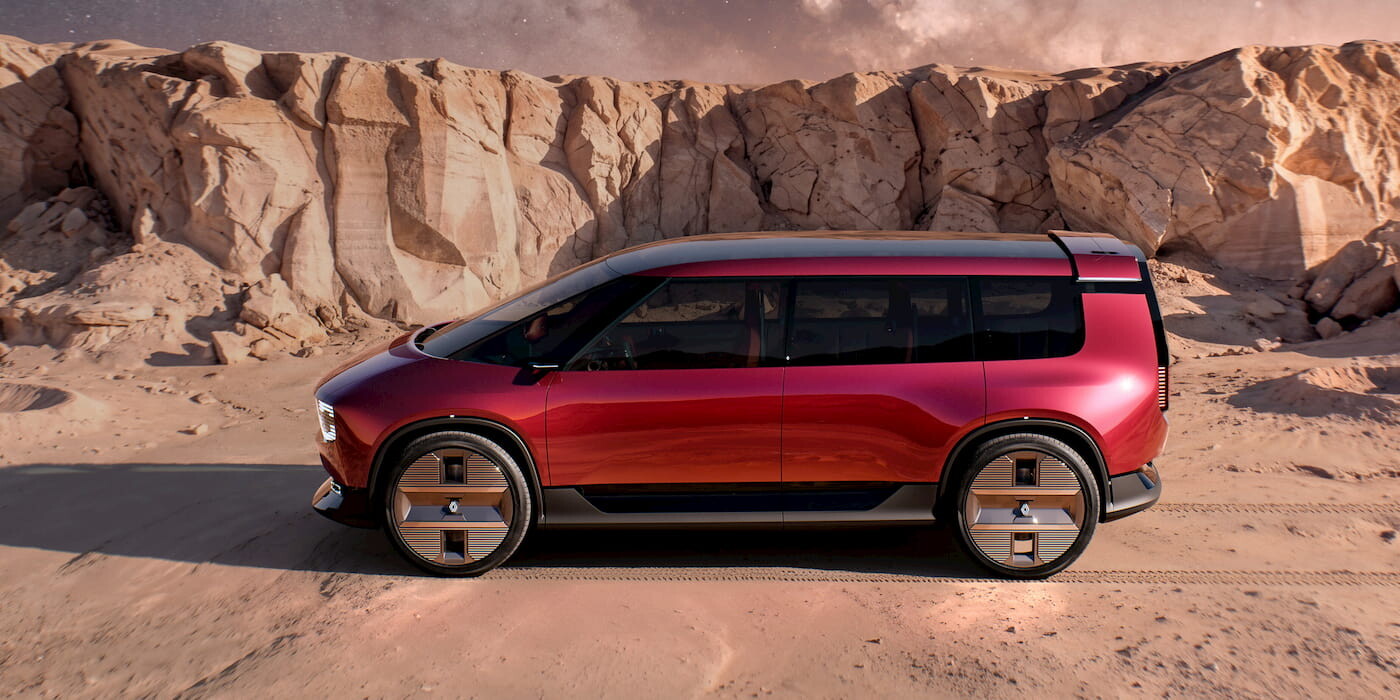
It was quite a moment to stand with 15,000 people outside the Mercedes-Benz Museum in Stuttgart, Germany, and watch Mercedes-Benz chairman and CEO Ola Källenius announce to the crowd that the Mercedes-Benz S-Class was our 2027 Car of the Year. It was the first time in history our COTY winner had been revealed at a venue outside the United States. And the announcement was made just before three S-Class sedans drove on stage to officially complete a nine-month, 40,000-mile journey around the world to celebrate the 140th anniversary of the debut of the Benz Patentwagen, the rickety single-cylinder three-wheeler built by Karl Benz that Mercedes touts as the world's first car. Car of the Year has been a big part of my career as an automotive journalist. MotorTrend invented COTY, of course, our first award going to the 1949 Cadillac. But Australia's Wheels Magazine cottoned on to the idea in the early 1960s, awarding its first COTY in 1963 to the Renault R8, the roomy little rear-engine French sedan that boasted full independent suspension, a four-speed manual transmission, and four-wheel disc brakes, a big deal back then. I became a Wheels COTY judge in 1990, joining a panel of peers and experts that unanimously voted Mazda's delightful little MX-5 Miata that year's Wheels Car of the Year. Later, when I was editor-in-chief of Wheels, I led the development of the testing, evaluation, and voting processes that I would eventually bring to MotorTrend's Car, Truck, and SUV of the Year programs in 2004, which are still used to this day. When I was asked to become a juror on this year's German Car of the Year, I was intrigued. Their process would be different than MotorTrend's, of course, though I would judge the contenders against the same criteria I have always used—engineering excellence, advancement in design, efficiency, safety, value (against each vehicle's competitive set), and, most important, performance of intended function. But I wanted to see which vehicles caught the attention of the 47 jurors—mostly German automotive media—and why. All the rankings and voting data was analyzed by AItastic, an AI-driven media and business intelligence company based in Mainz, Germany. First shock: Out of the 109 vehicles eligible for this year's GCOTY, the 20 highest-ranked by the jurors were EVs. Just four of the top 30 ranked vehicles were powered by an internal combustion engine. More than a few automakers might right now regret their expensive pivot to EVs in the context of their relatively poor sales over the past few years. But the GCOTY judging trend suggests history may see them as simply having been ahead of the curve rather than having taken a wrong turn. A deeper dive into the data revealed a couple of insights all product planners working on next-generation EVs should heed. Against the criteria, EVs topped the rankings in terms of significance, comfort, value, and safety, but ICE vehicles topped the design and fun-to-drive rankings. One fascinating side note: Hybrids, which in theory should offer the best of both worlds, topped none of the criteria. A bit like an all-season tire that's OK in the dry and OK in the snow but not great in either, hybrids—particularly plug-in hybrids—were seen by the GCOTY jurors as jacks of all trades but masters of none. Chinese automakers are fast building market share in Europe. Chinese brands now outsell the Japanese in Europe, accounting for almost 15 percent of new vehicle sales across the EU and U.K. in September, and sales of Chinese vehicles are on track to reach 1.3 million units across the region during 2026. The AItastic analysis of the GCOTY jurors' value rankings revealed why: They regarded the Chinese brands as delivering the best value, ahead of Japanese and then Korean brands. European brands came next. And American brands? Stone cold last. The GCOTY process whittled the 109 contenders down to five category winners: the Volkswagen ID.Polo (Budget), Kia PV5 (Compact), Mercedes-Benz GLC (Premium), Xpeng X9 (Luxury), and Hyundai Ioniq 6 N (Performance). It's an eclectic list, and I'll admit not all of them are cars I voted for. Let's take a closer look at how I saw some of their strengths and weaknesses. Volkswagen Budget: Volkswagen ID.Polo The Volkswagen ID.Polo is significant because it reveals how VW Group intends to steer the design and execution of its EVs away from the soulless low-rent futurism of the original ID electric cars and toward vehicles that have presence and character. This little hatchback is all about upping the emotional quotient of the company's EVs, to make them more approachable and desirable. Powered by VW's new APP290 electric motor, the ID.Polo also shows how VW's electric-powertrain vehicle architecture is evolving. The APP290 weighs 55 pounds less than the APP550 that powers the ID.4, thanks to a simpler, lower-cost water-cooling system. In Germany the base model starts at under the equivalent of $28,000, which buys you an ID.Polo with a 114-hp, 195-lb-ft version of the APP290. It is front-drive and takes 10.6 seconds to get to 62 mph, and it stores its energy in a heavy 37-kWh lithium iron phosphate battery that under EPA testing would likely deliver a range of just 175 miles. The top-shelf model gets 208 hp and 214 lb-ft, and it scoots to 62 mph in 7.1 seconds. It also gets a more energy-dense 52-kWh NMC battery that boosts the likely EPA-rated range to 240 miles. But this version of the ID.Polo costs $49,000 in Germany, 15 percent more than a base Tesla Model 3, which has more power and better range. Kia Compact: Kia PV5 The Kia PV5 is the first product from Hyundai Motor Group to be built on its new E-GMP.S electric commercial vehicle architecture. Compared with the E-GMP architecture that, among other vehicles, underpins the Ioniq 5 and Kia EV6, E-GMP.S positions the driver farther forward and has a compact motor and power electronics array behind the front firewall. Its battery pack is located lower in the structure, with cells packed directly into the battery pack rather than in modules that are then arranged inside the pack. The result is a platform that provides a lower, completely flat floor that runs from a point below the driver's knees all the way to the rear of the vehicle and can be topped with passenger van, cargo van, or cab-chassis body modules. Vans may not be glamorous, but they make money; the Transit van has kept Ford alive in Europe for decades. While its commercial vehicle roots show through at times—the slight suspension noise on rough roads and the somber industrial-strength plastics in the interior, for example—the Kia PV5 is decent to drive and well equipped, and it can carry a ton of stuff. It's also terrific value, offering better performance and range than a base Volkswagen ID.Buzz at a 25 percent lower price. Funkily utilitarian, it's the Kia PV5 and not the ID.Buzz that is the real spiritual successor to the Volkswagen Type 2 Microbus, the van that launched a thousand flower-power road trips back in the '60s. Mercedes-Benz Premium: Mercedes-Benz GLC The Mercedes-Benz GLC is the first of the three-pointed star's new generation of electric vehicles. It debuted the electric vehicle architecture dubbed MB.EA that underpins the recently launched electric powered C-Class and that will by 2029 also be found under the electric-powered E-Class and S-Class sedans, as well as the electric-powered GLE and GLS SUVs. The highly flexible MB.EA toolkit includes more powerful and efficient motors developed in-house by Mercedes-Benz, an 800-volt electrical architecture that allows for hyperfast charging, and new battery chemistries that promise lower cost and longer range. MB.EA is a software-defined vehicle architecture, with Mercedes-Benz's new MB.OS operating system overseeing all vehicle functions, and it can be equipped to deliver Level 3 autonomous driving capability. So far, so good. But what makes the Mercedes-Benz GLC a worthy winner of the GCOTY's Premium category is that, unlike the first-generation Benz EVs, it looks and feels unmistakably Mercedes. That big "grille"—really a decorative façade that can light up at night and behind which lurks a battery of sensors—recalls classic Mercedes grilles of the past and puts the three-pointed star front and center. More important, the GLC drives like a Mercedes. It's smooth and quiet as you'd expect of an EV, but its optional air suspension delivers a plush yet controlled ride that's almost the equal of an S-Class'. Angus MacKenzie - MotorTrend Luxury: Xpeng X9 This was a shock. For precisely the same reasons it was judged MotorTrend's 2027 COTY, the Mercedes-Benz S-Class seemed the obvious winner of the GCOTY's Luxury category. It was my pick, but most of my fellow jurors opted for the Xpeng X9 instead. The X9 is built on Xpeng's Smart Electric Platform Architecture (SEPA) 2.0, a skateboard platform that has an 800-volt electrical architecture and incorporates Xpeng's own X-EEA computing platform. It also has large diecast structures at either end to locate the suspension elements and the electric motors and their associated hardware. Inside is a roomy interior with captain's chairs in the second row that at the touch of a single button can position your body in an ergonomically correct position to eliminate pressure on your spine. On the road, the big Xpeng X9 is surprisingly composed and remarkably agile. The suspension is plush, and road and motor and wind noise are all very well suppressed. It might look like a minivan, but to the folks inside it's like riding in a supersized luxury limousine. It's not cheap, the base model costing the equivalent of $100,000. But that's 25 percent less than the least expensive Mercedes-Benz S-Class you can buy in Germany. The Xpeng X9 shows how the Chinese are going to commoditize luxury. And that's why Mercedes-Benz, BMW, and Audi should be alarmed: Xpeng has only been building automobiles for a little more than 12 years, and it's already playing in their backyards. Hyundai Performance: Hyundai Ioniq 6 N As with the Mercedes-Benz S-Class, you would have thought Porsche's 911 Turbo S would have been a shoo-in for a win in the GCOTY's Performance category. But Hyundai's brilliant Ioniq 6 N stole the trophy. And deservedly so, for while the 911 Turbo S is a masterclass in modernizing a heritage, the Ioniq 6 N is a far more significant performance vehicle. Why? Well, the driver engagement technologies pioneered by Hyundai with the Ioniq 6 N and its sibling, the Ioniq 5 N—technologies such as engine soundtracks linked to wheel speed, torque cuts and regen applications that replicate gearshifts, and driver-adjustable front-to-rear torque splits—have paved the way for a whole new generation of electric-powered performance vehicles that are not merely fast but are also genuinely enjoyable to drive. Want proof? Check out our drive stories of the new Mercedes-AMG GT63 and GT55 4 Door Coupes and the GT63 SUV. And yes, the Mercedes-AMG engineers admit the Ioniq 6 N and 5 N were benchmarked during the development of these monster EVs. But there's also real performance car substance behind the software stylings: The Ioniq 6 N is fast and responsive, with a nicely composed chassis, beautifully direct steering, and strong brakes. It was an absolute joy to thrash along quiet German back roads, the realistic engine noise helping to accurately gauge corner entry speeds and the fake gearshifts helping balance the chassis through all phases of the corner. It is a worthy category winner.

 Liked by Parker Fortin, Noah Tremblay
















 Liked by Parker Fortin, Noah Tremblay