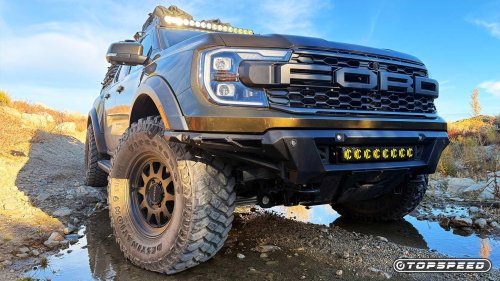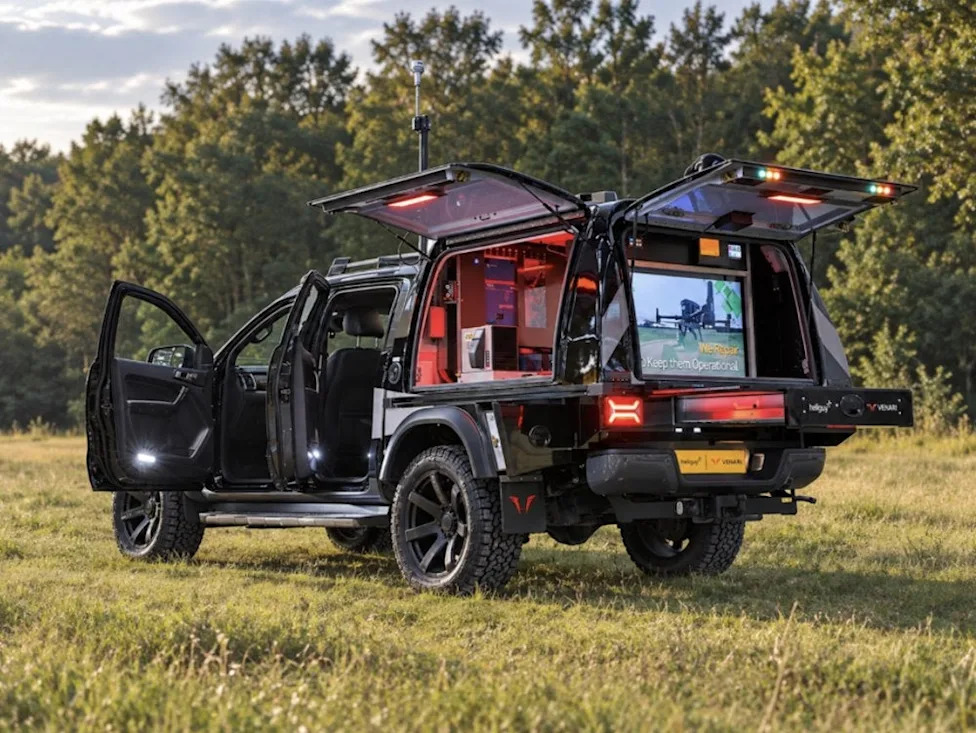



















How to Build a Trail-Ready Drone Base on a PickupOff-Road.comAlta MLFri, September 25, 2026 at 9:00 AM UTCAdd us on Googleford ranger droneA drone earns its keep by putting a camera where a person cannot easily or safely go, but the aircraft is useless if the crew cannot reach the launch point. That gap between the road and the survey site is what a pickup solves. The aerial survey firm Team UAVhas built its operation around Ford Ranger conversions that turn the truck into a self-contained flying base, described by founder Lewis Pritchard as "basically a mini aircraft carrier." The principle applies to any capable 4x4. The truck carries the power, the connectivity, and the launch platform to the edge of the survey area, then becomes the office from which the whole job runs. If you fly drones for inspection, mapping, or emergency work, the vehicle build matters as much as the aircraft, and the mechanical logic behind it is straightforward enough to copy.Why a pickup makes sense as a drone platformDrone survey work replaces slower and costlier methods. Inspecting a large building the old way meant scaffolding the entire structure on a multi-year cycle, a process that ran for months and cost a fortune. Anything larger than a building - a forest or a major event site - meant hiring a helicopter. A drone does the same job faster, cheaper, and with less disruption to the people using the site. That efficiency depends on getting the aircraft into position. Team UAV's core work involves inspecting pylons, bridges, and wind turbines, surveying flood impact, and feeding imagery into government emergency response. Much of it is disaster response in remote areas, which is why off-road capability is treated as essential rather than a nice extra. A survey after flooding may require driving through standing water to reach the damage, and an environmental survey may sit at the end of a mountain or forest track. A pickup with real ground clearance, four-wheel drive, and wading ability reaches those sites where a van or a car stops well short. The load bed is the other half of the equation. A pickup gives you a flat, open, load-rated deck behind the cab, which is the natural place to mount a launch platform, power gear, and storage. That combination of trail capability and cargo space is what makes the crew-cab pickup well-suited to this kind of mobile work.Wading capability and what it buys you off-roadOne feature Team UAV highlights for its Ranger fleet is wading capability. For flood damage assessment, that fording depth is the difference between reaching the launch point and turning back. If you are building your own drone rig, treat wading depth as a hard limit rather than a party trick. Know the rated fording depth for your platform before you commit to a water crossing, and remember that a raised air intake, sealed differentials, and protected electronics all factor into how deep you can safely go. The manufacturer's guidance is the starting point. Ford's own note on the Ranger is blunt about the discipline involved: check the owner's manual before any crossing, match your route to the terrain, and carry the right recovery and safety gear. Water crossings are where an expensive, kitted-out truck becomes an expensive, drowned truck, so the caution is warranted. Ground clearance and approach angles matter for the same reason. A rig loaded with survey electronics and battery banks is heavier than a stock truck, which affects how it rides over ruts and how much sag you carry at the rear. Plan the build around the terrain you actually expect to cross, not the terrain you hope to avoid.Building the load-bed platformThe mounting system Team UAV settled on is deliberately simple. Rather than fabricate a bespoke rack, the firm built its setup around an off-the-shelf accessory tray dropped into the load bed. That choice has a practical payoff: the whole kit lifts out and moves between trucks in the fleet, and it can even be bolted into a rented Ranger to cover a large short-term contract without buying another vehicle. That modular approach is worth copying. A drone base that lives on a single dedicated truck ties your capacity to one vehicle. A base built on a common accessory tray that any truck in your fleet can accept turns every pickup into a potential launch platform. For a small operation, that flexibility means you can scale up for a big job by hiring rather than buying, then strip the kit back out afterward. Because the tray is a standard accessory rather than a custom fabrication, it also keeps the build serviceable. Parts are replaceable, mounting points are known, and you are not dependent on a one-off design that no one else can repair.Powering the rig for a full day on siteA drone base is only self-contained if it makes its own power. On site, Team UAV runs software, connectivity and communications equipment, the drone dock itself, and battery chargers, all fed by an inverter off the truck's electrical supply. Because power is the constraint that governs how long a crew can work in the field, the build does not rely on the vehicle alone. Solar panels and additional batteries extend the runtime so the truck can sit at a remote launch point through a long survey without idling the engine to keep everything alive. That layered approach - inverter, solar, and a battery bank - is the standard recipe for any overland or work rig that needs to run electronics away from mains power. If you are specifying your own system, size it around your heaviest continuous draw, which for a drone operation usually means charging aircraft batteries while simultaneously running comms and mapping software. Undersizing the inverter or the battery bank is the most common way a mobile base runs out of usable power before the job is finished.What this build achieves in the fieldTeam UAV credits its ability to send a Ranger to remote sites and run the whole job from the truck as a major differentiator. The same trucks have surveyed pylons in the Scottish Highlands and moved on to perimeter security work protecting critical infrastructure. Live-streamed high-definition footage and 3D models are the product, but the truck is what delivers the crew and the power to the spot where that data can be captured.Practical next steps for your own buildStart with the vehicle's water and terrain limits, since those define where the whole operation can go. Confirm the fording depth and off-road ratings for your platform, and consult the owner's manual before attempting any crossing. Then build modular. A standard accessory tray that moves between trucks costs less flexibility than a custom install and lets you scale by hiring extra vehicles for big contracts. Finally, plan power as a system rather than an afterthought: an inverter sized to your real continuous load, backed by solar and a battery bank, is what keeps the base working through a full day in the field. Get those three elements right - capability, modularity, and power - and any capable pickup becomes a launchpad that reaches sites a survey team could not otherwise work.