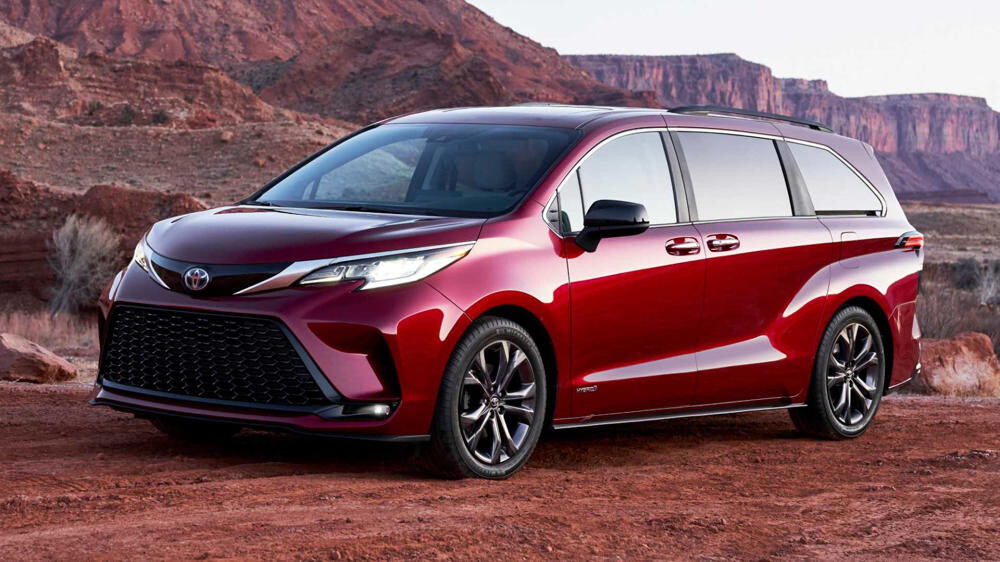
The Honda Odyssey has always been a high-ranking minivan in its market segment, and the latest one provides punchy V6 performance, agile handling for such a large car, and a spacious interior with highly configurable seating arrangements. Its major weakness for people living in cold climates where it snows regularly has been that it's not available with all-wheel drive. In common with the Kia Carnival, the Odyssey is FWD only, which is sure to limit its appeal where snowfall is frequent, and drivers want the extra traction, especially in view of the historic snowfalls expected this winter. Honda has fitted the Odyssey with a Snow Mode to entice buyers who would otherwise opt for a minivan that offers AWD like the Sienna or Pacifica. Snow mode in a car without AWD like the Odyssey is meant to mitigate the absence of AWD, but one has to ask whether any kind of computerized traction-management system can compensate for the fact that you only have two driven wheels. Isn't it just a band-aid on a broken leg? How useful is the Odyssey's Snow mode? Is it a worthy substitute for AWD, and should you still be considering the Odyssey if you live in a snowy area, or should you just go for an AWD rival like the Chrysler Pacifica or Toyota Sienna? Let's find out. How the Honda Odyssey's Snow Mode Works The Odyssey's Snow mode is part of the car's Intelligent Traction Management System, which is designed to adapt to varying road conditions to optimize traction and stability by adjusting and fine-tuning the powertrain on the fly. Snow mode has to be manually selected via a button on the center console and will remain active as long as it is selected, but Intelligent Traction Management will revert to the default Normal mode when the ignition is switched off. Depending on the gauge display fitted to your Odyssey, the selection screen may look like this: 2025 Honda Odyssey snow mode cluster display 7gshark on YouTube The Honda Passport's Snow mode works similarly, but the SUV also has access to optional AWD to further improve traction. Snow mode in the Odyssey works on various fronts to maximize front-wheel traction on snow: Throttle response. Snow Mode softens and dulls the drive-by-wire throttle system's response to avoid torque spikes on the driven front wheels that may induce wheelspin and cause a loss of traction. Soft and gentle throttle application is essential on slippery roads to maintain grip. Second-gear pull-away. Snow mode is specifically tuned to prevent wheelspin from a standing start in snow, and sets the 10-speed automatic transmission to pull away in second gear. This reduces wheel torque and the likelihood of wheelspin. Transmission shift mapping. The transmission will shift up quickly to higher gears to keep wheel torque as low as possible, as traction is more easily lost in a lower gear at higher engine revs. Stability control. Honda's stability control, called Vehicle Stability Assist (VSA), is optimized to work in conjunction with all these other measures to keep the vehicle stable and on course, with earlier intervention and more precise management due to the low-grip conditions. Tires are Your First Line of Defense It's important to understand that Snow mode cannot defy the laws of physics, and there will be conditions where the traction of two driven wheels will simply not be enough to overcome the conditions. That said, the value of snow tires is often grossly underestimated, and some people run summer or all-season tires on their AWD cars year-round because they think the AWD system can overcome any shortcomings the tires may have. This is an incorrect assumption, as tests have shown that a FWD car with snow tires comfortably outsprints an AWD car on summer tires to 60 mph on snow. This enlightening video by Jason Fenske of Engineering Explained puts it all in stark perspective: The Honda Odyssey's Snow Mode Vs. AWD: The Verdict Equipped with proper winter tires, a Honda Odyssey in Snow mode will do an admirable job, and the tires will give the car's control systems the best possible chance of maintaining traction and stability. You can indeed use your Odyssey in snowy conditions; in fact, a FWD Odyssey on winter tires is likely to outperform and outgrip an AWD rival on summer tires in the same conditions. However, that's the best-case scenario, and when you add all-season or winter tires to a car with AWD, the AWD car quickly gains the upper hand again – and never gives it up again. 2025 Honda OdysseyDIY Life Tech on YouTube All things being equal, and on the same tires, AWD will always be superior to even the best Snow mode on any RWD or FWD car, and that's the bottom line, especially in deep snow where the FWD car is likely to become bogged down and stuck more easily, and a more suitable snow car like a higher-riding SUV may be in order. However, given the very important role of tires and the excellent snow performance of winter tires, you will probably be perfectly well off in your Odyssey if you live in a snowy area and your driving conditions and snow depth don't tax the ground clearance of your Odyssey. Final Thoughts Snow mode on the appropriate winter tires will likely be enough to see you through winters that don't see severe snowfall, and if you prefer the Odyssey over rivals for its engaging driving experience, it can still be a feasible option for you. However, it's important to stress that high-quality and positively reviewed winter tires are going to be essential in the absence of AWD, and will give you the safety margin you need. For safety's sake, go for winter or all-weather tires at the very least, and not all-season tires. On the same tires, Snow mode can never hope to equal the performance of AWD, regardless of the claims the automaker makes. We suggest going for a winter test drive in an Odyssey with winter tires to see if it will meet your needs, or else you'll be better off in an AWD rival. About our ads