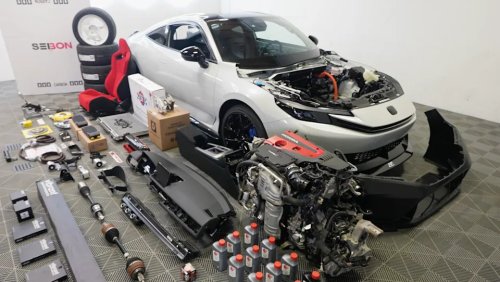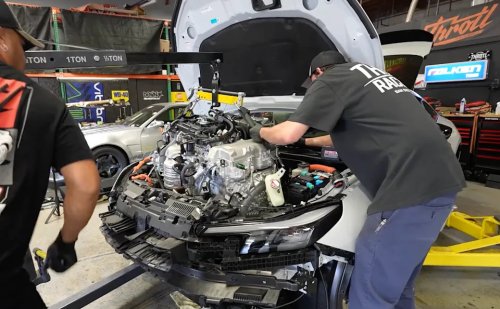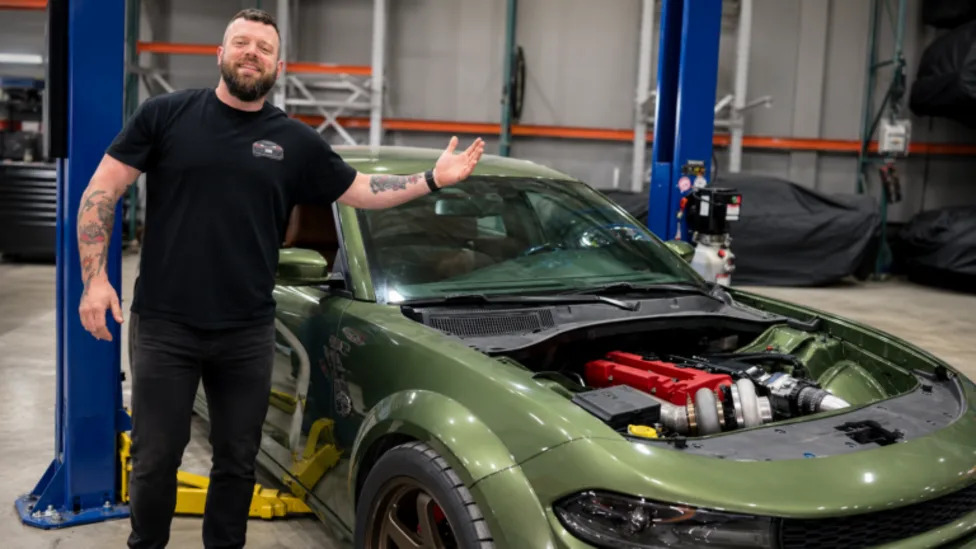



















He Ripped the 797-HP Hellcat Redeye V8 Out—Then Replaced it With a Honda K24 TurboThe 2021 Dodge Charger Hellcat Redeye is a 4,586-pound American land mass that, from the factory, uses a 2.7-liter supercharger bolted to a 6.2-liter Hemi to produce 797 horsepower and 707 lb-ft of torque. It does 0-60 in 3.6 seconds and tops out around 203 mph. It is, by every measure, the wrong candidate for a Honda engine swap. That's precisely why Lee Carter of the ScrapLifeLee YouTube channel did it.The car arrived at his shop already stripped of its Hemi – which, depending on your perspective, is either a head start or a disaster. Carter went a different direction than sourcing a replacement V8. Instead, he dropped in a Honda K24, a 2.4-liter inline-four that in stock form makes somewhere between 160 and 205 horsepower depending on the variant. Swapping out the 680-pound Hemi for the K24 cut the car's weight by 340 pounds, as the Honda four-cylinder with its flex plate tips the scales at around 340 lbs.The obvious question of whether 200 horsepower was going to move a 4,500-pound muscle car was also immediately addressed. Carter's goal, per HP Race Brands, was "One heavy car, one tiny engine, and one giant turbo. Let's see if we can get enough power out of this little K24 to propel a 4,500 lb brick down the track."AdvertisementAdvertisementThe turbo in question is an HPT F3 6870 – a 68mm unit that, at full chat, is rated to support over a thousand horsepower. Paired with aftermarket rods and pistons, a ported cylinder head, and Carter's in-house fabricated turbo manifold, the combination eventually put down 735 horsepower at 44 pounds of boost on the dyno. That figure actually clears what the stock supercharged Hemi made. Not bad for a four-cylinder out of a CR-V.Getting a Honda to Fit Where a V8 Used to LiveThe K24 was never designed to sit in a rear-wheel-drive American muscle car. Honda built it as a transversely mounted front-drive engine, which means every single aspect of the installation required either custom fabrication or creative problem-solving. The oil pan alone went through multiple rounds of surgery – the factory K24 sump geometry conflicts with the Hellcat's electric steering rack and subframe, so Carter and his fabricator cut it down, relocated provisions for the oil drain plug and temperature sensor, and welded the whole thing back together.The stock ZF 8HP90 eight-speed automatic transmission from the Hellcat was kept in place, connected to the K24 engine through a fabricated flex plate that allowed the driveshaft and rear axle to remain undisturbed. That presented its own challenge: the transmission is fixed in place, so the engine had to be positioned to meet it rather than the other way around. Custom motor mounts were fabricated from scratch.Coolant routing required building a multi-piece pipe assembly that runs out, down, across, and back to the factory Hellcat radiator. The intercooler – a custom air-to-air unit with fabricated end tanks – lives in the front grille opening where the heat exchanger and AC condenser used to be. The electronics package is an ECU Masters EMU Pro 8 with an ADU display and PMU power management unit, with the entire engine harness built from scratch using a wiring spreadsheet and factory Honda connectors.AdvertisementAdvertisementIt ran. On the first proper attempt, the K24 fired up inside the Hellcat chassis, held fuel and oil pressure, and rev-limited cleanly enough to draw a "Hell yeah" from Carter. The car also immediately threw a belt off a tensioner pulley that had been heavily modified for clearance – the kind of minor catastrophe that, on a build this involved, qualifies as a good day.The longer-term complications are more interesting. The ZF 8HP90, per Carter's tuner, isn't built to spin past 7,500 rpm, which is practically a warm-up point for a K24 at full boost. The Charger's 2.62:1 rear-end gearing – calibrated for a torque-heavy V8 chasing top speed – destroyed rear tires during early testing and, theoretically, would push the car toward 250 mph at redline in a 1:1 gear. Neither of those is a practical outcome. The build series spanned a minimum of seven installments, with the concluding episode expected to drop sometime in late 2025.The K24 has been swapped into a lot of unlikely things over the years – including a Ferrari 308 and a Porsche 911 – but a near-5,000-pound American muscle car with a ZF automatic and a factory limited-slip rear end is a different kind of problem. Carter's working through it one fabricated part at a time, which is either admirable or insane. Probably both.