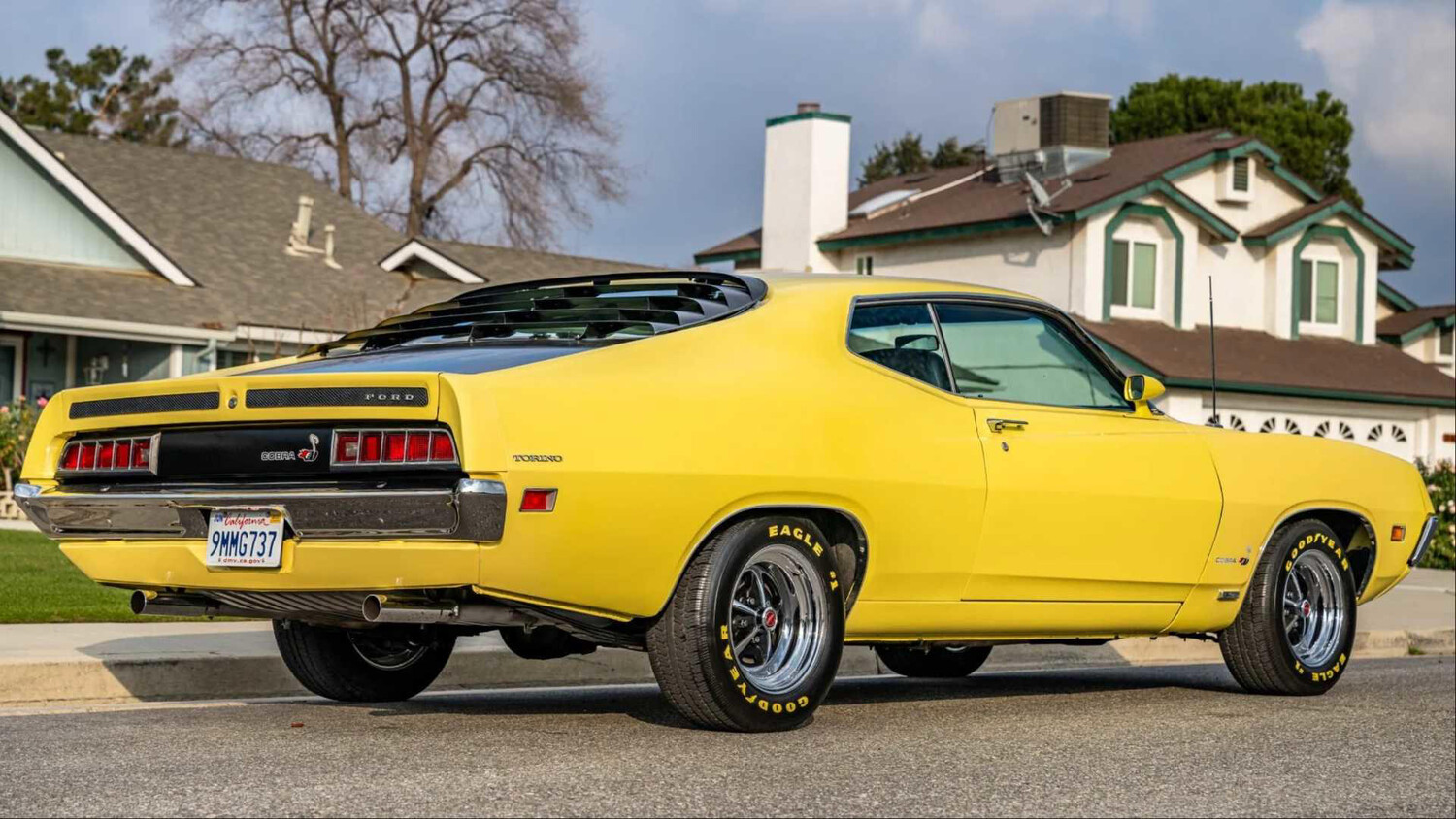
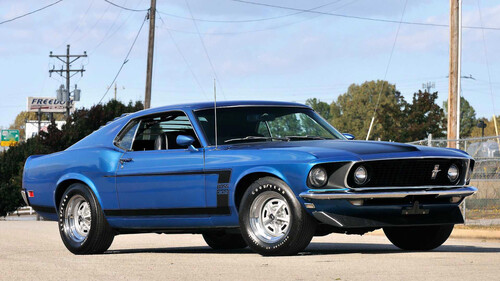
Ford’s big-block muscle cars are legendary, with the Thunderbird, Mustang, and Galaxie becoming household names. Even the engines themselves – not least the FE 427 – became well-known in their own right, proving popular with racers, tuners and enthusiasts more generally. But with legendary status has come desirability and demand, which has made the big-block V8 muscle of the 1960s and ‘70s appreciating assets that now command huge sums of money.Yet there’s one Blue Oval muscle car that has, to a point, avoided some of the inflation that has seen its peers become unattainable. The massive Ford Torino Cobra, launched in the late 1960s, is now one of the cheapest big-block Ford muscle cars you can buy today. That means you get lots for your money, and assuming the demand for big-block Fords never fades, the chances are you'll end up with an appreciating asset in your garage. Ford's Awesome Big-Block V8s Via Mecum AuctionsAfter the Second World War, the American car industry was hard at work building aspirational new cars for relatively wealthy customers. But the bigger, more exciting cars required bigger, more exciting engines, such as the big-block V8. Naturally, Ford was one of the big players, and its range of big-block cars became legendary, encompassing trucks, station wagons and, of course, muscle cars.Arguably the most famous early Ford muscle car was the Galaxie, which was a big vehicle with an equally enormous 427-cubic-inch V8 under the bonnet. Immensely powerful and very fast in a straight line, it became a racer, but the cornering wasn't exactly spectacular — at least not by modern standards. Anyone who has seen Galaxies battle Minis and MkII Jaguars at the Goodwood Revival will know exactly what we mean.Later on, Ford introduced its most famous muscle car, the Mustang, which came with a host of big-block options. Perhaps the most famous are the 1969 and 1970 429 Boss models, and the 428 Mach 1s. These days, they're immensely desirable and accordingly expensive, which might be a turn-off for some would-be buyers.Other famous big-block names included the Ford Fairlane and the Mercury Cougar, but while the muscle car continued to be popular until the present day, the big-block engine's lifespan was limited. By the mid-1970s, emissions laws ensured such massive engines faded into the history books, and the cars they powered became collectors' items. Yet their contemporary — the 428-cubic-inch Torino Cobra — hasn't gathered value in the way its stablemates have, and those on the lookout for one can pick up a bargain. You Can Pick Up A Torino Cobra For Less Than $40,000 Bring a TrailerFirst introduced in 1968, the Torino was essentially a larger Fairlane with two- and four-door body styles and a choice of six-cylinder engines. The big Torino offered buyers plenty of choice, but the most desirable option was arguably the powerful GT model with a small-block V8, before Ford gave the Torino real muscle with the addition of the “Cobra-Jet” engines. It was those high-performance Torinos that formed the basis of Ford's NASCAR entries of the late '60s and early '70s, and to satisfy the racing authorities, Ford had to build 500 for road use. In the end, Ford went all-out with the road cars, offering customers the Torino Talladega, which built on the GT 428 package.Via: Mecum AuctionsEarly models were bulky and blocky, but aerodynamics became more important in the late 1960s, and the Torino adopted a more curvaceous, "Coke-bottle" design that allowed it to cut through the air more cleanly. The final, third-generation car, made famous by Starsky and Hutch, dropped the high-performance Cobra option in favor of the Gran Torino Sport variant, which was fitted with a smaller 351-cubic-inch Cobra-Jet engine, and lost the glamor of the Cobra name. So if you want a big-block 428 -- and let's be honest, you do -- you're going to have to pick a first- or second-generation Cobra. What Can You Get For Your Money? Mecum AuctionsClassic.com data shows first-generation Torinos, built between 1968 and 1969, can sell for less than $20,000, albeit in modified six-cylinder form, whereas the slightly more desirable GT can be found for less than $30,000. V8 Cobras can be bought for less than $40,000, but most tend to be found in the $40,000-$50,000 bracket. Talladegas, however, can fetch six-figure sums in some cases.The second-generation Torinos, meanwhile, are similarly priced. The GT models tend to come in around the $30,000-$40,000 mark, while the Cobras tend to cost between $40,000 and $50,000. Naturally, some special cars — either with desirable modifications or in highly original condition — fetch more money at auction, but they're the exception rather than the rule. Here's One That Sold At Auction GAAThis 1970 Cobra, a second-generation car with little more than 30,000 miles on the odometer, sold for just $41,000 in February 2026, at the GAA sale in Greensboro, North Carolina. Finished in a shade of blue that really pops in the sunlight, the car is powered by the 429-cubic-inch Cobra Jet V8 engine, and is fitted with an automatic transmission. According to the GAA listing, the car was kept in storage for almost 40 years, and had new Ford brakes and a new battery. At just over $40,000, it feels like a lot of car — and a lot of power — for the money. Why Are Torino Cobras So Cheap? Bring a TrailerCompared with 1969 Mustang Fastbacks, which regularly change hands for $50,000 or more, according to Classic.com data, the Torino Cobra is a bit of a big-block bargain. Admittedly, the Torino is significantly more expensive now than it was in the 1960s and '70s. Back in 1971, a Torino Cobra would have set you back a little over $3,000, but a used example will cost more than 10 times that today, yet it's still cheaper than its contemporary rivals.That's partly because the Torino sold even better than the Mustang. Almost half a million Torinos were built in 1972 alone, while Ford produced just under 126,000 Mustangs that year. The Torino outsold the Chevelle, too, so they were surprisingly common at the time. And despite Starsky and Hutch's efforts, the Torino never became a household name in the same vein as the Mustang. But the Torino's loss is the bargain-hunter's gain, and the comparative lack of fame has ensured the Torino can be picked up relatively cheaply.That said, it's worth remembering that part of the reason comparatively few Torinos survive — and why Torino prices are relatively low — is down to corrosion issues that saw plenty of the original vehicles scrapped. That's something for prospective buyers to keep in mind, too, but despite that, the Torino remains an appealing option for customers who want cheap, classic muscle. How Does The Torino Cobra Stack Up Against Its Contemporaries? Bring a TrailerThe Torino's big rival was the Chevrolet Chevelle, which is generally more expensive on the used market. One of the most desirable Chevelles — the SS Malibu — regularly sells for $60,000 or more, according to Classic.com data. In fact, the site's figures suggest the average second-generation Malibu sells for around $68,000, which is considerably more than the $53,000 average for the second-generation Torino, or the $50,194 average Classic.com quotes for the first-generation Torino. Admittedly, those averages include less powerful models than the Cobra, but it also includes the outliers that sell for six-figure sums, which should even that out slightly.The other big-block hero of the era is the Torino's stablemate, the Mustang, which has become hugely desirable. Classic.com figures put the average sale price for a 1969-1970 Mustang at more than $90,000, which dwarfs the figures for the Torino. And the Torino is the bigger car. Yes, the Mustang is more of an icon — it starred in Bullitt, after all — but the prices some examples fetch only serve to underpin what spectacular value the Torino can prove.Sources: HowStuffWorks, Classic.com, Hemmings, The Autopian, GAA, Auto Evolution