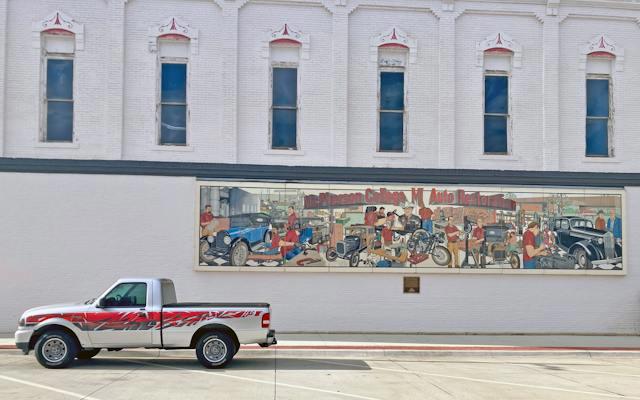
Fact-checking is far more important than vibe-checking, though these days that tends to get lost in our social media-infused lifestyles. In terms of car culture, this means we often lose the gravity of a story’s depth and details as we get caught up in the flash and hype of a 10-second video. I am as guilty of this as anyone, and this summer I knew I needed to make a correction. I found myself seeking grounding and knowledge once again at the Automotive Restoration Summer Institute at McPherson College, this time in their new class on Automotive History. Last year I studied Automotive Electronics at McPherson College’s long-running summer program, and I equated the experience to pouring sand into a jar of stones. It filled in many a gap in my thought processes, and I hoped Automotive History class would have the same impact. This was the first year of such a unique curriculum at McPherson’s summer program, and their freshman effort was beyond comprehensive. So let’s see how the course unfolded every day, and what we learned in the end. Day Zero — The Pilgrimage Last year I flew to Wichita, Kansas, to attend this program. Air travel is fine for getting from one place to another, but with my emphasis on the journey, driving and being able to pack everything I needed seemed better than finagling the bare minimum into my checked baggage. The ride offered plenty of time to rewind to my days as a college student, and by the time I pulled up to McPherson I found myself eager to learn about one of my favorite subjects. At five full days, and with the (very affordable) option of lodging in McPherson College’s dorm rooms, it is very much a throwback experience I intended to take advantage of. The rooms are sparsely furnished, so this year I enjoyed packing up my Ford Ranger with things like a boombox, a sit-up pillow, a desk light (so I could still do work on my Hagerty-issued laptop), and other decor items intended to spruce up the place. Making a dorm room feel like your own space is almost necessary when in college, even if this was the only time I felt vibes were more important than facts. Day One — Initiation We got a healthy dose of both vibes and facts on the first day. The morning started with a meeting in McPherson College’s brand-spankin’ new Campus Commons, with the inspirational spirits of a 1972 Ferrari 365 GTB/4 Daytona and a 1956 Austin-Healey 100M Le Mans Roadster hanging above us, like a message from a high-performance deity wishing us well on our journey of automotive wisdom. The Summer Institute was originally intended to enhance skills needed in automotive restoration, for professionals and hobbyists alike. McPherson added the history class to anchor the mechanical-education offerings in a deeper context—old cars might be nuts and bolts, but they’re also a step in a very human story. We gathered in a classroom adjacent to the hands-on labs, allowing us to absorb knowledge in a setting that embraced the physical and the theoretical. We started our class with introductions. Luke Chennell, our instructor, is a dedicated automotive historian. I was the only person who writes about cars for a living, so it was fascinating to learn why the other five students came here. Everyone seemed to be enamored with the metal, the artifacts, and the vibes behind the automobile industry. Most were interested in a specific topic, but everyone had come to broaden their horizons. We were all primed for fresh knowledge, and we started by learning about the keepers of automotive facts: the Society of Automotive Historians. Chennell is a part of that organization and teaches both the social and technological history of the automobile. For our summer class, we focused on societal elements in the morning, and technical history in the afternoon. The first day was all about building context. We’re far enough removed from the origins of the automobile that for many, cars are a given; understanding the circumstances that led to their creation and then how they quickly came to shape the world around them creates a broader understanding of everything from a given model’s place in history to the modern technological upheaval underway in today’s market. We discussed seven main themes of automotive history, aggressively paraphrased here: Technology Evolution – the proliferation of railroads, bicycles, even tires Mass Production – seen in the textile and meatpacking industry Centralized Business Management – a fixture of the Industrial Revolution Technology adoption – improved lifestyles by the machinery usage Socioeconomic Conditions – A growing middle class, transitioning from horses, to streetcars, to automobiles Public Policy – Governmental efforts, lobbying from the The League of American Wheelmen Societal Transformation – Private roads, Interstates following railroads, suburb creation, Michelin star guidebooks, and so much more. Our afternoon session focused on the materials that make the automobile. Advancements in steel (Bessemer Process, 1856) ensured the automobile had a firm foundation, while rubber with zinc oxide (a UV stabilization agent) improved tire life. Tires were originally treadless, but Continental saw the future in 1904, with hand-carved tread. Firestone pioneered a molded-in tread (1908), with a pattern that repeated the words “Non-skid.” Glass went from life-threatening in a collision to “safety glass” that was first laminated (late 1920s), then tempered so it could break into manageable shards (late 1930s). A general theme began to emerge: The automobile both gave and took from society. It wouldn’t exist without past achievements, but its creation spawned new concepts for our society. The automobile’s reciprocity might be applicable to both vibes and facts, as its history impacted both specific moments and general feelings across multiple generations. I get the feeling that Chennell did this by design, and those “takes” turned into “gives” as time progressed. Day Two — Research Materials We started the day off by drawing slips of folded paper from a jar. Noteworthy automotive people were printed on each—I drew Frank Lockhart, and quickly began googling him. His accolades and connections with the Stutz Motor Company likely make him the most impressive but forgotten person in motorsport. After the class completed this warm-up, we discussed sources for our historical endeavors: primary documentation (firsthand), secondary documentation (what I create on a regular basis), and tricks for finding both sources. Chennell openly admitted to the power of Google searching in modern times. Wikipedia is great, provided you scroll down to the links used as citations. But these are just the top of the funnel for verifying facts. We discussed inductive research, which requires reading an archive of materials that collectively help you find a conclusion for your research. Chennell himself just read 20 years of Road & Track magazine to create and present a thesis, which you can find here. You can find these archives like this in libraries, both in digital and paper format. JSTOR is great, because it has the rights to all Society of Automotive Engineers (SAE) publications. Then there’s HathiTrust, which has resources like Motor Age magazine. Look around via Google—odds are you can find a digital resource (like the Library of Congress or newspapers.com) or a library to visit to meet your needs. Chennell recommends you create a system of note-taking, and he recommends the old-school trick of note cards for your sources, footnotes, and summaries. From there, the note cards can be plugged into an outline, which turns into a finished product with appropriate amounts of wordsmithing. I agree with Chennell’s procedure, and this very article was created using these tools, though given my profession, I am used to taking detailed notes on my Hagerty-issued laptop. (I would prefer note cards if I were in a library setting, however.) The afternoon session focused on more technology, including roadways, bicycles, steam-powered vehicles, electric cars, and pre-1900 gasoline automobiles. Going back 125-plus years wasn’t all that different from going back 30 years—print publications and trade magazines like Motor and Motor Age covered the industry, and Horseless Age magazine promoted long drives (Cleveland to New York City) to prove the automobile’s might and potential. The conversation then blossomed into some early automotive endurance victories (The first successful transcontinental journey by Horatio Nelson Jackson happened in 1903), and the afternoon wrapped up with Henry Ford and the concept of Fordism. This day offered a good refresher on the how of pursuing facts and the methodology behind the effort. It also provided context that filled in the gaps in my knowledge of early automotive history. I bet you’ll feel the same way if you click on all the embedded hyperlinks used in my coverage. Knowledge of process can be empowering, and it feels good to learn how to connect the dots with facts. Day Three — Wars and The Interwar Period This morning started with another pass of the paper-slip-filled jar, and I hit the jackpot: I had the honor of discussing the legendary Tom McCahill. When I was but a young automotive blogger full of spit and vinegar, one of my readers suggested I reminded him of this esteemed journalist. I didn’t know of the man until that moment, but I had plenty to discuss as we have a fair bit in common. We continued yesterday’s discussion on Fordism, this time focusing on the concept of Giantism. Ford became a juggernaut, thanks to concepts like integration, centralization, and their efforts in growing market share by mastering the concepts of distribution, financial services, and marketing. Ford moved away from wholesale distributors in 1905, replaced by branch sales offices. There were 31 such offices in 1913, supporting 7000 dealerships. By 1914 there were also branch assembly points in 28 cities: their sole purpose was to fully assemble Ford vehicles that were shipped as knock-down kits. But Ford wasn’t playing in the upscaling space by itself, as William C. Durant created General Motors, Chevrolet, and wound up with tragically little in his twilight years. General Motors was the poster child of the period of consolidation, as there were 253 automobile companies in 1908, but only 44 by 1929. By the afternoon, we shifted gears to discuss the impact of war on industrialization. Henry Ford was a noted pacifist (with the more troubling issues briefly discussed), but was okay with his vehicles being used as ambulances in World War I. Lawrence of Arabia replaced camels with Model Ts. Armored tanks mirrored the production values of cars, using similar factories, steel, and self-propelled engineering. FIAT made trucks, munitions, aircraft engines, and airframes. But since nobody had created a Jeep-like vehicle yet, a reported 8 million horses, donkeys, and other animals died in combat. New tooling and technology to make these products of war were easier to assemble for any labor force, but excess production of vehicles and personnel trained to use them created a new problem: We needed more roads. After World War I, we saw an automotive industry maturing to a new level. Ford and Fordism created a one-size-fits-all product with a continuous assembly line and vertical integration. Alfred P. Sloan, the man who took the reins of General Motors from Durant, matured the industry with new levels of organization, decentralized goals and divisions, de-emphasizing innovation, and a priority of accounting placed over engineering. Thanks to this initiative, General Motors innovated with model year changes and a priority on automotive styling. The latter includes the work of Harley Earl, innovations like clay modeling, and the concept of dynamic obsolescence. The automobile could now be considered art, and its impact was felt in music references, public sculpture (like the Cadillac Ranch), film, and even individual expression. This period in time is likely where hard facts were matched by good feelings, as cars became more than whatever they promised on paper. They now evoked passion and became a source of inspiration for all forms of media. As a Lincoln-Mercury brand loyalist myself, I know my feelings get in the way of the cold hard truth for my chosen brand. The more I think about my feelings and the truths presented in automotive history, I start to realize there’s a balance that must be struck between both camps. If you stick with one, you might not be telling a compelling—or complete—story. (Such is the joy of being in my position here at Hagerty Media!) Day Four — Post War Ups, Malaise Era Downs After discussing Mark Birkgit of Hispano-Suiza fame from the now-familiar glass jar handed to everyone in the morning, we continued on with the march of time. After World War II, the automobile now entered a new level of maturity. This era holds familiar themes to even more casual car enthusiasts: As Japanese, German, Italian, French, UK, Czech, and Soviet factories were bombed to rubble, the 1950s and ’60s came to be dominated by Detroit’s automakers. Postwar America was a seller’s market, because worn-out old cars, returning GIs with deep pockets, the growing Interstate highway system, and export markets were ripe for profit during a global automotive shortfall. But it was proving difficult for automakers outside of the Big Three (GM, Ford, Chrysler), as companies like Kaiser-Frazer were running out of money and Tucker failed after approximately $22,000,000 invested. A full 70% of the global market was American in 1950, and the Big Three battled for that market share. The sheer volume of historical concepts discussed over the course of this day would inundate this page, and there are plenty of postwar automobile history discussions elsewhere on the internet. But one novel discussion in class noted how the high-paying United Auto Workers (UAW) jobs in a pre-Japanese automotive market are akin to high-paying software coding jobs in a world before artificial intelligence. That’s because the General Motors strike of 1970 was the costliest in American history, but the relationship between labor and management changed tone as Japanese car market share went from insignificant to threatening. Things were getting tough for Detroit during the Malaise Era (1973-83), as foreign competition, safety, emissions, and inflation joined in on the strife with labor. Much to my surprise, Chennell didn’t gloss over the retailing side of the car business. Car dealerships both took abuse from manufacturers and doled it out to their customers. History tells us that manufacturers forced (force?) dealers to accept too many cars, hold expensive parts in inventory, buy unpopular cars to get allocations for desirable ones, build stores too close to each other, and even fabricate freight rates. In turn, we discussed how dealerships began terrorizing customers with recording devices in their offices, bait-and-switch advertising, mandatory accessories, inflated fees, and a host of tricks in modifying the sales price and financing terms of a deal. But since this is an automotive history class, a discussion of the Automobile Information Disclosure Act of 1958, which mandated a Monroney label showing the vehicle’s price, was also added into the mix. The afternoon wrapped up with discussions on the genesis and prevalence of Japanese automobiles, which, again, is well documented elsewhere on the internet. There were plenty of nuggets of wisdom sprinkled into the conversation; the one that stuck in my mind was that 1980 was the first year Japan produced more cars than the United States. We spent the rest of the day in McPherson College’s beautiful Mid-Century library, researching our own projects for a presentation on the final day. The library’s architecture provided plenty of vibes to inspire a compelling argument for our theses. Day Five — Putting Into Practice My final day of Automotive History immersion required presenting a compelling thesis from the prior day’s research. Some folks had specific cars they wished to discuss, and everyone clearly showed their passion for automotive knowledge. My presentation centered around the mass adoption of carpeted floor mats in the Malaise Era, inspired by an eBay find that I discussed here. I presented the topic in a manner that got some giggles from my classmates, and it became a story on this very website. This presentation wasn’t life-changing in its conclusion, but it ensured that something crystallized within my soul. I’d like to think that I have always provided my readers with content that is both informative and entertaining, but spending this week at McPherson College felt like a definite, purposeful step in always pursuing a richness of research and context in my writing. This class both honed my research skills and gave me context I hadn’t previously considered. My biggest personal takeaway was how the railroads helped spawn interstate highways, which made life with the automobile so much easier and relevant. This, in turn, spawned subjects like the growth of suburbs, urban planning, smog, and even the concept of a “road trip.” I finished the day with a trip back to the library. They have free books for students—they often cannot use the sheer volume of donations coming from well-intentioned individuals, as it duplicates their existing collection. I was happy to ease their burden by loading up my Ranger with decades of back issues of Automobile Quarterly. My budget made owning this hardbound publication impossible until now, and the extra weight smoothed out my ride back home to Houston. But my time in McPherson wouldn’t be complete without squeezing even more knowledge from my professor. So I asked a few questions, and Chennell happily provided answers: Q: What does the Summer Institute mean to you as a McPherson professor? A: The Institute is a wonderful way to engage with enthusiasts from around the world. It’s an amazing time, as people are very passionate about the automobile. They are willing to go to great lengths to grow and share that enthusiasm. I have so many friends that I’ve made over the years teaching at the Institute, and I look forward to seeing them and talking in-depth about cars for a week or more at a time with them. Q: Why did McPherson add an Automotive History component to the Summer Institute? A: I decided to offer the course because history is one of the core components of our overall curriculum in the Automotive Restoration Program. I have the privilege of taking over one history course and also developing a new one. I wanted to share that with the students of the Institute because I thought they would like to see more of what students get in the four-year degree. Q: Why is it important for undergrad Automotive Restoration students to study automotive history? A: History is the backbone of what we do in the automotive heritage world. Our cars are what they are because of the stories, lore, and myths behind them. If we don’t continue to tell those stories, to do research on the past, and to engage with the active nature of historical memory, automotive enthusiasm as we know it will die. Every car enthusiast is at some level a historian, whether that be of a marque, or even just their own car. A deeper understanding of that creation of memory only strengthens our connection to the hunks of metal, glass, and rubber that we call automobiles. Q: What challenges did teaching this class pose to you, if any? A: Teaching a traditional history course in 2-3-hour blocks per week is a much more wieldy format. Doing 7-8 hours of classroom time in a day can be challenging. While I can listen to myself talk all day, I also know that variety is the spice of life. As a result, I tried to break up the course by incorporating students’ own interests, some research time, and also engaging with automotive historians working in the field to show the practical applications of history as practised by those who do it every day. Q: Aside from my thrilling dive into the world of carpeted floor mats—crickets chirping—what did you learn from the class that might show up in a future class? A: As always, teaching is a process of learning from students as much as it is showing them content. I learned from our time together the significance of Ohio, and perhaps will add that into future courses an exploration of the American automotive industry as fundamentally a Great Lakes-based enterprise. I loved our time together in the library, finding gems and bits that helped people on their own quests. I plan to do more hands-on engagement with students as a result of that experience in the future. Chennell is a great instructor. Like everyone at McPherson College, he clearly has a passion for the subject material. I was a unique student in his class, as I attended with the intention of getting better at my job. I want to improve the quality of my tales about automobiles, and hopefully refine my mix of enlightening facts with entertaining vibes. While the final product of my efforts is for you to judge in the coming weeks and months, I know this automotive history class made my job a little easier. It added a necessary context that I didn’t even know I was missing. I left campus feeling personally enriched and confident that I can continue to write with facts and vibes in a proper proportion. Looking to purchase a car? Find your match on the MSN Autos Marketplace

 Liked by Ethan King, Daniel Green
 Liked by Ethan King, Daniel Green