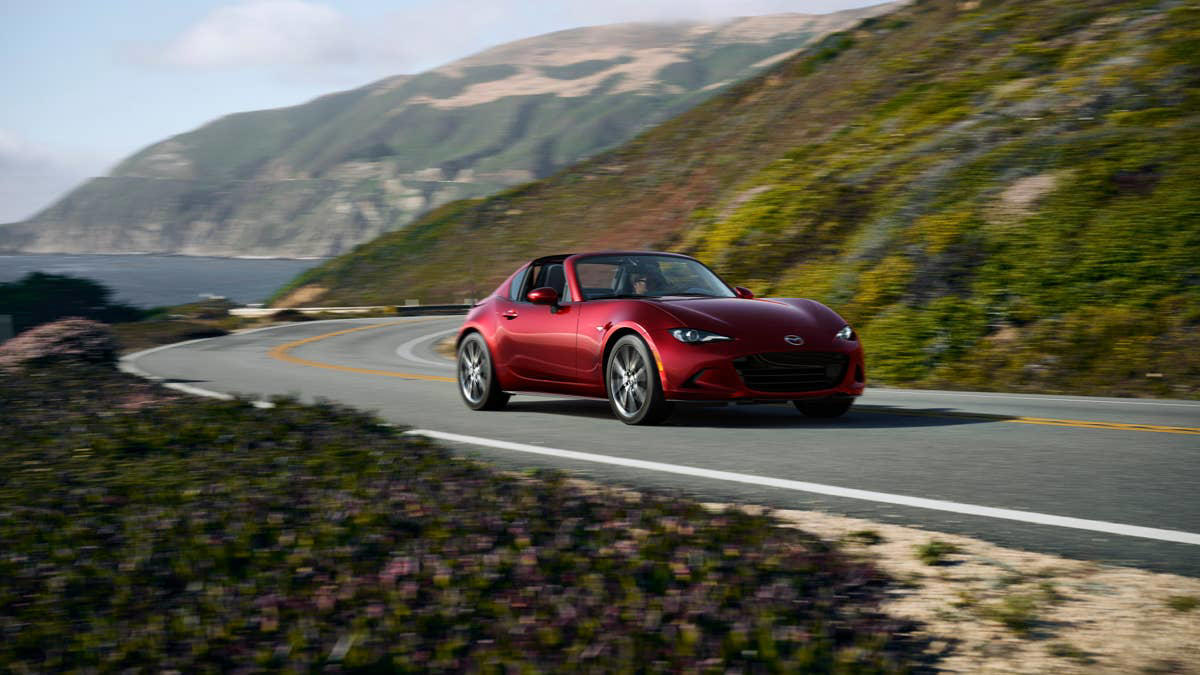
The Mazda MX-5 reignited the roadster craze when it was introduced way back in 1989. It inspired several other manufacturers to follow suit, yet most have fallen by the wayside where the MX-5 has endured. Its success can be attributed to an unrelenting focus on keeping to the principles that made the original model such a hit, namely simplicity and lightness imbued with Japanese precision. Those traits have helped keep the MX-5 both reliable and affordable to run, but can the fourth-generation model really deliver on that front? We decided to see how the ND generation models have fared over the years, and to gain a more representative picture of durability, we used reliability data from J.D. Power and Kelley Blue Book (KBB) surveys for the data below. The Mazda MX-5 Engine 2.0-liter inline-four Power 181 hp Torque 151 lb-ft 0-60 mph 5.7 seconds est (manual) Transmission types 6-speed manual 6-speed automatic Drivetrain RWD Base MSRP $30,730 Sport $34,230 Club $36,030 Grand Touring The Mazda MX-5 may still look fresh, but the current generation ND model has been on sale since the 2015 model year. It has undergone several detail upgrades over the years, but the basic chassis and powertrain (albeit with a bit more power) remain the same. For 2026, there are three primary trim levels on offer: Sport, Club, and Grand Touring. All are powered by a 181-hp 2.0-liter inline-four, and are rear-wheel drive. A 6-speed manual transmission is standard, although the top Grand Touring trim can be optioned with a six-speed automatic. The mid-spec Club trim is the sweet spot in the range as it adds a limited-slip differential, sport-tuned suspension, wireless smartphone connectivity and gets larger and wider 17-inch wheels. An RF hardtop convertible is also available in the top two trims. J.D. Power Scores Model Year Total Overall Score 2023 83/100 2022 83/100 The most recent J.D. Power overall scores were for the 2022 and 2023 model years, and show a consistently high level of owner satisfaction, maintaining a solid 83/100 overall. This consistency highlights a stable platform; since the ND generation received a power upgrade in 2019, Mazda has kept the mechanical components largely untouched while gradually introducing updates to the infotainment hardware that have also been implemented in other Mazda models. This lack of dramatic mechanical and technological change has helped keep reliability and satisfaction levels above average for years. Owner complaints tend to focus on earlier model years, where some early ND models (2016-2017) suffered from manual transmission complaints, but factory revisions resolved these, making models from 2019 onward far more reliable. Kelley Blue Book Scores Model Year Overall Consumer Rating Reliability 2026 4.7 / 5.0 4.8 / 5.0 2025 4.7 / 5.0 4.8 / 5.0 2024 4.7 / 5.0 4.8 / 5.0 2023 4.7 / 5.0 4.8 / 5.0 2022 4.7 / 5.0 4.8 / 5.0 The Kelley Blue Book consumer data reveals an exceptionally high reliability average of 4.8/5.0 across the last five years. The overall consumer rating is also excellent, showing that the rest of the package is also well above average. KBB assesses owner feedback across areas like performance, quality, value, comfort and styling as well as overall reliability. Because the current generation has been gradually refined rather than completely overhauled every few years, severe factory defects are incredibly rare, leading to strong long-term dependability. When owners do report issues, they are typically over standard age and usage-related issues, such as convertible top fabric degradation, rapid brake wear from aggressive driving, and minor flaws like failing window seals. Mazda MX-5 Vs. Rivals Make and Model JD Power Quality and Reliability Kelley Blue Book Reliability Toyota GR 86 81/100 (2026) 79/100 (2025) 4.0/5.0 (2026) 4.0/5.0 (2025) Subaru BRZ N/A 3.3/5.0 (2026) 3.3/5.0 (2025) Ford Mustang 85/100 (2026) 4.8/5.0 (2026) 4.8/5.0 (2025) In an increasingly shrinking segment of affordable sports coupes and roadsters, the MX-5 does not have any direct competitors, although the Toyota GR86/Subaru BRZ twins, and the Ford Mustang EcoBoost come closest. The Toyota GR86 and Subaru BRZ, share a co-developed platform, and entered their second generation for the 2022 model year. They offer a slightly more practical 2+2 seating layout and a more powerful 228-hp 2.4-liter boxer engine, but performance levels are very similar and neither model is available as a convertible. Value-for-money is strong though, especially with the GR86, which offers a standard LSD and starts at just $31,500. KBB owners rate the GR86’s reliability at 4.0/5.0 and the BRZ at 3.3/5.0, compared to the MX-5’s 4.8/5.0, and over the past five years, owners of the GR86 and BRZ have had issues with incorrectly applied factory engine sealant that can cause oil flow restrictions, and loud ticking noises originating from the direct injection fuel pump. The GR86 scored well in the J.D. Power surveys but still trailed the Mazda’s impressive results. The Ford Mustang EcoBoost competes in a larger, heavier class of sports cars and is the newest of the bunch, having been introduced for the 2024 model year. Its 2.3-liter turbocharged engine develops 315-hp, but the heavier bodyshell and standard automatic transmission make it more of a cruiser than a canyon carver, yet its still the quickest among this group, and the rear seats are actually usable. Value-for-money is also decent, with the EcoBoost fastback starting at $33,490, although the Convertible is pricier at $40,935. It’s not as direct and engaging to drive as an MX-5, but it is way more spacious and practical. In terms of reliability, it is also more than a match for the MX-5, earning an 85/100 for Quality & Reliability from J.D. Power in 2026 and matching the little roadster on KBB with a 4.8/5.0 reliability score. But nothing is perfect, and Mustang owners have cited issues with sluggish infotainment software, there has been a recall regarding a wiring harness issue, and early models required a stop-sale recall tied to water leaking into the Body Control Module (BCM). Is The MX-5 Still The Reliability Benchmark? In a market that has moved away from the philosophy of producing simple and compact vehicles, the MX-5 stands alone as a beacon of how well that formula can work. Rivals like the BMW Z4, Porsche Boxster, and Audi TT have either disappeared or may return in the future as EVs or complex hybrids, and the current batch of rivals comes down to just three vehicles. The Toyota GR86 and Subaru BRZ follow a similar recipe, but have not proven to be as durable and a lack of a convertible takes some of the lighthearted fun out of the equation. The Ford Mustang EcoBoost is a larger, more practical and less focused rival, but it has proven to be similarly reliable so far, although opting for a droptop drastically lowers its value proposition. Against this backdrop the Mazda MX-5 remains a unique offering, and it continues to deliver the same pure driving experience that its predecessors are famous for. It also matches them for long-term durability, thanks to a simple mechanical formula that has been honed to perfection.