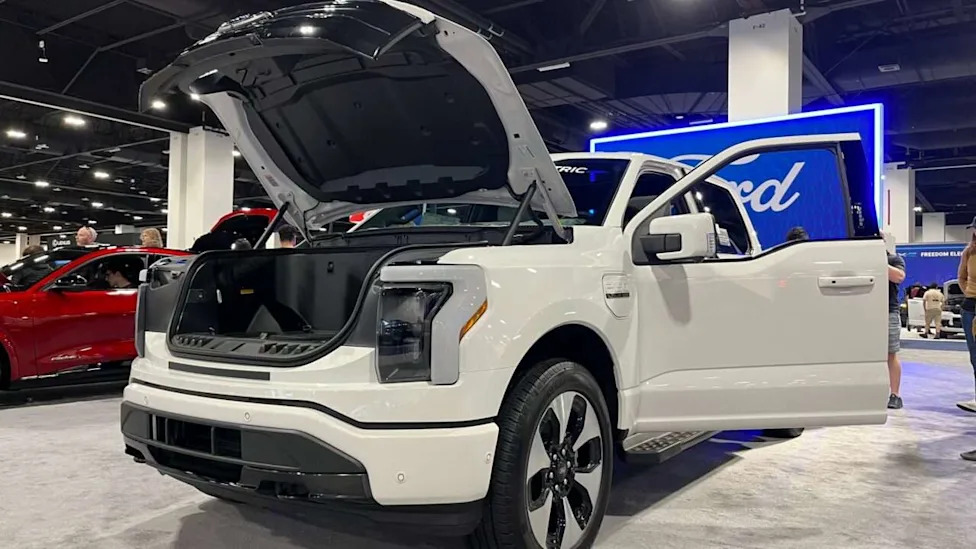
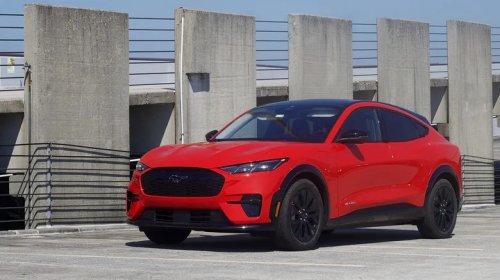
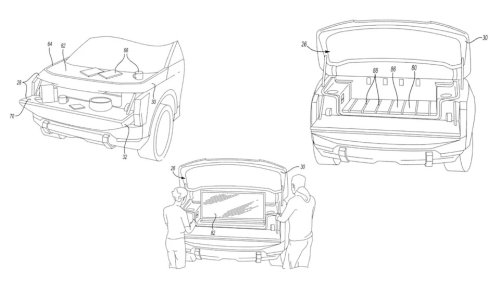
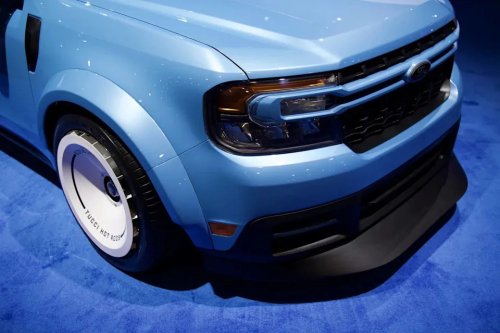
Ford Patented a Hood That Folds Into a Workbench. It Still Has to Crumple.The Auto WireEL PuckettSun, September 27, 2026 at 8:30 PM UTCAdd us on Google1 / 2Ford Patented a Hood That Folds Into a Workbench. It Still Has to Crumple.Every vehicle has one body panel that is engineered to fail on purpose. Not to resist an impact, not to survive it, but to give way at a controlled rate into a measured pocket of empty space underneath. That panel is the hood.Ford's engineers in Germany would like it to hold a circular saw.A Ford Global Technologies application published on April 2, 2026, US 2026/0091718 A1, "Vehicle having a convertible front hood", describes a hood built in two pieces. The forward piece stays where it is. The larger piece behind it unlocks, swings out on a hidden axis below the top edge of the grille, and settles flat and level, jutting out past the nose of the vehicle instead of standing up in the air. The underside nobody ever sees becomes the tabletop.AdvertisementAdvertisementThe application was filed in September 2025 and claims priority to a German filing from October 1, 2024. The inventors are Michael Georg Figura, Torsten Kluge and Klaus Achterberg. It is still pending, and Ford has filed the same concept in Germany and China. Keep that geography in mind, because it explains the design.The tabletop is the giveawayFord is not proposing a bare sheet-metal surface. The inner face of the folding panel is flat and stiffened by a block of rigid foam, then finished with a covering of wood, plastic or metal that the filing says should be exchangeable. One of the options is a perforated pegboard, so clamps, grippers and work tools can be fastened to what used to be the inside of your hood. The document puts a mixing bowl and a circular saw in the same category of load the surface should carry.Then comes the number that tells you who wrote this. The finished surface is meant to sit 70 to 110 centimeters above the ground. That is workbench height. Somebody measured real workbenches. The mechanism's end stops can also be made adjustable so the top can be brought level when the van is parked on a slope, which is the kind of requirement that only appears after an engineer pictures a running saw sliding off it.A hood is a safety device before it is furnitureHere is the part most people never consider. On any modern vehicle, hood design is dominated by what happens when a pedestrian's head lands on it. Europe requires that head-impact test for type approval under UN Regulation No. 127, and passing it depends less on the panel than on the air beneath it. The hood has to bend and slow the head down before something hard underneath stops it. Strut towers, engine covers and the cowl are the enemy. There is no matching standard among the Federal Motor Vehicle Safety Standards, so the global rule is the one shaping the sheet metal on a van engineered in Germany.AdvertisementAdvertisementWhich is why one line buried in Ford's filing is far more interesting than the picnic table. The foam block has to be positioned at a distance from the hood's outer skin and designed to soak up the load it receives, so that objects outside the vehicle are still protected in what the document calls "unfavorable traffic events."Read that again. Ford's own engineers are telling you they had to design a workbench that still crumples.That is the quiet tension inside every front-trunk feature, and almost nobody says it out loud. The reason an electric vehicle can have a deep storage box up front is the same reason its hood is comparatively easy to certify: there is nothing hard up there. Every bracket, latch, linkage and stiffener added to exploit that space eats into the crush distance that made the space valuable in the first place.This was never a pickup featureThe patent never pitches a truck. It talks about vans, motorhomes, mobile workshops and tradespeople who want a bench next to the vehicle without hauling a folding table and strapping it down for every trip. There is even a second, simpler version of the mechanism, a single pivot lever with a telescoping support leg, described specifically for utility vehicles with a short front overhang and a steep hood. That is a Transit-shaped sentence.AdvertisementAdvertisementThe business logic follows. Ford Pro sells vans, upfits and service contracts, and a factory option like this is high-margin precisely because it replaces something the customer already buys separately. The filing notes that the linkage can be produced as a prefabricated subassembly and retrofitted. That is upfitter vocabulary, not design-studio vocabulary.There is a cheaper motive too. Ford has already put a price tag on front-end storage. It pulled the frunk out of the Mustang Mach-E's standard equipment for 2026, then sold it back as a $495 option. A hood that becomes a work surface has one advantage no in-frunk accessory can match: it consumes no cargo volume at all, because it is the lid. When the box underneath is being value-engineered down to an option box, the panel on top is the only piece of front-end real estate left with room to earn.What it would mean to own oneAssume for a moment it reaches production. A split hood means a second shutline across the most visible painted panel on the vehicle, a lock holding the two halves together, a four-joint linkage tucked behind the grille, and cutouts in the grille itself so the linkage has somewhere to swing. Yes: in this design, the shape of the grille is partly dictated by the table.Federal rules already treat the hood as a hazard in its own right. FMVSS No. 113 requires a hood latch system, and a front-opening hood that can block the driver's forward view has to have a second latch position or a second latch system. Ford's panel folds forward and down rather than standing upright, which neatly sidesteps that issue, but it introduces a lock between two hood halves that never existed before, plus the option of an electric motor to release and swing it.AdvertisementAdvertisementEvery one of those items is a place for water, road salt, rattles and misalignment to turn up at 80,000 miles. More importantly, it converts a commodity part into a system. A parking-lot tap that used to mean a bumper cover and a hood would now involve linkage geometry, a lock and a panel with a structural foam core inside it. The industry has run this experiment before, and anyone who has read an EV collision estimate lately knows how it ends. Hardware added to the front of a vehicle has a habit of resurfacing in insurance data.And patents are not products. Most published applications die in the file drawer, and Ford filings in particular get read as roadmaps when they are nothing of the sort, including the one the internet decided was a snitch machine. This application is still pending. The three-country family tells you Ford wants the option protected, not that a launch date exists.The idea worth keepingFord tried the obvious version of this seven years ago. A 2019 filing, granted in October 2021 as "Vehicle front trunk utility systems", put a deployable table inside the frunk of an electric pickup. The new patent quietly walks away from that approach, and its own background section explains why: a table you carry is a table you have to stow and secure. A lid does not need stowing.That progression is the actual story here. The frunk was a windfall, free volume that appeared when the engine left the building, and it is already being rationed and priced as cheaper electric trucks and vans arrive. The hood is different. It is a panel every automaker is already obligated to build, already obligated to certify, and has so far only ever been asked to do two things: look good and give way.AdvertisementAdvertisementEvery other part of a work van has already been handed a second job. The hood was the last holdout.The post Ford Patented a Hood That Folds Into a Workbench. It Still Has to Crumple. appeared first on The Auto Wire.