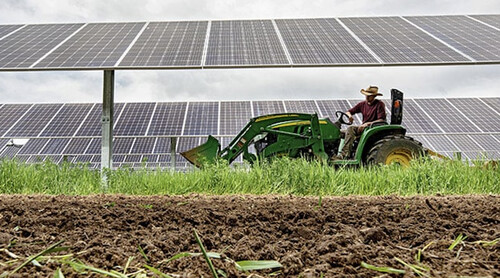
America’s family farmers are facing mounting challenges. Input costs like fertilizer and diesel are going up while international markets recede and commodity prices crater. Despite these challenges, American farmers are resilient and resourceful. They make decisions every day that balance risk, reward, and long-term stewardship. They adapt to volatile commodity prices, unpredictable weather, and shifting markets while pragmatically evaluating new crops, technologies, and sources of income. Today, thousands are farms are choosing to add or lease solar to stabilize their income and restore soils during this period of uncertainty. It’s an opportunity that each farmer should be allowed to consider and a decision that rests solely with the landowner. Unfortunately, a growing number of local governments are considering—or enacting—restrictions on solar development on farmland. These policies are taking decision-making power away from farmers and limiting their ability to adapt to a changing economic landscape. So, let’s examine how solar is supporting farmers and ranchers and debunk the arguments made by bureaucrats seeking to take choices away from America’s farmers. State Stories From Oklahoma to California to Texas to Iowa, farmers are choosing solar not because they’re told to—but because it works. In Oklahoma, growers are increasingly turning to solar to help deliver a financial buffer for both families and rural communities. That same story is playing out in Texas, where farmers and ranchers are using solar to weather downturns in agricultural markets and keep the land in the family. In California’s water-strapped breadbasket, solar has become a sustainable solution for land that can no longer be irrigated. Farmers can receive stable income through solar leases without having to use precious water resources. In Iowa, a guest column in the Cedar Rapids Gazette put it simply: “these energy sources should be seen as an added commodity for farmers to cash in on, advancing their bottom line.” For multi-generational farms, that stability can be the difference between holding onto land—or selling it. Solar has proven to be a tool for rural resilience, not replacement. Increasingly, it is the needless restrictions that pose a greater threat to the health of farms. In Ohio, Wayne Greier, a local soybean farmer, had hoped to access $540,000 in annual solar lease payments to help pay for his family’s mounting medical debt. However, local officials used a state law to block the solar project that Greier was relying on. Greier and many of his neighbors are now being forced to make hard decisions about how to keep the farm in the family. Addressing Misinformation Unlike other forms of development, solar helps supplement conservation and environmental protection efforts and has a far smaller physical footprint. Download the Factsheet → At the end of 2024, only about 0.05% of American farmland has been affected by solar development according to SEIA’s of USDA data. In contrast, urban expansion and residential development accounted for 95% of farmland loss between 2001 and 2016. Golf courses alone cover over 3x more prime farmland than utility-scale solar. Even in a long-term, high-end scenario where solar entirely decarbonizes the entire gird, the DOE estimates the land required would only be about 0.5% of contiguous U.S. land area, roughly equivalent to the area currently used for surface coal mining and far more environmentally safe. Contrary to some internet claims, solar panels do not contain harmful levels of toxic substances. Even damaged panels would need to be abandoned for decades to extract any materials, and most projects are built with decommissioning plans in mind. Plus, solar panels can be (and regularly are) recycled. Benefits to Rural Economies At its core, solar is just another tool for farmers—one that doesn’t depend on rainfall, doesn’t fluctuate with global commodity markets, and doesn’t require fuel to produce value. Best of all, solar can also work in tandem with traditional crops and livestock. Agrivoltaics—the practice of combining solar with agriculture—is opening new opportunities for farmers to do more with the same land. Sheep grazing under panels reduces vegetation management costs. Pollinator-friendly ground cover supports biodiversity and improves soil health. Crops that thrive in partial shade are using solar to maximize the value of each acre. High-value crops like leafy greens, broccoli, peppers, strawberries, and blueberries thrive in reduced light conditions. In one study, cherry tomato yields doubled under solar panels, while water efficiency improved by 65%. Watch what American Solar Grazing Association President Stacie Peterson said about the the colocation opportunities that farmers are utilizing: These are farmer-led innovations, creating numerous co-benefits for farms and local communities alike. Texas’ current utility-scale solar fleet will generate $12 billion in tax revenue for local governments. In every corner of the country, solar projects are adding to the local tax base, supporting infrastructure, and improving social services. Putting Trust in Farmers At the end of the day, we need to trust farmers. Trust that farmers—who have managed their land for generations—are best positioned to decide how to use it. Trust that rural communities can weigh opportunities and tradeoffs without one-size-fits-all restrictions. And trust that innovation, when it comes from the ground up, will reflect the values and needs of the people it serves. Solar is one more tool in that tradition. And like every tool before it, it should be up to farmers—not bureaucrats—to decide how to use it.