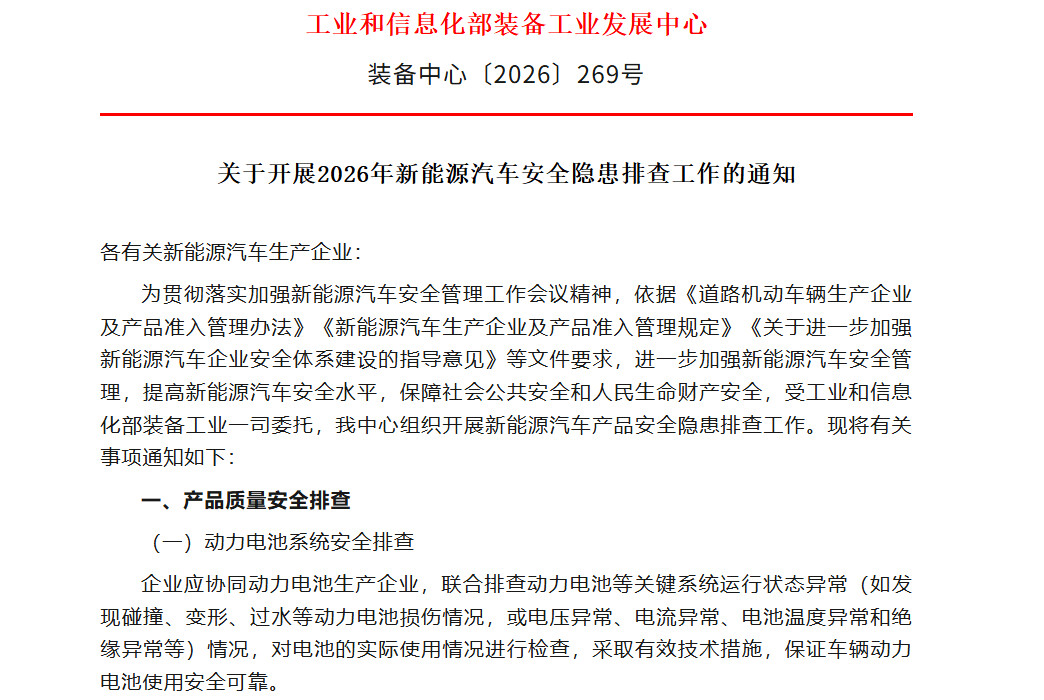
Audrey Clark · 5 months ago@audreyclark93China Tightens EV Safety Oversight With New Fire-Reporting Rules Liked by+77 othersPost commentRelated PostsThe Cadillac Vistiq Seat Recall Is Really About the Safety Rule That Doesn't Exist Yet 35 · Nicole Carter · 3 months agoChina's EV charging war escalates as Geely touts 2.2-MW tech for 4-minute full charges 13 · Chloé Rogers · 1 months agoJay Leno Drives The Ford Bronco Concept That Safety Rules Won’t Let Us Have 30 · Matthew Scott · 3 months agoChangan Nevo Q06 EV crossover started sales in China ahead of global rollout 98 · Abigail Campbell · 1 months ago5 Safety Rules To Follow For Your Next Road Trip 62 · Lucas Wilson · 4 months agoFord China begins exporting its Transit City EV to Europe 63 · Nicole White · 1 months agoResearchers Drove a Chinese EV Into an Underground Mine. It Kept Calling China Anyway. 89 · Aiden Morgan · 1 months agoDirty ‘Chameleon Carriers’ Ignore Truck Safety Rules by Sneakily Switching Names 80 · Adam Johnson · 6 months agoAudi Is Fighting to Keep Its Own China-Only EVs Out of Germany 75 · Chloé Morgan · 1 months agoMore cars get IIHS top safety pick awards despite tougher 2026 rules 94 · Amélie Young · 7 months agoThe Unstoppable Rise of Leapmotor — August’s China EV Sales Report (45% BEV Share) 53 · Jacob Bouchard · 1 months agoNIO Recalls 686 firefly EVs in China Over Potential Steering Assist Issue 75 · Nathan Wilson · 1 months agoGlobal EV Market Grows 2% in August as Europe Offsets China, North America 21 · Adam Turner · 1 months agoLi Auto launches i9 EV in China: world’s most aerodynamic mass-production SUV at 0.215 Cd 89 · Madeleine Green · 1 months agoChina, Sweden study ties early EV battery retirement to a small cluster of aging cells 26 · Samuel Girard · 1 months agoJeep’s 202,000-SUV Recall, China’s 70% EV Target, and What Else Moved 16 · Abigail Smith · 1 months agoChina exported more cars in 8 months than in all of 2025 - and most are EVs 33 · Owen Martin · 1 months agoChina's Best-Selling EV Can Drift Really Well 68 · Mia Pelletier · 1 months agoChina's Rapid EV Development Linked to Battery 'Batch Failures' 31 · Ava Lewis · 1 months agoChina is launching nearly 3 new EVs a day, CATL warns of batch battery failures 40 · Olivia Johnson · 1 months ago




 +77 others