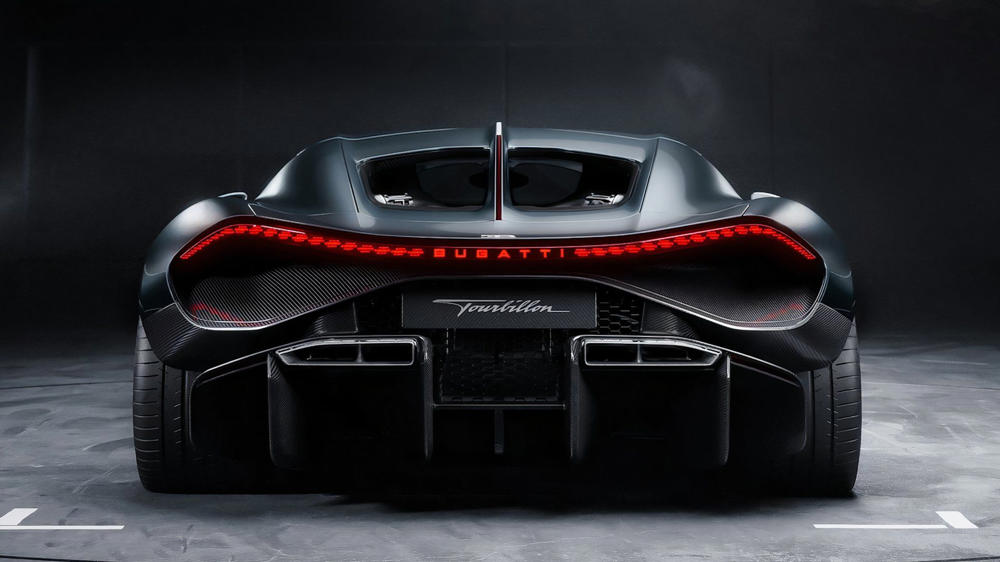
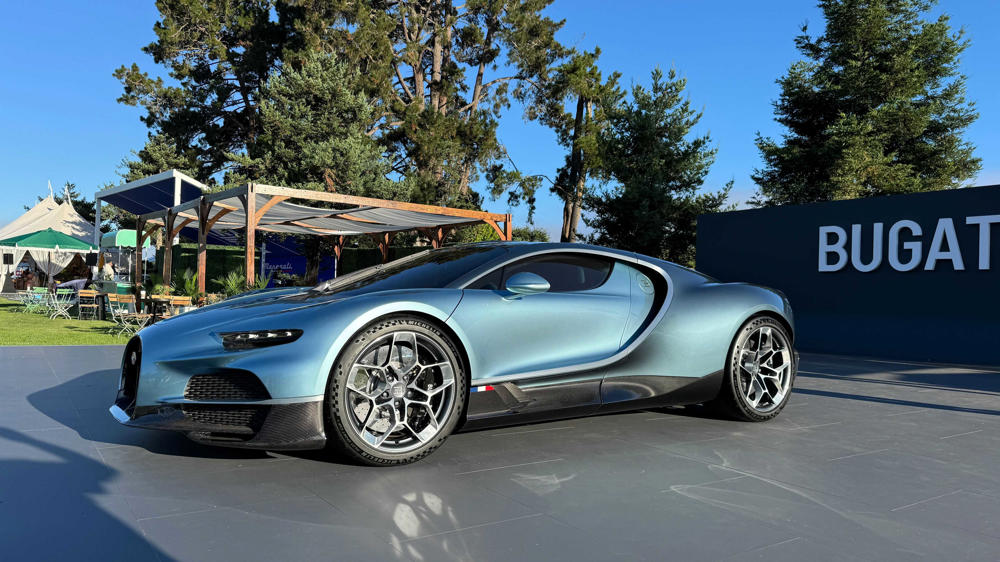
Bugatti finally went the electrified route with the Tourbillon, unveiled in 2024 as the V16 hybrid successor to the Chiron. The new car clearly marks a bigger departure from its predecessor than the Chiron did from the groundbreaking Veyron it replaced, since the two older cars share their famous W16 engine. But electrified cars often get a lot of flak in performance circles because the technology tends to add tremendous weight. The Tourbillon, though, doesn't weigh any more than the Chiron despite its added hardware. In fact, it's even lighter. Magic Mate Works Wonders On The Tourbillon's Powertrain The Tourbillon's powertrain consists of a 90-degree 8.3-liter V16 that produces almost 1,000 horsepower on its own. Three electric motors add further power, bringing the car's combined output to 1,775 hp. The V16 is mated to an eight-speed (one more than the Chiron) dual-clutch automatic transmission and a torque-vectoring differential, and drives the rear wheels alongside a single electric motor. This motor also charges the battery and provides torque fill when necessary. The remaining two electric motors independently power the front wheels, creating an all-wheel-drive system. All of this hardware tips the scales at 948 lbs, which Bugatti says is roughly the weight of the Chiron's W16 engine alone. Much of the weight in the Chiron's powertrain comes from its four turbochargers and all the extra piping and cooling hardware they require. Of course, the Tourbillon also has to carry a 25-kilowatt-hour battery, which forms a T-shape and sits in the center of the car's carbon-fiber monocoque chassis. However, even with the battery and its associated cooling systems added into the equation,the Tourbillon still weighs less than the Chiron, which tips the scales at 4,398 lbs. Bugatti hasn't provided an exact figure for its newest hypercar but CEO Mate Rimac says it's a few pounds lighter. But the more surprising story isn't the number on the scale – it's how Bugatti achieved it without compromising the engine it fought to keep. Much of the weight saving comes from the Tourbillon's new monocoque, which Bugatti constructs from aerospace-grade carbon-fiber composites. The structure integrates several components that would normally require separate housings or supports, including the battery casing and front air ducts, making them structural parts of the chassis instead. Bugatti also integrated the rear crash structure into the diffuser, eliminating the need for a conventional crossbeam and saving further weight. Bugatti also makes extensive use of 3D printing, particularly for the suspension components and structural braces. The suspension arms and uprights, for example, use 3D-printed aluminum and help cut suspension weight by 45% compared with the Chiron. These components also have an unusual organic appearance, with intricate shapes that look more like bone structures than conventional automotive parts. That's by design, as Bugatti uses advanced computer modeling to remove material wherever it isn't needed, atom by atom, leaving only what's necessary to maintain strength and rigidity. How Mate Rimac Convinced VW To Let Cosworth Build A 9,000-rpm V16 All those weight savings from the chassis exist in service of one goal – letting the V16 at the heart of the Tourbillon perform without compromise. The Tourbillon's V16 is an engineering marvel in its own right. Developed in partnership with Cosworth, the same company behind the V12s in the Aston Martin Valkyrie and all of GMA's modern supercars, the Tourbillon's naturally aspirated 8.3-liter engine draws on Formula 1 design principles and uses lightweight materials to keep its weight down while allowing it to rev to a heady 9,000 rpm. Its dimensions are also crazy considering how light everything is, with the engine stretching almost a meter in length and using a 900 mm crankshaft machined from a single piece of billet. Bugatti has also thought beyond the engine's immediate performance targets, leaving room for potential upgrades as emissions regulations become more demanding. The space between the V16's cylinder banks, for example, could accommodate a water-injection system in the future. Water injection can help control combustion temperatures and reduce certain emissions, giving Bugatti another potential way to keep the large naturally aspirated engine viable as requirements evolve. Sound requirements also played a major part in the design brief. Bugatti and Cosworth ran thousands of simulations across the intake and exhaust systems to find the right balance of performance, refinement, and the raw character expected of a Bugatti engine. According to Bugatti, the engine sound is one of the key strategies to foster a greater connection between driver and machine. We don't disagree. What makes this all the more impressive is Bugatti's CEO having made his name founding an EV technology company, Rimac. When he joined Bugatti earlier this decade, while the brand was still part of the Volkswagen Group, his superiors wanted the Chiron's successor to go fully electric. He pushed back, arguing that a Bugatti needed to retain an internal-combustion engine, and instead came up with the V16. Top Gear's Passenger Ride Reveals A Track Athlete Where The Chiron Was A Powerlifter Bugatti hasn't yet offered the media a chance to drive the Tourbillon, as the car hasn't been fully signed off and production has only just started. However, Top Gear was given a passenger ride in a pre-production example, with none other than Mate Rimac behind the wheel. The experience revealed just how different the new car feels compared with the Chiron. The magazine likened the change to swapping a powerlifter for a track athlete, with the V16 delivering a more explosive character, quicker responses, and a greater appetite for revs. The difference becomes particularly apparent as the engine climbs past 3,000 rpm, unleashing a ferocity that the old quad-turbo W16 couldn't quite match. The electric motors provide instant torque when needed, but they take a back seat to the naturally aspirated V16, whose character defines the entire experience. In fact, you can even switch off the hybrid system to leave the Tourbillon running in pure combustion mode at all times. Conversely, there's also an electric mode where you can drive around 30 miles on battery power alone. According to Top Gear, the Tourbillon also feels more agile than the Chiron, changing direction with greater enthusiasm while retaining the stability expected of a Bugatti. Official performance claims include zero to 60 mph acceleration in less than two seconds, zero to 186 mph in under 10 seconds, and a top speed currently capped at 276 mph. The Only Other V16 Supercar Was Designed By The Same Legend Behind The Lamborghini Diablo For obvious reasons, few production cars have been powered by a V16 engine. Cadillac and Marmon were among the main automakers to experiment with the configuration in the 1930s, while the modern era has seen just two companies put one into production: Cizeta and now Bugatti. Cizeta is the only automaker to have previously powered a supercar with a V16, in the form of its V16T, which was built briefly during the 1990s. The V16T was the only model ever offered by Cizeta, which went bankrupt in 1994 after producing fewer than a dozen examples. Its 6.0-liter V16 produced 400 hp and was mounted transversely, much like the V12 in the Lamborghini Miura, often regarded as the world's first supercar. There's another interesting connection between the two cars, as both were designed by the legendary Marcello Gandini. Fortunately, Bugatti is unlikely to suffer the same fate as Cizeta. All 250 production slots for the Tourbillon were reserved shortly after its debut, and we're confident that any additional variants Bugatti has planned will prove just as popular. The V16 is clearly here to stay, at least for a little while longer. Sources: Bugatti, Top Gear

 Liked by Mia Smith, Alexander Turner

















 Liked by Mia Smith, Alexander Turner


