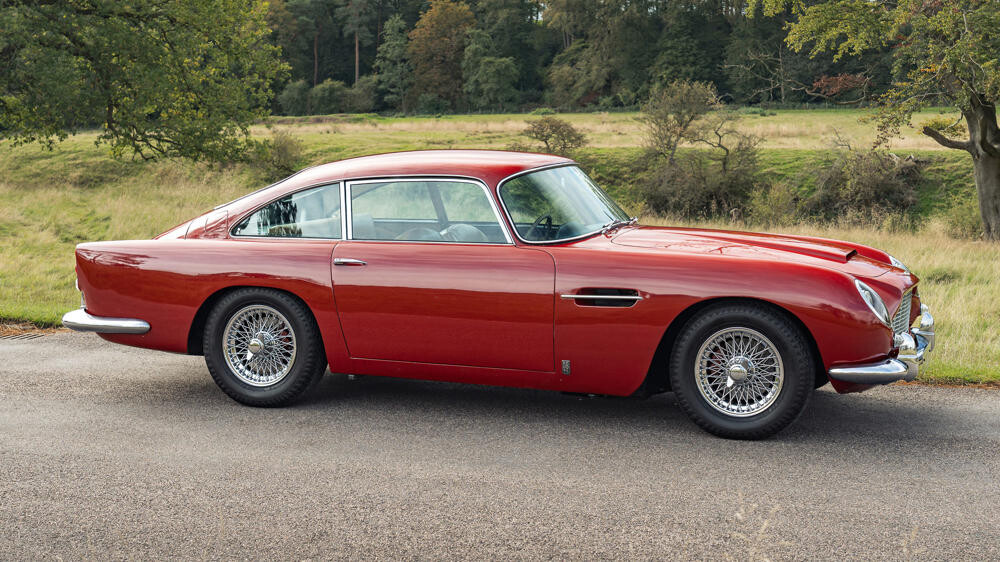
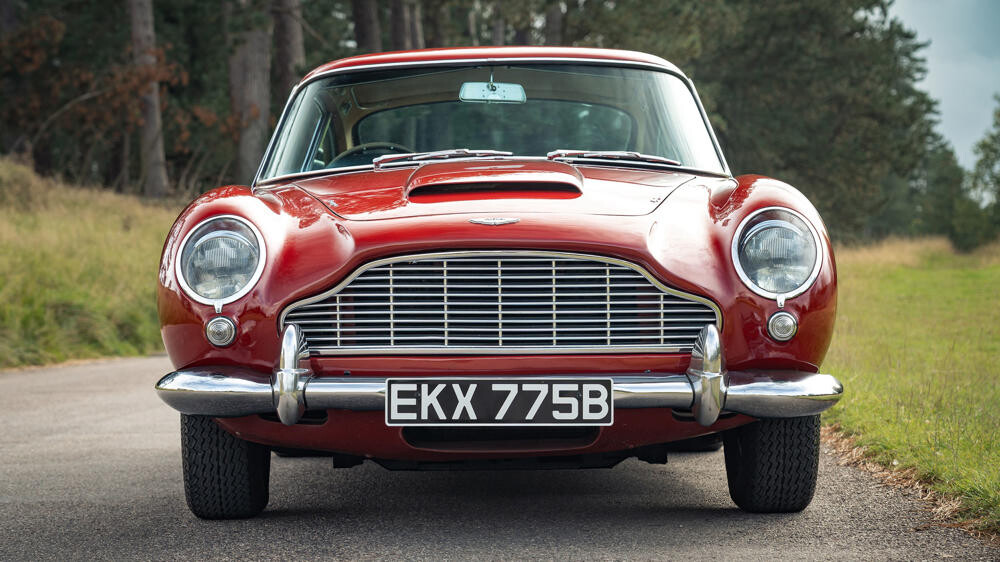
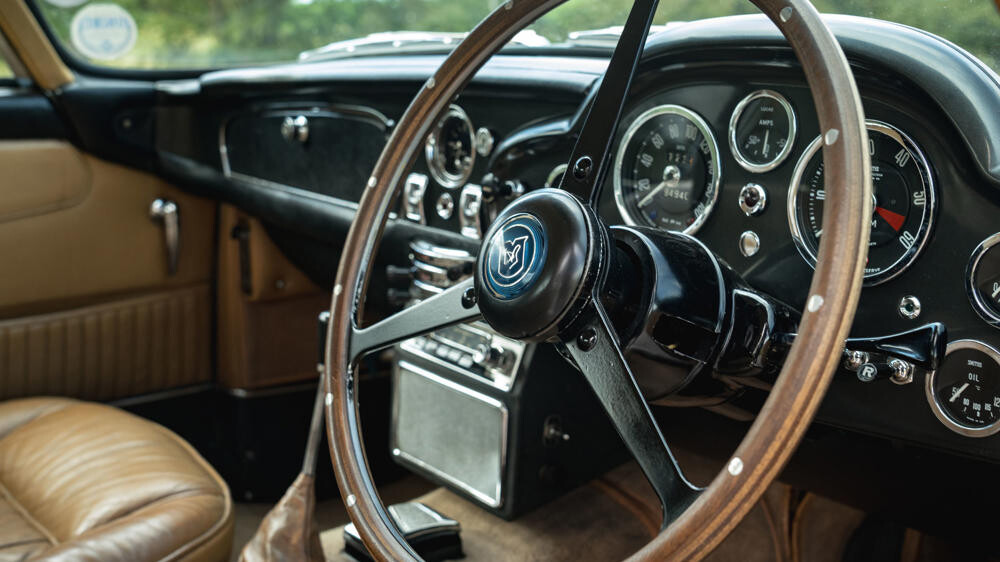
Everyone likes the idea of their assets accruing additional value, but, unlike with stocks and shares, a car's usability changes with what it's worth. Today, the idea of leaving an Aston Martin DB5 in a busy city centre in a narrow parking spot, or driving it on wet, muddy, broken roads, would make many cringe with fear. After all, they're worth £300-800,000. The beauty of Rodney McMahon's Roman Purple 1965 DB5, however, is that it has been rebuilt not to win concours rosettes but to be driven. "I have a bit of a thing for Aston Martins," says Rodney, in a textbook demonstration of British understatement. The well-loved DB5 is the most recent addition to an impressive collection that also includes a DB4, DB6, DB7, V8 Volante and Rapide. Of his more classic Aston Martins, the DB4 and DB6 are immaculate, show-condition cars, so when he asked marque specialist RS Williams to look out for a DB5 on his behalf, he requested one that wasn't quite so perfect. "The restored ones are beautiful, but the problem is that you can only damage them from that point on," says Rodney. "I wanted a car that someone could open a door into in a car park, or I could pick up a stonechip, and it'd just become part of the patina." Well, how is four decades sitting in a barn for patina? The car RS Williams found was a remarkably original, and unusually coloured, DB5 that hadn't been on the road in 41 years. "Two brothers owned it," continues Rodney. "They stored it pretty well, actually; they hadn't left it to rot, and with some recommissioning I drove it as it was for a year." He doesn't know why the car sat unused for so long, but the Aston Martin was a relatively high-mileage car among a collection of classics, so had likely suffered a minor breakdown that never got fixed. The DB5's paint reflects the miles it covered before heading into storage. There are grazes, patches of discolouration and stonechips. It is solid, straight and without rust, but this car has had more work done to it than you would guess from the outside. "We found rust underneath, and in a year or two it wasn't going to pass an MoT," says Rodney. Preserving the Aston Martin's original paintwork posed a challenge during what became a complete rebuild down to a stripped bodyshell. The corroded aluminium sills had to be replaced, then painstakingly colour-matched to the rest of the car. A dent in the front wing was gently hammered out by hand from inside the wheelarch across two weeks, rather than risk disturbing the finish by applying any kind of heat. Where damage to the paintwork was minor and utterly cosmetic, however, it was left as is, and the focus on keeping this car as a driver didn't end there. With the straight-six engine already being rebuilt, RS Williams upgraded the unit to its 4.7-litre specification – an engine Rodney already knew, having had a similar item fitted in his Aston Martin DB4. A rebore increases capacity by 700cc, with a focus on boosting the torque output from 280lb ft to 330lb ft. That extra torque is the first thing you notice out on the road. Instinctively, you drop a gear to climb a steep hill, but it quickly becomes apparent you're wasting your time. Next time up the hill you stay in fifth gear, and the car climbs with no drop in acceleration. This isn't just an engine that pulls well from low-down, though: it's also utterly unstressed by the weight of the bodywork. Changing ratios is perfectly pleasant, with a light, snicking gearlever and intuitive clutch pedal, but the fact that it can be left in top and still deal with all but low-speed manoeuvres is a mark of true proficiency as a classic grand tourer. The long-distance touring ability of this car is not only in its comfortable seats and luggage capacity, but also its engineered-in competence. That's not to say that this DB5 drives like a soft cruiser, however. Yes, it has that ability, but it can offer real sporting thrills, too. This is a bit of a surprise, because the DB5 has a reputation for looking better than it drives – which has long served as a comforting nugget of conventional wisdom that prevents those who can't afford one (the vast majority of us) from too much jealousy. Rodney's car doesn't offer such respite from envy, however. We're driving the DB5 on exactly the sort of roads that suit it, and on these gradually curving and undulating routes you quickly get into an enjoyable groove. Riding slightly lower than a standard car, it has a subtle lean into each corner. The steering communicates well as you traverse the bend, allowing you to feed in power without doubt over the levels of rear grip, before the road straightens and you can level the throttle again. There's a slight squat, which adds to the entertaining approach of braking early for corners and powering through the bend, delighting in selecting each ratio on the way out as you play tunes with the trumpet-like sound of the engine. It's a car that feels much lower once you're inside it, the dashboard nowhere near as high as it often looks in photographs. There is a good view over the Aston Martin's long bonnet, which helps to make it feel biddable. The DB5's clutch is relatively heavy, but it is otherwise a very easy car to drive. There's nothing idiosyncratic about the way it handles, with just a well-located live axle at the back, and it's easy to place on the road thanks to the excellent vision and relatively narrow dimensions. Once the expensive valuation is forgotten, it's a remarkably approachable car to drive, with a playfulness you wouldn't expect from its brawny image. There's no doubt that the engine and gearbox are the stars of the show. However, the chassis of this Aston Martin DB5 is more than capable of allowing you to enjoy engineer Tadek Marek's straight-six motor to the full. But a winding section of tight corners is where the Aston reveals its compromises. It doesn't feel as happy quickly shifting its weight from side to side as it does being able to slowly lean into a bend; it sits a touch too tall on its suspension, despite Rodney's improvements, to be a precision-handling car. But that's a sacrifice for remaining comfortable within the constraints of 1960s suspension technology, and the DB5 is well insulated from road noise plus avoids excessive rattling and jumping over bumps. You have got to be careful of rushed gearchanges, though: coming off the clutch too abruptly on the exit of a turn, or over a poorly surfaced road join, will unstick the rear, but it's a chirrup of the tyres or small slide rather than utter waywardness – and a consequence of the engine's addictive torque. But this car wasn't rebuilt solely with the occasional B-road blast in mind. It's intended for cross-continental journeys and commuting alike. Thanks to the five-speed ZF gearbox, the Aston Martin can settle into a comfortable cruise even on modern roads, and unlike many 1960s British classics, the DB5 was clearly built for the motorway age. You can cruise at 70mph (113kph) at 2800rpm in top, and the DB5 will travel effortlessly at higher speeds still. "I drove it all the way to Greece in the summer of 2021," says Rodney. "It sat for hours at the speed limit on the autostrada in Italy, in hot weather, and wasn't bothered at all." So too for commutes into London – "as long as the weather isn't absolutely miserable!" An unexpected bonus of doing such journeys in a DB5 is the courtesy it receives. Autocar remarked on the phenomenon back in 1964 – before the model had made its famous Goldfinger appearance – noting that fellow motorists were happy to move out of the way of a DB5 and help it on its way. "It's like driving a piece of England's heritage," enthuses Rodney. "People don't dislike you for driving it like they might a Ferrari or Lamborghini. It's not showy, either." Certainly, as we drive into Wantage, a historic market town in Oxfordshire, UK, we don't struggle to be let out of junctions or for admiration when parking. The DB5 connects with the public in a way few other cars do. The famous Touring-crafted Superleggera aluminium bodywork needs no introduction, although the Roman Purple of Rodney's car does seem to puzzle the occasional passer-by in a way you suspect a Silver Birch example wouldn't. It's rare to see Aston Martin DB5s in a dark colour, although the neat contrast this provides with the elegant lashings of chrome makes that rather a shame. As the light fades on our day with the Aston Martin, the purple almost becomes black – and suddenly the car doesn't just look cool, it looks pretty mean, too. Inside, the DB5 is entirely black no matter what the time of day, and once again it looks gloriously original. The cabin is beginning to show some age-related marks, like a few cracks on the leather seats, and this perfectly complements the exterior wear on the body. Still, this isn't an abused interior. The black-painted metal dashboard is unscuffed and glossy, while the knobs, dials and instruments in front of you are all clear and correct. Ergonomically, the Aston Martin DB5 is a well-sorted car, with the pedals well placed relative to the driver and the seating position halfway between a legs-outstretched sports car and an upright saloon. Of course, it had to be a comfortable place to sit to be a truly accomplished grand tourer. There are impressive technical details in the interior, too, such as electric windows that are far quicker and quieter than most 1960s set-ups – Aston Martin's own design, no less. So too the ventilation controls, which are operated independently by driver and passenger, each having a lever mounted next to the door opening. But, again, there's more than first meets the eye in Rodney's fabulous car. The original radio is just for ornamentation, while the actual head unit, a more modern item, is hidden in a pleasingly 'Q Branch' concealed compartment behind the central speaker grille, with two speakers now mounted in the footwells instead. Thanks to the James Bond effect, the values of DB5s have become completely disconnected from what they are capable of on the road – and only billionaires can ever truly ignore that. But Rodney's Aston Martin is as close as we can get to stepping back in time. Not to 1965, but more like 1980, when old DB5s were being ragged around, commuted in and taken on holiday by enthusiasts. There can't be many of them still doing that, but we're glad there's at least one – and that it's still a thrilling experience. Images: Max Edleston Thanks to: RS Williams Factfile Aston Martin DB5 Sold/number built 1963-'66/1063Construction steel platform chassis; tubular steel frame clad with aluminium panelsEngine all-alloy, dohc 3995cc straight-six, triple SU carburettorsMax power 282bhp @ 5500rpmMax torque 288lb ft @ 3850rpmTransmission all-synchromesh ZF five-speed manual, RWDSuspension: front independent, by unequal-length wishbones, telescopic dampers, anti-roll bar rear live axle, trailing arms, Watt linkage, lever-arm dampers; coil springs f/rSteering rack and pinionBrakes discs, with servoLength 15ft (4752mm)Width 5ft 6in (1676mm)Height 4ft 4in (1320mm)Wheelbase 8ft 2in (2489mm)Weight 3233lb (1466kg)0-60mph 6.2 secsTop speed 149mphMpg 15-20Price new £4248 (1964) We hope you enjoyed reading. Please click the 'Follow' button for more super stories from Classic & Sports Car.

 Liked by Abigail Campbell, Aiden White








 Liked by Abigail Campbell, Aiden White